
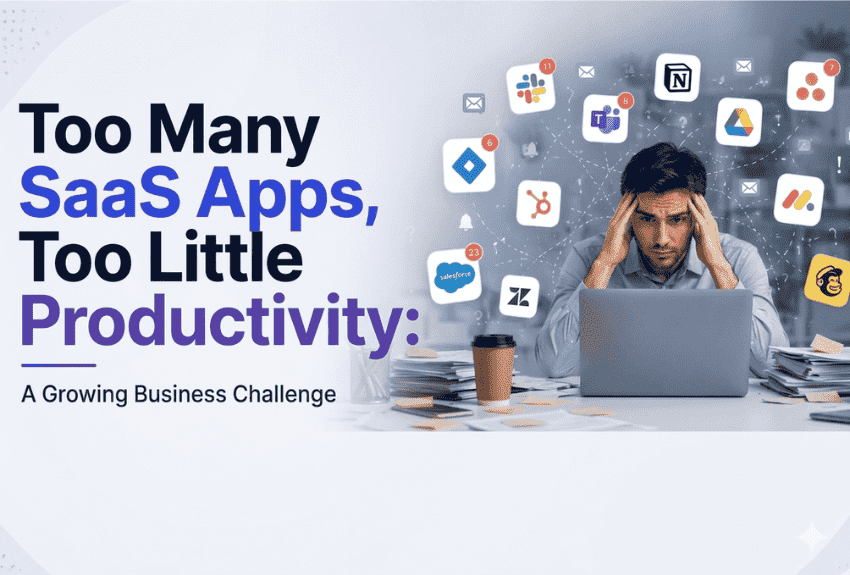
Businesses today have access to more software tools than ever before. From communication and project management to analytics, HR, sales, and customer support, there seems to be a SaaS platform for every operational need.
At first, this appears to be a major advantage. Companies adopt new tools hoping to improve efficiency, automate tasks, and streamline collaboration. However, many businesses across the United States are now facing an unexpected problem: too many SaaS applications are actually reducing productivity instead of improving it.
Employees constantly switch between platforms, data becomes fragmented across systems, workflows become disconnected, and operational complexity continues to grow. What was once considered a smart digital transformation strategy is now becoming a hidden business challenge.
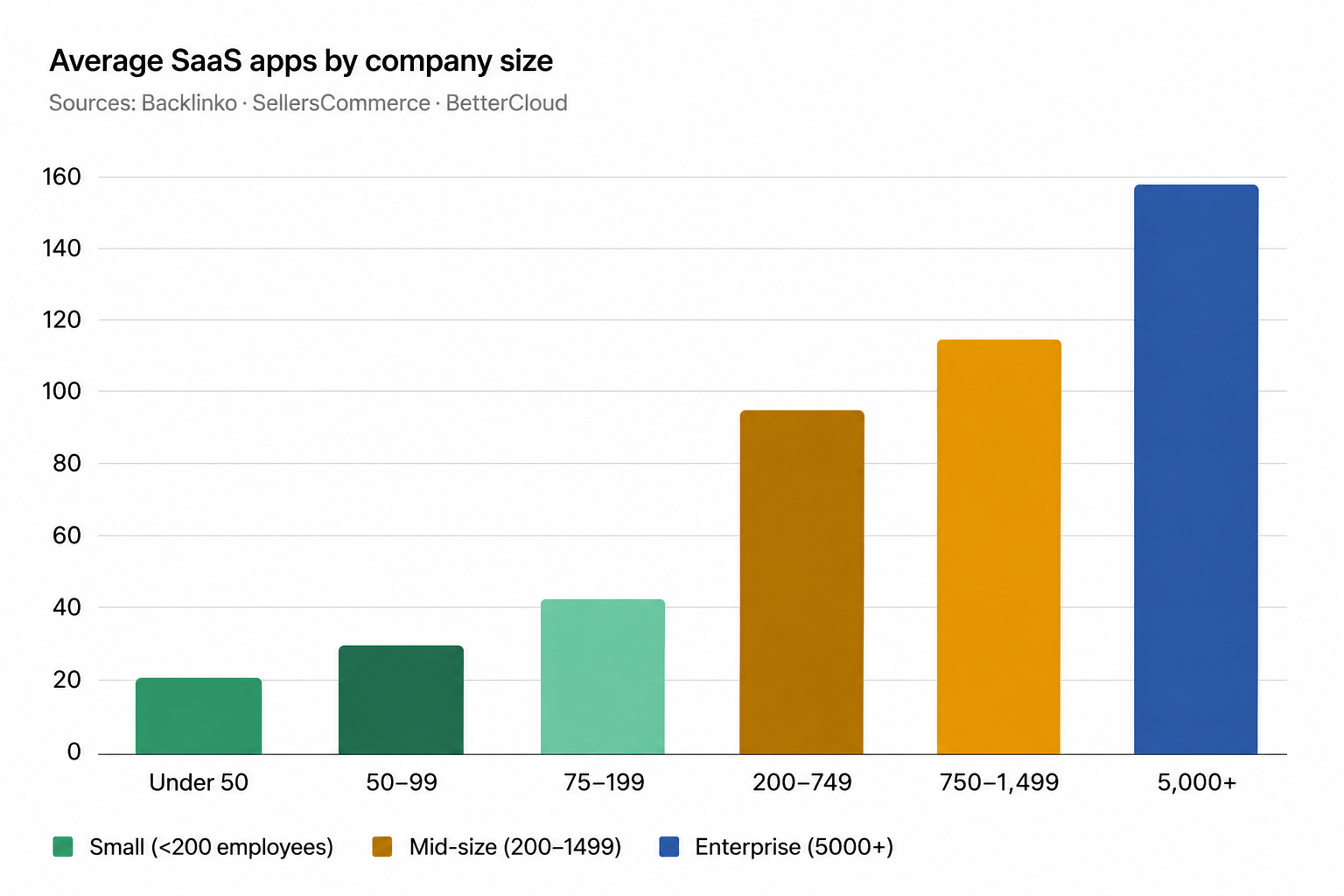
Recent studies show that the average organization now manages more than 100 SaaS applications, while larger enterprises may operate hundreds simultaneously. As software stacks continue expanding, businesses are beginning to realize that adding more tools does not always create better outcomes. Instead, modern productivity depends on how well systems work together.
Why Are Businesses Using So Many SaaS Applications?
The rise of SaaS solutions completely changed how companies operate. Businesses no longer needed expensive infrastructure or internal servers to access advanced software capabilities. Cloud-based tools made it easier to scale operations quickly and support remote work environments.
As organizations grew, different departments started adopting their own preferred platforms:
- Marketing teams added automation tools
- Sales departments adopted CRMs
- HR teams implemented hiring and payroll software
- Operations teams introduced project management systems
- Customer support teams integrated ticketing platforms
Over time, businesses accumulated dozens of disconnected applications across departments.
This expansion accelerated significantly after remote and hybrid work became common in the United States. Teams needed digital collaboration tools, video conferencing platforms, workflow systems, cloud storage solutions, and AI-powered productivity apps to maintain operations.
While each tool solved a specific problem individually, together they often created a fragmented operational ecosystem.
How Does SaaS Overload Reduce Productivity?
One of the biggest issues businesses face today is app switching fatigue. Employees spend large portions of their day moving between communication apps, dashboards, CRMs, spreadsheets, project management tools, analytics systems, and AI platforms. Research from Pegasystems found that employees switch between applications more than 1,100 times per day on average. This constant switching disrupts focus and reduces efficiency.
Instead of spending time on meaningful work, employees often waste hours searching for information, copying data between systems, updating multiple platforms, or managing notifications from different tools. Even small interruptions reduce concentration. Over time, these disruptions create mental fatigue, slower decision-making, and lower overall productivity.
Many employees appear busy throughout the day, but much of that activity involves navigating software complexity rather than completing high-value work.
Why Do Disconnected SaaS Tools Create Workflow Problems?
As businesses adopt more software applications, workflows become increasingly fragmented.
For example:
- customer information may exist inside one CRM,
- marketing data may be stored elsewhere,
- finance teams may rely on spreadsheets,
- and operations may manage projects in separate systems.
When platforms fail to integrate properly, teams lose visibility across departments. This creates several operational problems such as duplicate data entry, inconsistent reporting, communication gaps, delayed approvals, and inefficient collaboration.
Employees often spend unnecessary time manually transferring information between systems because tools cannot communicate effectively with one another. This is also where the promise of low-code platforms falls short — why low‑code/no‑code isn’t enough becomes clear when businesses need deep integrations, custom logic, or workflows built around their specific operations rather than generic templates. Ironically, businesses invest in software to improve efficiency, yet disconnected systems often create more operational friction.
Is SaaS Sprawl Increasing Business Costs?
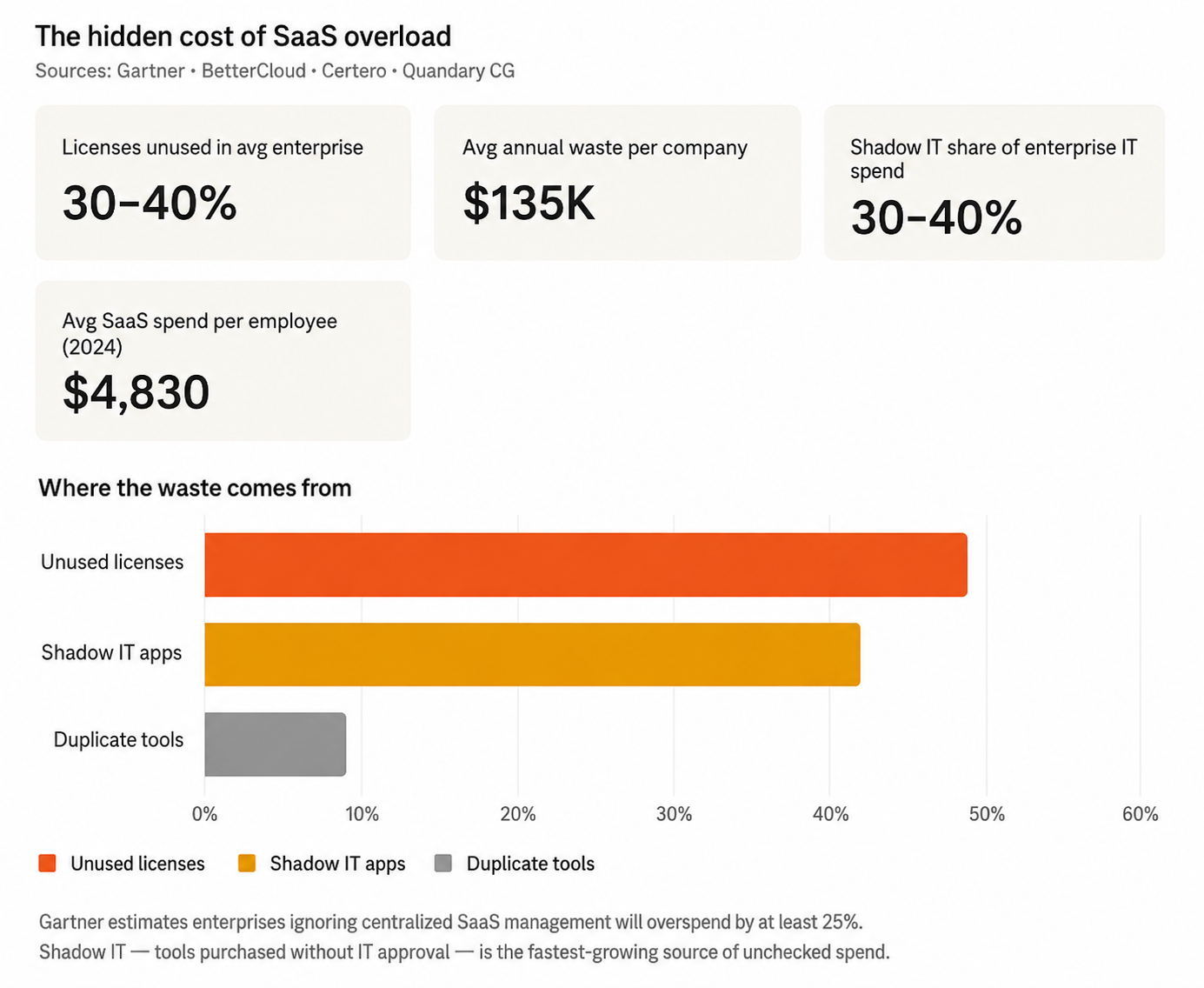
Beyond productivity challenges, SaaS overload also creates significant financial waste. Businesses today spend thousands of dollars annually per employee on software subscriptions. However, many organizations lack complete visibility into unused licenses, overlapping software, duplicate tools, or unauthorized subscriptions.
In many companies, different departments purchase similar platforms independently without coordination. As a result, businesses pay for multiple tools that perform nearly identical functions. Industry reports suggest that companies may waste a substantial portion of SaaS spending on redundant or underutilized applications.
The rise of AI tools has further complicated this issue. Employees frequently adopt new AI applications without IT approval, creating “Shadow IT” environments where organizations lose control over software usage. This not only increases operational costs but also creates security and compliance concerns.
How Does Too Much Software Affect Employees?
One of the most overlooked consequences of SaaS overload is employee burnout. Modern workers already manage constant notifications, endless meetings, repetitive administrative tasks, and growing performance expectations. Adding dozens of disconnected software platforms increases cognitive overload and workplace stress.
Employees must remember multiple logins, different workflows, separate interfaces, and inconsistent systems across departments. Instead of simplifying work, excessive software complexity often makes work more exhausting.
Studies continue showing that repetitive low-value administrative tasks consume a large percentage of the workday. Employees become frustrated when they spend more time managing software than performing strategic or creative work.
Over time, this affects:
- morale,
- productivity,
- engagement,
- and employee retention.
Businesses often assume productivity problems are caused by employees themselves, when in reality inefficient systems may be the bigger issue.
Why Doesn’t Adding More SaaS Tools Always Solve Business Problems?
Many organizations adopt software reactively. When a problem appears, teams quickly search for a tool to solve it. While this approach may fix a short-term issue, it often introduces additional operational complexity later.
For example:
- one tool solves communication problems,
- another handles reporting,
- another manages automation,
- while yet another tracks workflows.
Eventually, businesses end up with a patchwork system of disconnected applications. The problem is not SaaS technology itself. SaaS platforms remain essential for modern businesses.The real challenge is poor workflow alignment.
Many companies focus too heavily on adding features instead of improving operational simplicity. But productivity is not determined by how many tools a business uses. It depends on how seamlessly systems work together. This is why businesses are increasingly shifting toward integrated and centralized digital ecosystems — and why partnering with a software development company to build purpose-built solutions is becoming a more strategic choice than stacking off-the-shelf subscriptions.
Why Are Businesses Moving Toward Unified Platforms?
As operational complexity grows, many companies are reconsidering their software strategies. Instead of managing dozens of disconnected applications, businesses are investing in integrated systems, centralized dashboards, workflow automation, AI-powered platforms, and custom software solutions.
The goal is to reduce operational friction. Unified systems help businesses centralize data, automate repetitive tasks, improve collaboration, reduce app switching, and simplify workflows. Custom software development is becoming especially valuable because businesses can design systems around their actual operational needs rather than forcing employees to adapt to generic platforms.
AI-powered automation further improves efficiency by handling reporting, scheduling, customer interactions, workflow approvals, analytics, and repetitive operational tasks. This creates a more connected and scalable work environment.
Are Too Many SaaS Tools Creating Security Risks?
Every additional SaaS application introduces new user accounts, new integrations, new APIs, and additional access points for sensitive data. When businesses lose visibility into their software ecosystem, security risks increase significantly. Unmanaged SaaS environments can create compliance issues, inconsistent security policies, data exposure risks, and unauthorized access vulnerabilities.
This becomes especially concerning for businesses handling financial information, healthcare records, customer data, or enterprise operations. As cybersecurity threats continue growing, businesses need systems that are not only productive but also secure and centrally managed. This is also where Quality Assurance matters — rigorous testing and QA practices ensure that integrated systems remain stable, secure, and compliant as they scale.
How Can Businesses Solve the SaaS Overload Problem?
Solving SaaS overload requires more than simply removing a few applications. Businesses need a long-term strategy focused on workflow alignment, operational simplicity, and connected systems.
Forward-thinking companies are now investing in:
- centralized business platforms,
- workflow automation,
- AI-powered operational systems,
- custom software development,
- and scalable digital ecosystems.
Instead of forcing teams to manage dozens of disconnected applications, businesses can streamline operations through software solutions designed around their actual workflows. This is where custom software development becomes valuable.
OpenSource Technologies (OST) helps businesses build intelligent, scalable, and fully customized digital solutions that reduce operational complexity and improve productivity. From AI-powered automation and enterprise software development to workflow optimization and system integrations, OST helps organizations replace fragmented SaaS environments with connected business ecosystems.
Whether businesses need:
- centralized dashboards,
- custom AI software,
- workflow automation,
- enterprise web applications,
- logistics software,
- healthcare platforms,
- or secure scalable systems,
OST develops solutions tailored to operational goals rather than relying on one-size-fits-all platforms. As businesses continue facing growing operational complexity, the companies that invest in connected and streamlined systems will gain a significant competitive advantage.
What Does the Future of Workplace Productivity Look Like?
The future of productivity is not about adding more tools. It is about creating simpler, smarter, and more connected workflows. Businesses across the United States are beginning to realize that operational efficiency comes from streamlined systems, centralized operations, intelligent automation, and better software integration. Solutions that can turn every chat into business intelligence — capturing insights from conversations, support tickets, and customer interactions — are a strong example of how modern platforms move beyond passive data storage toward active operational value.
Employees perform better when technology reduces friction instead of creating it. The companies that succeed in the coming years will not necessarily be the ones with the largest SaaS stack. They will be the organizations that build connected operational ecosystems designed around efficiency, collaboration, and simplicity.
Final Thoughts
Too many SaaS apps are creating a growing business challenge that many organizations are only beginning to recognize. While software tools remain essential for modern operations, excessive and disconnected SaaS adoption often leads to fragmented workflows, rising operational costs, employee burnout, reduced efficiency, and security concerns. Businesses are now shifting their focus from software accumulation to workflow optimization.
Instead of continuously adding disconnected applications, forward-thinking companies are investing in integrated systems, AI-powered automation, and custom software solutions that simplify operations rather than complicate them. In today’s competitive business environment, productivity is no longer measured by how many tools a business uses. It is measured by how effectively those tools work together.