
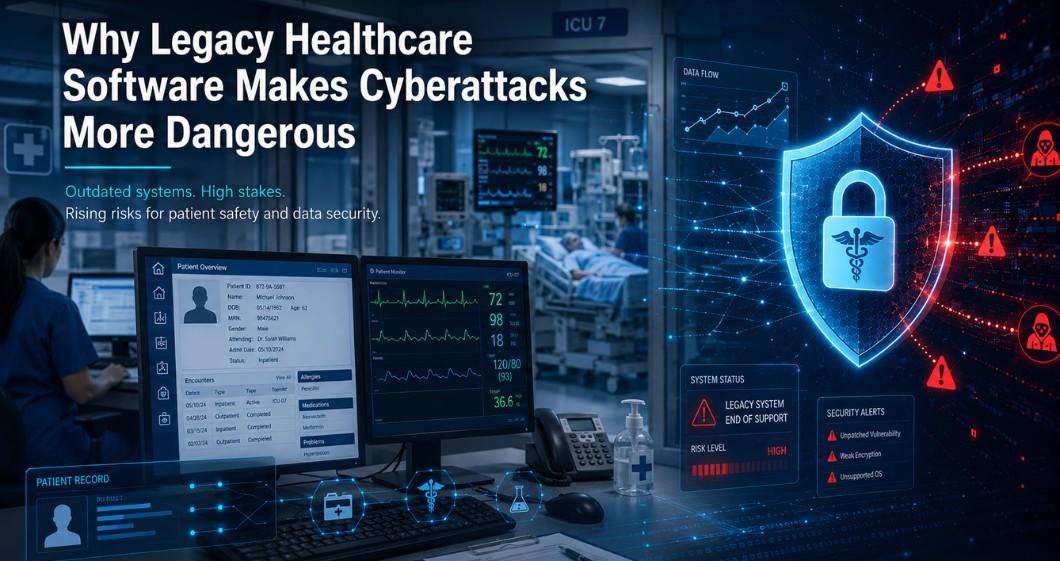
Healthcare organizations depend on software for almost every part of patient care. Electronic health records, billing systems, patient portals, lab systems, imaging platforms, scheduling tools, insurance workflows, and third-party integrations all need to work reliably. When these systems are modern, secure, and well-maintained, they help providers move faster and deliver better care. When they become outdated, they can turn into serious cybersecurity risks.
Legacy healthcare software is not dangerous simply because it is old. It becomes dangerous when it is unsupported, poorly patched, difficult to monitor, hard to integrate, or unable to meet today’s security expectations. In the Healthcare Industry, that risk is even greater because cyberattacks can affect patient data, clinical operations, regulatory compliance, and care delivery at the same time.
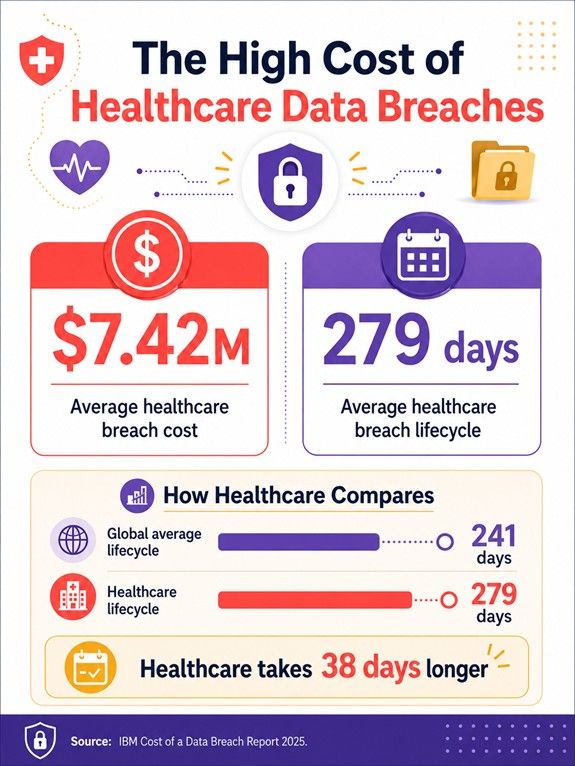
IBM’s 2025 Cost of a Data Breach Report found that healthcare remained the costliest industry for data breaches, with an average breach cost of $7.42 million. Healthcare breaches also took the longest to identify and contain, averaging 279 days.
That makes legacy healthcare software more than a technical concern. It is a business continuity, compliance, and patient safety issue.
Why Outdated Healthcare Systems Create Bigger Cybersecurity and Patient Safety Risks
A cyberattack on a healthcare organization is different from an attack on a regular business website. If an e-commerce site goes offline, sales may stop temporarily. If a healthcare system goes offline, doctors and staff may lose access to patient histories, prescriptions, lab results, imaging records, appointment details, and care instructions they need to make timely clinical decisions.
Older applications may not support modern authentication, detailed audit logs, encrypted data exchange, real-time monitoring, or secure API connections. Some may run on outdated operating systems or databases that no longer receive security updates.
This creates a wider attack surface. Attackers do not need to break every system. They only need one vulnerable entry point. Once inside, they may move across connected systems, steal protected health information, disrupt operations, or deploy ransomware.
What Counts as Legacy Healthcare Software in Hospitals, Clinics, and Health-Tech Organizations?
Legacy healthcare software is not defined only by age. It includes systems that remain in use but no longer meet current operational, security, integration, or support requirements.
Examples may include:
-
Older EHR or EMR platforms.
-
Outdated patient portals.
-
Custom billing or claims applications.
-
Unsupported lab and imaging integrations.
-
Aging practice-management systems.
-
Internal applications built on obsolete frameworks.
-
Databases or servers that no longer receive vendor support.
Some healthcare platforms were originally created through custom software development to support specialized clinical, administrative, or billing workflows. These systems may continue to serve an important purpose, but the frameworks, databases, and integrations behind them can become difficult to maintain when documentation, vendor support, and security updates are limited. Some legacy systems are easy to identify because the vendor has formally ended support. Others may appear to work normally while relying on outdated plugins, libraries, databases, or integration layers behind the scenes.
Healthcare organizations often delay upgrades because these systems are closely connected to clinical workflows, payer requirements, medical devices, vendor platforms, and years of patient records. Replacing them without careful planning can disrupt essential operations. However, postponing modernization can allow security, maintenance, and recovery risks to grow quietly over time.
How Unsupported and Unpatched Systems Give Attackers Easier Entry Points
One of the biggest risks with legacy healthcare software is that vulnerabilities may already be publicly known. Cybercriminals often scan for outdated platforms, exposed services, weak configurations, and missing patches. They do not always need a new or advanced technique. Many attacks begin with known weaknesses that were never fixed.
CISA identifies the use of unsupported or end-of-life software in critical infrastructure and national critical functions as dangerous because it significantly elevates risk. Healthcare organizations are part of the critical infrastructure ecosystem, so running unsupported systems can create serious exposure.
HHS ransomware guidance also lists software vulnerabilities, including unpatched systems and zero-days, among the top initial access vectors for ransomware. This is especially important for healthcare providers because older systems often cannot be patched without breaking workflows or integrations. When that happens, the organization may continue operating with known security gaps simply because the software is too fragile to update safely.
Why Weak Access Controls in Older Healthcare Software Increase Data Exposure
Modern healthcare software usually supports stronger access controls, such as multi-factor authentication, role-based permissions, single sign-on, session controls, audit logs, and centralized identity management. Legacy software may not support these features, or it may support them only partially.
This matters because healthcare environments have many types of users. Physicians, nurses, billing teams, administrators, contractors, labs, pharmacies, and external vendors may all need system access. Without strong access control, users may see more data than their role requires. Former employees may remain active in old systems. Shared logins may make it impossible to know who accessed what.
The HIPAA Security Rule requires regulated entities to protect electronic protected health information with administrative, physical, and technical safeguards. It also requires protections for confidentiality, integrity, and availability of ePHI. If an older system cannot support these safeguards properly, it becomes harder to control risk and harder to demonstrate compliance after an incident.
Why Patient Data Is More Valuable and More Difficult to Protect Than Ordinary Business Data
Healthcare data is highly valuable because it contains sensitive and long-lasting information. A credit card number can be canceled. A medical diagnosis, prescription history, insurance ID, Social Security number, or behavioral health record cannot be reset in the same way.
Legacy systems increase the risk because patient data may be stored in old databases, copied into spreadsheets, moved through insecure exports, or shared through outdated integrations. Over time, this can create data sprawl. The organization may not have a complete picture of where protected health information lives, who can access it, or how it moves between systems. The HIPAA Security Rule specifically protects electronic protected health information that is maintained or transmitted electronically. That makes visibility and control essential. If old systems make data difficult to trace, the organization may struggle to secure it effectively.
How Legacy Healthcare Systems Make Ransomware Attacks More Disruptive
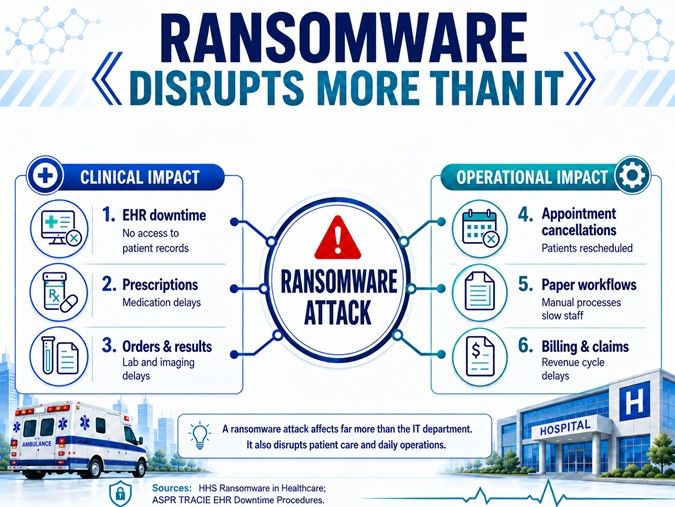
Ransomware is one of the most dangerous threats to healthcare because it targets availability. If attackers encrypt important systems, staff may be forced to switch to manual workflows. This can delay care, slow communication, interrupt billing, and increase pressure on clinical teams.
HHS ransomware guidance lists healthcare impacts such as IT outages, EHR downtime, cancellations, and temporary switches to paper records. ASPR TRACIE also highlights the importance of EHR downtime procedures across areas such as communication, patient visits, documentation, billing, prescriptions, and orders or results.
Legacy software makes ransomware recovery more difficult because old systems are often poorly documented. The original vendor may no longer provide support. The developer who built the system may no longer be available. Backups may exist, but they may not have been tested. Integrations may fail when one application is restored but another remains offline. In a healthcare setting, every hour matters. A system that takes longer to restore can affect both operations and patient trust.
Why Old Healthcare Integrations Can Create Hidden Security Gaps
Healthcare systems rarely operate independently. An EHR may connect with a billing platform, laboratory system, patient portal, pharmacy, claims clearinghouse, reporting tool, or third-party analytics platform. Many of these connections are added over several years by different vendors and development teams.
Older integrations may rely on:
-
Flat-file transfers
-
Shared credentials
-
Insecure or unencrypted data transfers
-
Outdated APIs
-
Custom scripts with limited documentation
-
Manual imports and exports
-
Incomplete logging or error handling
Even when the primary healthcare platform is protected, an outdated integration can become a weak point. Attackers may exploit exposed interfaces, reused credentials, excessive permissions, or misconfigured data flows. These risks can be difficult to detect when the organization does not have a complete map of how patient and operational data moves between systems.
In some cases, Custom Web Application development may be needed to rebuild an outdated patient portal, internal dashboard, or workflow application around stronger authentication, structured data exchange, clearer permission controls, and modern APIs. This can reduce dependence on fragile point-to-point connections and make future maintenance and security updates easier to manage. For healthcare organizations, integration security is essential because protected health information may pass through several applications before a workflow is complete. Every connection should therefore be documented, monitored, and reviewed as part of the organization’s broader security and modernization strategy.
How Legacy Software Can Increase HIPAA, Compliance, and Audit Risk After a Breach
After a cyberattack, the question is not only whether the organization was targeted. Regulators, insurers, patients, and partners may also ask whether reasonable safeguards were in place before the attack happened. HHS explains that the Security Rule requires regulated entities to perform an accurate and thorough assessment of potential risks and vulnerabilities to the confidentiality, integrity, and availability of ePHI. It also requires regular review of records to track access and detect security incidents.
If a legacy system was known to be unsupported, unpatched, over-permissioned, or poorly monitored, the organization may face difficult questions. Was the risk documented? Was there a modernization plan? Were compensating controls in place? Were backups tested? Was access reviewed? Legacy systems can make those answers harder.
Why Healthcare Software Modernization Does Not Always Mean Replacing Everything at Once
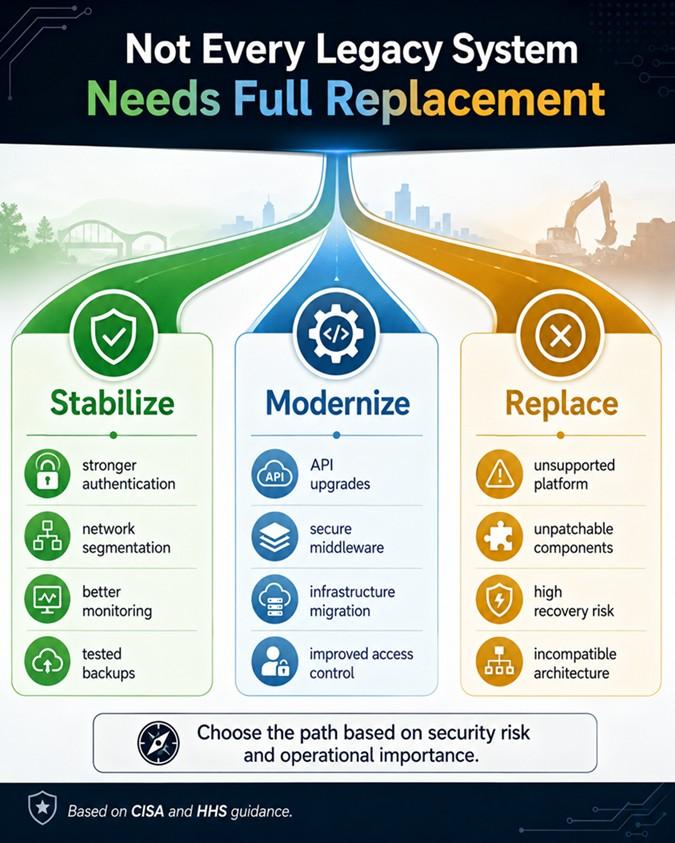
Many healthcare organizations delay modernization because they assume it requires a full system replacement. In reality, modernization can be phased. A practical first step is discovery. Organizations should identify all applications, databases, servers, integrations, vendors, user roles, data flows, and known vulnerabilities. From there, they can prioritize systems based on security exposure, clinical importance, support status, compliance risk, and recovery difficulty.
Some systems may need full replacement. Others may be stabilized with stronger authentication, network segmentation, encryption, logging, backup improvements, API upgrades, or cloud migration. In some cases, a secure middleware layer can help older systems communicate with newer platforms while reducing direct exposure. The goal is not to modernize for the sake of new technology. The goal is to reduce risk without disrupting care.
Practical Steps Healthcare Organizations Can Take to Reduce Legacy Software Risk
Healthcare organizations should start by building a complete software and integration inventory. Every system that stores, processes, or transmits patient data should be documented. Unsupported software, exposed systems, weak passwords, shared accounts, missing logs, and outdated integrations should be flagged as priority risks. Next, organizations should review access control. Users should only have access to the data and systems required for their role. Multi-factor authentication should be added wherever possible. Vendor access should be limited, monitored, and reviewed regularly.
Backups should also be tested, not just created. A backup that cannot be restored quickly during a ransomware event is not enough. Healthcare teams should also maintain downtime procedures so clinical work can continue safely if digital systems become unavailable. Finally, modernization should be treated as an ongoing program, not a one-time project. Regular updates, security reviews, integration audits, and recovery testing help prevent today’s useful software from becoming tomorrow’s legacy risk.
Final Thoughts: Modernizing Healthcare Software Before Legacy Risk Becomes a Breach
Legacy healthcare software does not automatically mean a cyberattack will happen. But it can make an organization easier to attack, harder to monitor, slower to recover, and more exposed if something goes wrong. Healthcare cybersecurity is no longer only about firewalls and antivirus tools. It depends on secure software architecture, strong access control, reliable integrations, tested backups, audit visibility, and long-term maintenance.
For healthcare providers, clinics, wellness companies, and health-tech organizations, the safest path is structured modernization. Working with a software development company that understands legacy systems, healthcare integrations, security requirements, and operational workflows can help turn technical risk into a practical, phased roadmap.
OpenSource Technologies (OST) helps organizations assess aging applications, strengthen software security, improve integrations, and build modern healthcare platforms that support business needs, patient care, and long-term maintainability.