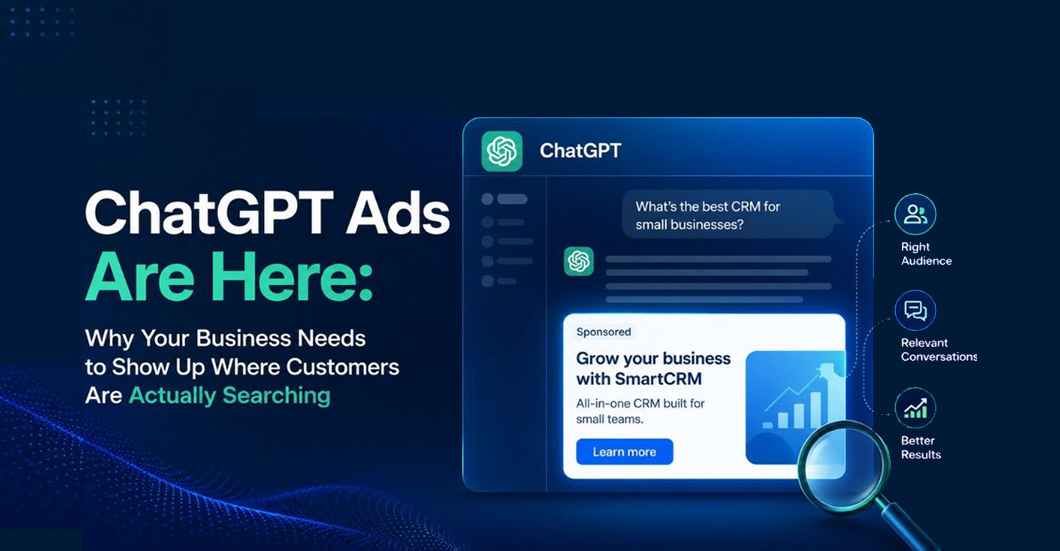
For twenty-five years, "getting found online" meant one thing: ranking on Google. That's no longer the whole story. Millions of people now open ChatGPT the way they used to open a search tab — to ask a question, compare products, or get a recommendation. And in 2026, OpenAI gave brands a formal way to show up in those conversations: paid ads inside ChatGPT itself.
This is a genuine shift in consumer behavior, not just another marketing trend. Below, we'll look at the data behind why AI tools are pulling attention away from traditional search, why ChatGPT's new ad platform is generating so much interest among marketers, and how a business can actually run — and benefit from — ChatGPT ads.
The shift you already know about — and the part that's new
We've written about the consumer side of this shift before — in why ranking in AI tools is the future of local SEO and in our breakdown of McKinsey's research on AI search adoption — so we won't repeat those numbers here. What's new, and what matters most to anyone holding a marketing budget, is what OpenAI did with that shift: it turned it into an actual, buyable ad product, and in 2026 opened that product up to businesses of any size.
-
Three data points explain the timing. OpenAI's subscriber base has been accelerating hard — the company reported that January and February 2026 were its two largest months for new paying subscribers on record, funding a business now aggressive enough to chase more than $100 billion in ad revenue by 2030.
-
On the research side, Gartner has predicted that traditional search engine volume will fall 25% by 2026 as AI chatbots become "substitute answer engines" for queries that used to go straight to Google.
-
And on the buying side, Boston Consulting Group found that shopping-related use of generative AI tools grew 35% between February and November 2025, with over 60% of consumers now saying they trust the results these tools give them.
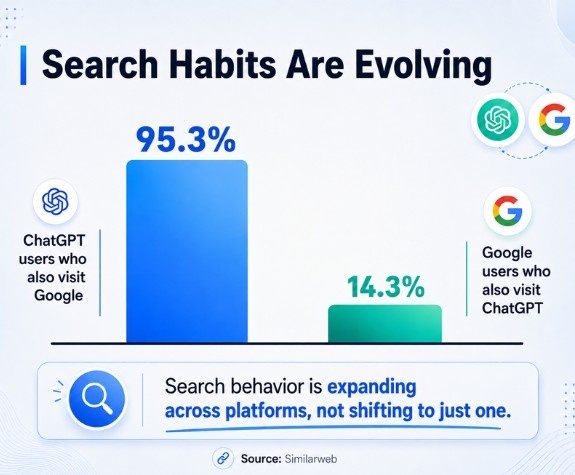
Worth adding some nuance, though: Similarweb data shows that as of mid-2025, 95.3% of ChatGPT users still also visit Google, while only 14.3% of Google users visit ChatGPT — Google still handles roughly 84 billion visits a month against ChatGPT's 5.8 billion.
AI assistants are picking up a real, fast-growing share of research and comparison queries that run alongside traditional search, not instead of it. That's still an audience large enough to be worth paying to reach — and now there's a formal way to do it.
Why ChatGPT paid ads are gaining popularity so quickly
Advertising inside ChatGPT is new, but adoption has moved fast because OpenAI has systematically removed the barriers that kept it a big-brand-only experiment.
It started as a closed pilot. OpenAI's initial ChatGPT ads rollout appeared for free-tier and Go-plan users only (Plus, Pro, Enterprise, and Education stay ad-free), with sponsored links visually separated and placed beneath ChatGPT's responses. Early participants were major holding companies — Omnicom Media, Dentsu, and WPP Media — running campaigns for brands in automotive, retail, travel, and CPG. Entry required a minimum spend of roughly $200,000 and pricing around $60 CPM, positioning it closer to premium streaming ad rates than typical search advertising.
Then it opened up to everyone. In May 2026, OpenAI launched a self-serve Ads Manager in beta, removing the minimum spend requirement entirely and adding cost-per-click buying alongside the original cost-per-impression model. That single change is what turned ChatGPT ads from an enterprise pilot into something small and mid-sized businesses can actually test.
And the early performance data is promising. People are clicking on these ads more often than they typically click on banner ads or podcast promotions. And OpenAI isn't treating this as a side project either — it's aiming for over $100 billion in ad revenue by 2030, a clear signal that this is a platform the company plans to keep building on for years to come.
Put together: a fast-growing, high-intent audience, a lower barrier to entry than six months ago, and early click-through data that looks competitive with established channels. That combination is why paid visibility on ChatGPT is moving from "interesting experiment" to "line item marketers are testing" so quickly.
How paid ads can actually get your business results on ChatGPT
The mechanics matter here, because ChatGPT ads don't work like a Google Ads auction or a Meta feed placement.
Ads appear in context, not just on a results page. Sponsored links show up beneath ChatGPT's organic response, tied to what the user is actually asking about. OpenAI has been explicit that ads don't influence the model's underlying answer — they sit alongside it. That matters for trust, but it also means relevance is everything: your ad is competing for attention against an answer the user already perceives as helpful.
Targeting is conversational, not just demographic. Instead of relying purely on keywords or audience segments, targeting draws on conversation topics, a user's chat history, and prior ad interactions — while OpenAI maintains that advertisers never get access to the underlying conversations or personal data. Users can also opt out of personalized ads, dismiss individual ads, or avoid ads altogether by staying on paid tiers.
Ads aren't shown everywhere. OpenAI restricts advertising for users under 18 and keeps ads away from sensitive topics like health, mental wellness, and political content — worth knowing if your category brushes up against any of those areas.
Buying options now match how performance marketers actually work. With CPC bidding added alongside CPM, and OpenAI's more recent move toward conversion-based bidding (more on that below), ChatGPT ads are starting to look less like a media buy and more like a performance channel you can actually optimize.
The upshot: a well-matched ad, shown to someone already in a research or buying conversation, in a format built around the answer they came for — that's a genuinely different intent signal than a banner ad or a cold social placement.
How to run ChatGPT ads — a practical starting point
If you're ready to test the channel, here's roughly how the process works today:
-
Confirm eligibility and register. OpenAI's self-serve Ads Manager is available to eligible businesses in supported markets, including the United States, United Kingdom, Canada, Australia, Japan, Korea, and New Zealand. Advertisers can sign up directly through Ads Manager rather than needing to participate through one of the large agency partners.
-
Choose your objective and buying model. Select the campaign objective that best matches your goal. Use CPM (cost per thousand impressions) when your priority is reach and brand awareness, CPC (cost per click) when you want to drive traffic and engagement, or oCPC (optimized cost per click) when you want OpenAI to optimize delivery toward a specific tracked conversion, such as a lead or purchase.
-
Set targeting. Define who you want to reach using the targeting options available in Ads Manager. This can include geographic targeting, contextual relevance based on the types of conversations and topics related to your business, and eligible first-party Custom Audiences. OpenAI refers to contextual signals as context hints—they help the system understand which conversations may be relevant to your ad rather than functioning like traditional exact-match keywords.
-
Build ad creative that fits the format. ChatGPT ads appear alongside the conversational experience and are clearly identified as sponsored. Depending on the available format, an ad can include elements such as your advertiser name, favicon, headline, description, destination URL, and image creative. The goal shouldn't be to make the loudest ad possible; create concise, useful messaging that feels relevant to what the user is already trying to accomplish.
-
Connect conversion tracking before you launch, not after. This is the step many businesses underestimate—and it's the difference between “we ran ChatGPT ads” and “we know whether ChatGPT ads worked.” Configure your important conversion events, such as qualified leads, successful contact-form submissions, purchases, or other meaningful actions, before campaign traffic begins. This also gives conversion-optimized campaigns the measurement signals they need.
-
What to actually budget for a first test. You don't need a huge budget to start experimenting with ChatGPT Ads. For many small and mid-sized businesses, $1,000–$3,000 can be a practical initial test budget to validate tracking, understand traffic quality, and gather early performance data. Rather than committing heavily from day one, start with a controlled test, measure the results, and increase spending if the channel begins generating qualified traffic and conversions.
-
Submit for review and launch. Once your campaign, targeting, creative, budget, billing, and conversion tracking are ready, submit the campaign for review. OpenAI requires ads to pass review before they can begin serving, and business or account verification may also be required. Because OpenAI does not publish a fixed review-time Service Level Agreement (SLA), it's sensible to build a few days of buffer into any time-sensitive launch rather than assuming your campaign will be approved and serving the same day.
Before launching, also make sure your Ads Manager account is fully configured with your advertiser information, favicon, billing profile, payment method, and appropriate team-member access. Ads Manager also includes API-key functionality as OpenAI continues to develop the platform's integration capabilities.
How to make sure you actually benefit from ChatGPT ad spend
Early advertisers on the platform ran into the same problem performance marketers hit with every new ad channel: strong top-of-funnel numbers (clicks, impressions) with weak visibility into what happened after the click. eMarketer reported that OpenAI has been actively addressing this by shifting ChatGPT advertising toward conversion-based bidding, using tracking pixels placed on advertiser websites, product catalogs, and checkout pages to send actual conversion data back into OpenAI's optimization algorithm — plus first-party audience matching from customer lists. The catch is that this only works if your tracking setup is actually capturing and passing that conversion data reliably.
That's exactly the gap most businesses hit first, because the simplest client-side tracking setups tend to under-report conversions — blocked by browsers, ad blockers, or privacy settings — right when you need clean data to prove the channel is working. The more reliable fix is server-side tracking, which is why we wrote a full walkthrough on setting it up correctly: ChatGPT Ads Conversion Tracking with Server-Side Google Tag Manager. It covers how to wire up server-side GTM so conversion events actually reach OpenAI's Ads Manager cleanly, which is the foundation for any real ROI analysis on this channel.
Beyond tracking, a few practices will separate businesses that benefit from ChatGPT ads from those that just spend on them:
-
Start with a modest test budget and treat the first few weeks as a benchmarking exercise — CTR and conversion rate on this channel are still early-stage and will vary a lot by industry.
-
Pair paid visibility with organic AI visibility. Ads get you in front of users today; showing up in ChatGPT's organic answers (through the structured content, citations, and technical foundations covered in our GEO playbook) compounds that visibility over time without ongoing ad spend.
-
Watch attribution, not just clicks. Because this is a new measurement environment, cross-check conversion data reported inside ChatGPT Ads Manager against your own GA4 and CRM numbers rather than trusting either source blindly.
-
Keep creative conversational. Ad copy written like a search ad headline will feel out of place next to a chat response; write it like a helpful, specific answer instead.
The bottom line
A fast-growing base of consumers already trusts AI-generated recommendations enough to shop based on them, and there's now an ad platform — open to businesses of any size, with no minimum spend and early click-through data that holds up against established channels — built specifically to reach them there. ChatGPT visibility has moved from "nice to have" to a channel worth testing deliberately, provided you set up tracking well enough to actually measure what it's doing for you.
If you want help building and measuring a ChatGPT ads test — from campaign setup through server-side conversion tracking — OST's digital advertising team can help you get it right the first time.