

Understanding the New Rules
A two-part series. Part 1 covers the protocol landscape and how each platform approaches agentic commerce. Part 2 covers the actual decision: which platform wins for your brand, what implementation looks like, and what to do this quarter.
For more than a decade, the Shopify-vs-WooCommerce decision has come down to a familiar checklist — themes, apps, hosting, transaction fees, headless flexibility. But in 2026, that checklist is suddenly outdated.
The new question founders are asking is sharper and more existential: which platform makes my store readable, transactable, and trusted by AI agents? Because increasingly, your next customer isn’t a human scrolling on a phone. It’s an AI agent — ChatGPT, Gemini, Claude, Perplexity, or a procurement bot — acting on a human’s behalf, comparing options across thousands of catalogs, and completing checkout without ever loading your homepage.
This isn’t speculation. Shopify and Google launched the Universal Commerce Protocol (UCP) in January 2026 with 20+ retail partners. WooCommerce shipped native Model Context Protocol (MCP) support in version 10.3 back in October 2025. Stripe’s Agentic Commerce Protocol is live on both platforms. The infrastructure has arrived. The question is no longer if AI agents will buy from your store — it’s whether your platform is ready for them when they do.
This post is Part 1 of a two-part breakdown. We’ll cover the protocol landscape, how Shopify and WooCommerce each approach the agentic shift, and where their philosophies diverge. Part 2 covers the decision framework, implementation lift, and the playbook to execute right now.
What Is the Difference Between Shopify UCP and WooCommerce MCP?
Let’s start by clearing up the most common confusion in this space: UCP and MCP are not competitors. They operate at different layers of the stack.
MCP (Model Context Protocol) is the interface layer. Originally created by Anthropic, MCP is now a shared standard adopted by ChatGPT, Claude, Gemini, Cursor, and most major AI clients. It’s how an AI agent reads your store’s live data — current inventory, real-time pricing, product specs, order status — instead of working from stale training data.
UCP (Universal Commerce Protocol) is the commerce orchestration layer. Co-developed by Shopify and Google, UCP defines how agents discover merchants, negotiate capabilities (discounts, subscriptions, pre-orders, loyalty), and complete full checkout flows. UCP is transport-agnostic — it works over MCP, REST, JSON-RPC, A2A, and other protocols.
The cleanest way to think about it: MCP is the language, UCP is the contract. WooCommerce ships MCP natively today. Shopify ships UCP, which is MCP-compatible. So in the Shopify UCP vs WooCommerce MCP debate, you’re really comparing two different philosophies — Shopify’s managed, opinionated standard versus WooCommerce’s open, composable protocol stack.
The full stack looks like this:
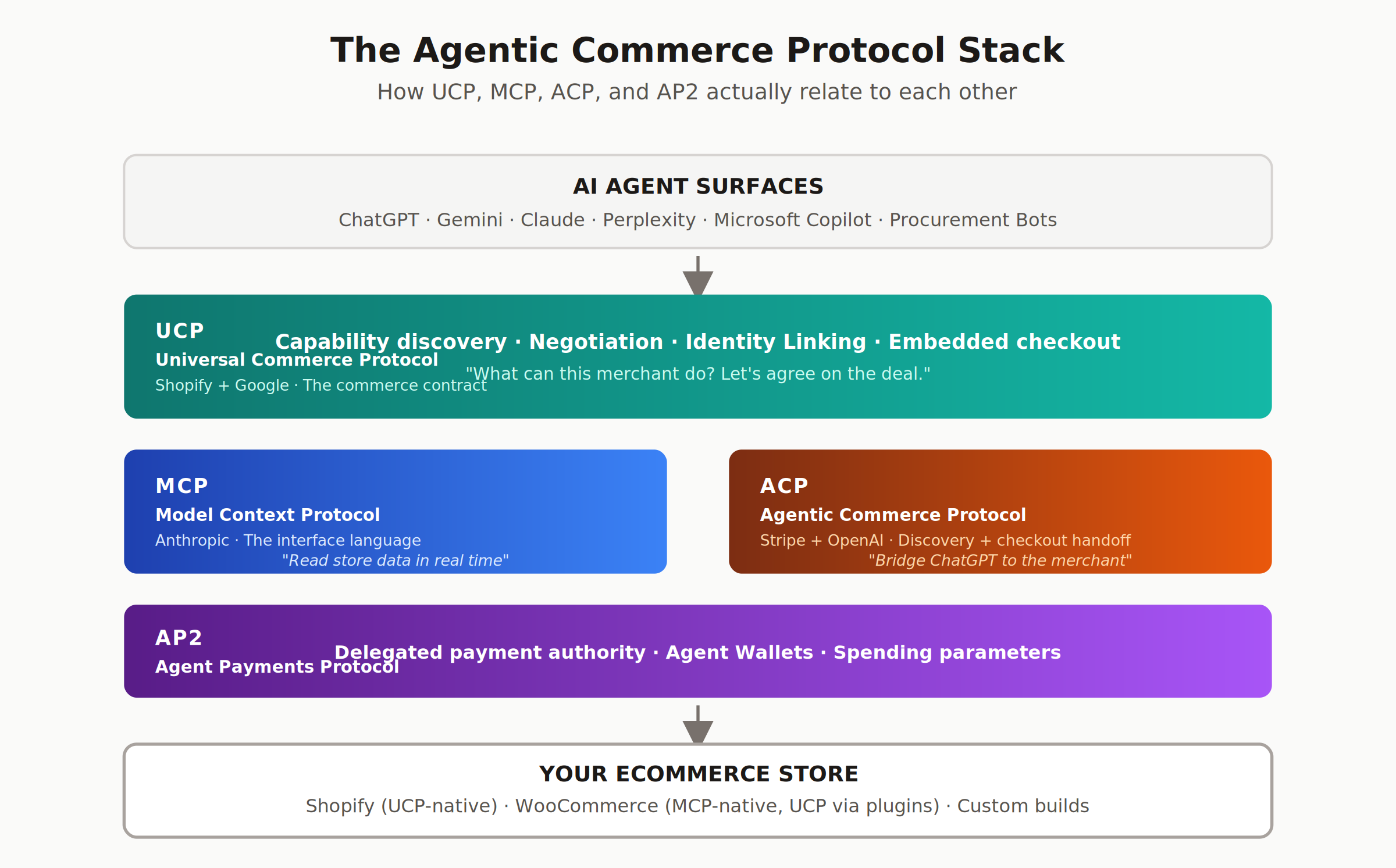
UCP is the merchant-agent contract. MCP is the live-data interface. ACP (Stripe + OpenAI’s Agentic Commerce Protocol) bridges ChatGPT to merchants for product discovery and checkout handoff. AP2 (Agent Payments Protocol) handles delegated payment authority and agent wallets. They’re designed to coexist, not compete — and most stores will eventually touch all four.
What Is the Universal Commerce Protocol (UCP) and Which Platforms Support It?
UCP is an open standard, but Shopify is its primary first-party implementer. Per Shopify’s official documentation, UCP defines:
- Capability discovery — merchants declare what they support (subscriptions, pre-orders, B2B pricing, loyalty programs)
- Negotiation — agents and merchants agree on what the agent can and can’t handle
- Identity Linking — OAuth-based delegation so the agent inherits the customer’s preferences (shipping, payment, purchase history)
- Embedded Checkout Protocol (ECP) — checkout renders inside the agent surface, not on your site
- Payment flexibility — works with Shop Pay, Stripe, or any processor; payment handlers are negotiated, not prescribed
UCP is endorsed by 20+ retailers and is co-stewarded with Google. WooCommerce stores can adopt UCP through community plugins (developer-preview today), and the platform is actively building first-party UCP support alongside its existing MCP and ACP integrations.
What Is the Model Context Protocol (MCP) and How Does WooCommerce Implement It?
MCP shipped natively in WooCommerce 10.3 (October 2025) and has matured through versions 10.4–10.7. It’s currently in developer preview but stable enough for production pilots.
The woocommerce model context protocol architecture works like this: an MCP-compatible AI client (Claude, ChatGPT, Gemini, Cursor, VS Code, etc.) connects to your WordPress instance through the mcp-wordpress-remote proxy. The proxy translates MCP messages into authenticated REST API calls. WooCommerce exposes its functionality as discoverable “abilities” through the WordPress Abilities API — a foundational layer the entire WordPress ecosystem is being built on.
What you can do today with WooCommerce MCP AI agents:
- Search, create, and update products through natural language
- Manage orders end-to-end
- Pull inventory, customer, and analytics data on demand
- Build custom abilities specific to your business logic
What’s coming: full agentic checkout flows, deeper UCP compliance, and direct integration with Stripe’s ACP. WooCommerce’s open-source foundation means as the protocol layer evolves, the platform evolves with it — without you waiting on a vendor roadmap.
How Do AI Agents Actually Buy From a Shopify Store vs. a WooCommerce Store?
The buyer flow looks identical from the customer’s side — they just ask a question and get a recommendation. Underneath, the mechanics differ meaningfully.
On Shopify: When an agent gets a query like “find me a waterproof daypack under $120,” it queries Shopify Catalog — a centralized, AI-optimized product index that every Shopify store automatically syndicates into. The agent uses UCP to discover the merchant’s capabilities, negotiates checkout, and completes the transaction through Shop Pay or any other supported processor. Identity Linking means the agent already knows the customer’s preferences, so checkout is essentially one step.
On WooCommerce: The same agent connects via MCP directly to your WordPress instance, authenticated through WooCommerce REST API keys. It calls discoverable abilities exposed through the WordPress Abilities API. For checkout, the agent uses ACP or — increasingly — a UCP-compliant plugin layer to complete the purchase. You retain direct ownership of the customer relationship, the data, and the payment flow.
The functional outcome is similar. The architectural posture is very different.
How Does Shopify’s Agentic Storefront Plan Work, and What Does It Cost in Trade-offs?
Shopify’s agentic storefront shopify offering and the new shopify agentic plan bundle Catalog, Sidekick, UCP, ECP, and Identity Linking into a managed offering. The merchant value is real:
- Auto-syndication into ChatGPT Shopping, Perplexity, Google AI Mode, Gemini
- Out-of-the-box agent wallet and delegation handshake
- Embedded checkout that renders inside the agent surface
- Built-in handoff for human-in-the-loop scenarios
- Standardized analytics for agent impressions, conversion lift, and recurrence
The trade-offs are equally real:
- Standardization tax — your storefront conforms to UCP’s capability model. Custom commerce logic that doesn’t map cleanly to UCP’s primitives requires workarounds.
- Platform lock-in deepens — the more you build on UCP-native features, the harder a future migration becomes.
Pricing pressure — the Agentic Plan, Shop Pay fees, and capability-tier upsells stack on top of standard Shopify costs. For high-volume brands, this math matters.
- Catalog control — Shopify Catalog uses proprietary small language models to optimize how your products are described to agents. Powerful, but it’s not your model.
For most DTC brands under $50M revenue, the trade-offs are worth it. For larger brands with bespoke commerce logic or strong opinions about data ownership, the calculus shifts — and that’s exactly the territory Part 2 covers.
How Do Payment Flows Differ Between UCP and ACP for AI Agents?
Both protocols solve the same core problem — letting an agent complete payment on the user’s behalf with proper authorization — but they take different paths.
UCP (with AP2): Identity Linking establishes the user-agent-merchant trust triangle upfront. When checkout happens, the agent uses an Agent Wallet with delegated authority — the customer has pre-authorized spending parameters (price ceiling, category, frequency). Payment routes through whatever processor the merchant supports.
ACP (Stripe + OpenAI): ACP focuses tightly on the discovery-to-checkout handoff between ChatGPT and merchants. After OpenAI scaled back its in-chat Instant Checkout, ACP shifted toward a model where ChatGPT handles product search and recommendation, and purchases either redirect to the merchant site or complete through Stripe’s payment infrastructure. ACP works natively with Stripe and is being integrated into WooCommerce, Shopify, and other platforms.
The practical takeaway: UCP is the more comprehensive commerce contract. ACP is a tighter, more focused payment and discovery handoff. Both protocols are designed to coexist.
What About Identity, Wallets, and Delegated Authority?
This is where the philosophical difference between Shopify vs WooCommerce agentic commerce becomes most concrete.
Shopify’s model is opinionated and standardized. A user links their Shopify account to their AI assistant once via OAuth. From then on, any agent acting for that user inherits their shipping, payment, and preference data. Agent Wallets carry delegated spending authority. Fast to deploy, but on Shopify’s terms.
WooCommerce’s model is composable. Authentication is via WooCommerce REST API keys with permission scoping baked in. There’s no first-party identity-linking or agent-wallet equivalent yet — but the open architecture means you can build (or plug in) exactly the delegation model your business needs. For B2B, regulated industries, or high-AOV brands where delegation rules need to be precise, this flexibility is a feature, not a bug.
If you want this handled for you, Shopify is faster. If you want to design it yourself, WooCommerce is the only platform that lets you.
Which Platform Gives Me More Control Over My Customer Data and Margins?
WooCommerce, unambiguously.
On Shopify, agent-mediated transactions flow through Shopify Catalog and (often) Shop Pay. You retain customer data, but Shopify sits in the middle of the discovery and transaction layer. Margin is reduced by Shopify Payments fees, agentic plan fees, and capability-tier upsells.
On WooCommerce, your agent-mediated transactions flow through your own infrastructure. You own the customer relationship, the data, and the payment routing end-to-end. Stripe ACP fees apply where used, but you have processor flexibility throughout.
For brands where data ownership and unit economics are core strategic concerns — subscription brands, regulated categories, high-AOV B2B — WooCommerce’s posture is materially more aligned with long-term independence. This is why the best ecommerce platform for AI agents isn’t a single answer: the right answer depends on whether you optimize for speed or sovereignty.
Coming in Part 2
That’s the landscape. The protocols, the architectural differences, the trade-offs each platform asks you to accept. What we haven’t answered yet is the question that actually matters for your business: which one should you choose, and what does the work look like to get there?
Part 2 covers:
- The decision framework by revenue band ($5M, $50M, $500M+) — concrete segmentation, not generic “it depends”
- Whether you should migrate platforms (spoiler: almost certainly not)
- Side-by-side capability comparison across 10 dimensions
- Realistic implementation timelines for each platform
- Hybrid setups: when running both makes strategic sense
- The platform-agnostic playbook to execute this quarter
Building Agent-Ready Stores on Both Shopify and WooCommerce
At OpenSource Technologies (OST), we’ve spent 14+ years building ecommerce stores that work — and now, building stores that work for both human shoppers and the AI agents shopping on their behalf.
Our Ecommerce App development team is one of the few in the market with deep, production-grade expertise across both Shopify (UCP, Agentic Storefronts, Shopify Catalog optimization, headless builds) and WooCommerce (MCP integration, custom WordPress Abilities, Stripe ACP rollout, headless commerce). That dual expertise matters in the agentic era — because the right answer often depends on the brand, not the platform.
We’re a women-led engineering team based in Lansdale, PA, with 500+ successful projects delivered across 35+ countries and a 100% on-time delivery record.
If you’d like a clear, honest assessment of where your store stands on agent-readiness — whether you’re on Shopify, WooCommerce, or weighing a platform decision — we’d love to talk. Reach out at [email protected] or visit www.ost.agency to book a free Agent-Readiness Audit.