

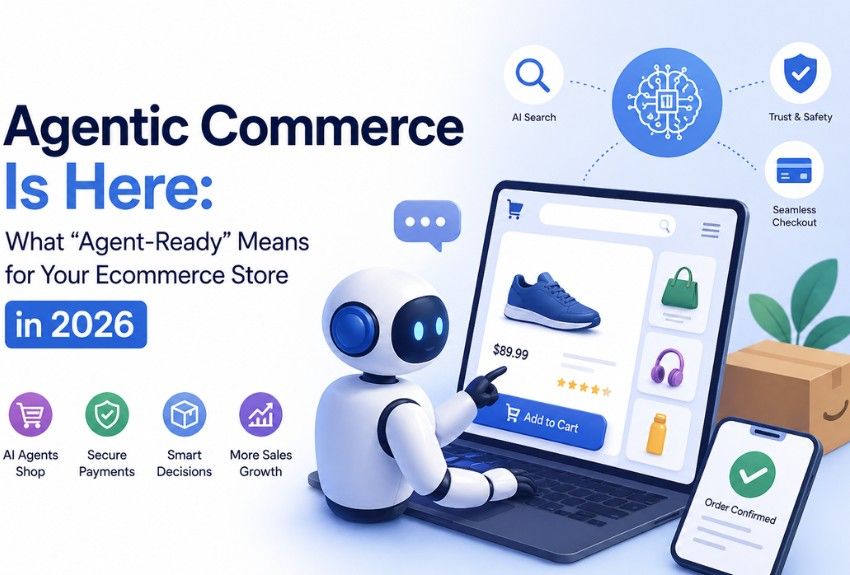
Agentic Commerce Is Here: What “Agent-Ready” Means for Your Ecommerce Store in 2026

If you run an ecommerce business, there’s a good chance you’ve spent the last year trying to figure out how to show up in ChatGPT and Perplexity answers. That work is still important. But while most brands are still catching up on Generative Engine Optimization (GEO), a second, bigger shift is already underway — and it’s going to change what a “visitor” to your site even means.

Your next customer might not be a person. It might be an AI agent shopping on their behalf.

Agents like Perplexity’s Comet browser, OpenAI’s ChatGPT apps, Google’s AI Mode shopping, and Amazon’s Rufus aren’t just recommending products anymore. They’re doing the shopping — navigating to your product page, comparing your prices to competitors, reading your return policy, adding items to cart, and in some cases completing checkout without the human ever touching your site.

This is agentic commerce, and it’s happening right now. OpenAI’s Instant Checkout launched inside ChatGPT in September 2025 with Etsy, Shopify, Walmart, Target, Sephora, Nordstrom, Best Buy, Lowe’s, and Home Depot. Google released its Universal Commerce Protocol (UCP) in January 2026. Amazon sued Perplexity in November 2025 specifically to keep AI agents off its platform — and the case is still being fought in federal court, making clear just how high the stakes are. The agentic AI market is projected to reach $93.2 billion by 2032.

Your GEO work helps the AI recommend you. Being “agent-ready” is what gets you bought. They’re not the same thing, and most stores today are optimized for neither.

What Actually Happens When an Agent Shops Your Store

Before we get into the fixes, it helps to picture what’s going on mechanically. When an AI agent tries to buy something on behalf of a user, one of three things is happening, depending on the platform:

Protocol-based transactions. Platforms like OpenAI’s Agentic Commerce Protocol (ACP) and Google’s UCP exchange structured data directly with your backend — product catalog, inventory, pricing, checkout — via APIs. The user never leaves the chat interface. The merchant stays the merchant of record. Stripe’s Shared Payment Token handles payment without the agent ever seeing card details.

Browser-based agents. Tools like Perplexity’s Comet actually open your website inside an AI-controlled browser, log in using the user’s saved credentials, and click through your checkout flow just like a person would — only faster, and without ever looking at your hero image, your discount popup, or your sponsored product placements.

Hybrid app experiences. After OpenAI pulled back on native Instant Checkout in March 2026, it pivoted to ChatGPT apps — where merchants like Walmart run their own mini-checkout inside the chat, with their own payment systems and loyalty programs.

Each of these imposes different requirements on your site. And here’s the uncomfortable truth: most ecommerce stores today are actively hostile to all three. Modal popups, forced account creation, CAPTCHAs, slow-rendering product pages, inventory that’s out of sync with the cart — every one of these is a conversion killer for humans, but for agents, they’re often a full-stop blocker.

Isn’t This Just GEO With Extra Steps?

No, and this distinction is the most important thing to understand about what’s coming.

GEO (Generative Engine Optimization) is about getting the AI to recommend your product in its answer. That means structured data, brand mentions, clear content, reviews across the web. It ends when the AI names your product.

Agentic readiness picks up where GEO ends. It’s about what happens after the recommendation — when the agent actually tries to purchase. Your product page loads. Your inventory API responds. Your checkout accepts a programmatic payment. Your return policy is machine-readable. Your shipping estimate is accurate in real time.

A store can be brilliantly optimized for AI discovery and still fail the moment the agent tries to transact. We’re seeing this pattern constantly in audits: the AI recommends the brand, the user says “yes, buy it,” the agent navigates to the product page, and then… a cookie banner blocks the viewport, or the add-to-cart button requires a login, or the inventory shown doesn’t match what’s actually available. Sale lost.

You need both GEO and agent-readiness. They solve different problems.

We Tested 10 Ecommerce Stores With a Shopping Agent. Here’s What Broke.

To pressure-test what we’ve been seeing in client audits, we ran a small experiment earlier this month. We picked 10 mid-market ecommerce stores (mix of Shopify, WooCommerce, and custom platforms, $2M–$50M revenue, across apparel, home goods, beauty, and outdoor gear), and asked a Comet-based shopping agent to complete a specific purchase on each one.

The results weren’t pretty:

Only 3 of 10 stores successfully completed a purchase end-to-end. The other 7 failed at various points in the flow. 4 stores were blocked at the product page by modal popups, newsletter signup overlays, or cookie banners the agent couldn’t reliably dismiss.

2 stores had product pages that rendered fine but returned inconsistent inventory data between the page and the cart, causing the agent to give up mid-checkout.

1 store had a CAPTCHA triggered during checkout — unsurprisingly, the agent could not solve it.
5 of 10 stores required account creation before checkout with no guest checkout option, which the agent (correctly) flagged as a privacy issue and refused to complete.

Only 2 stores exposed clean, machine-readable shipping and return information. The rest buried it in PDFs, image-based graphics, or dynamically-loaded modals.

The stores that succeeded had three things in common: fast-loading product pages with no blocking overlays, guest checkout with autofill-friendly form field names, and real-time inventory/pricing accuracy. None of them had done anything particularly “for AI.” They just had clean, human-first UX that happened to also be agent-friendly.

That’s the good news and the bad news: the fixes aren’t exotic. They’re the same things that would improve your human conversion rate. But the cost of neglecting them just went up dramatically, because now you’re losing both customer segments.

7 Things You Need to Do to Be Agent-Ready

1. Make Your Product Data Queryable, Not Just Displayable

GEO got you to add schema markup so AI engines could read your product pages. Agent-readiness takes that one step further: your product data needs to be available via a clean, consistent API, not just rendered in HTML.

If you’re on Shopify, you’re already halfway there — the Shopify Catalog API feeds ChatGPT, Google, and others. If you’re on a custom build or headless setup, this means exposing a product endpoint that returns canonical fields (SKU, price, inventory, variants, shipping options, return policy) in a stable JSON format. OpenAI’s ACP and Google’s UCP both define schemas for this; you don’t need to invent your own.

The practical test: can a developer query your site for the canonical price, stock level, and estimated ship date of any SKU in under 200ms with a single API call? If not, agents will skip you in favor of competitors who can.

2. Stabilize Your Page Structure and DOM

Browser-based agents like Comet work by reading and clicking on your rendered page. That means they’re vulnerable to every change you make to your frontend — especially if your CSS class names are auto-generated (common in React and Vue projects) or your DOM shifts around on each page load.

The fix is boring but important: use semantic HTML  (<button>, <form>, <input type=”email”>), give important elements stable IDs or ARIA labels, and avoid class names that change between deploys. This is the same accessibility work that helps screen readers and keyboard users — agents benefit from it for the same reasons.

3. Fix Your Checkout Flow — Especially the Parts Humans Tolerate but Agents Don’t

Humans put up with a lot of checkout friction. Agents don’t. Every one of these is a potential conversion killer in 2026:

Forced account creation. Offer guest checkout. If an agent can’t complete a purchase without creating an account, most agents will stop.

CAPTCHAs on checkout. If you’re gating checkout behind a CAPTCHA to prevent fraud, you’re also blocking legitimate agentic purchases. Consider moving bot detection earlier in the flow, or using invisible challenges that only trigger on genuinely suspicious signals.

Multi-step wizards with ambiguous field labels. An agent needs to know that a field labeled “Apt/Suite” maps to an address line 2. Use standard autocomplete attributes (autocomplete=”given-name”, autocomplete=”postal-code”, etc.) — they’re defined by the HTML spec for exactly this reason.

Dark patterns. Pre-checked upsells, mandatory insurance add-ons, and “are you sure?” exit-intent popups don’t just annoy users — they cause agents to pause, re-prompt the human, and often abandon the flow entirely.

4. Get Your Inventory and Pricing Accuracy Right in Real Time

This is the one that caught OpenAI off-guard. When OpenAI walked back its native Instant Checkout feature in March 2026, one of the main reasons cited was the difficulty of keeping product data — inventory, pricing, shipping — accurate enough for a real-time transaction. Scraped or cached data wasn’t good enough. Agents that recommended out-of-stock items made the whole system look unreliable.

If your inventory is updated once a day via a scheduled job, you will lose agentic sales. If your pricing can lag between your PIM and your storefront, agents will see one price and charge another, and your platform will start deprioritizing you.

The fix is architectural: your product page, your cart, and your checkout all need to read from the same source of truth, updated in near real time. For most mid-market stores this means investing in proper inventory middleware, a headless architecture, or — at minimum — aggressive cache invalidation on stock changes.

5. Decide Your Agent Policy — and Make It Explicit

This is where it gets legally interesting. The Amazon v. Perplexity case is still winding through the Ninth Circuit as of April 2026, and the core question — whether an AI agent acting with user permission needs separate authorization from the platform — is genuinely unsettled.

Most ecommerce brands aren’t Amazon, and blocking agents is almost always the wrong call. Amazon had a specific reason to fight this: its advertising business depends on human eyeballs seeing sponsored placements. If you’re a typical DTC or mid-market brand, agents visiting your site are customers trying to buy from you.

That said, you need an explicit policy. At minimum:

Update your robots.txt to allow the crawlers and agents you want (GPTBot, PerplexityBot, ClaudeBot, Google-Extended, and similar) and block any you don’t trust.

Update your Terms of Service to explicitly permit (or prohibit) autonomous agent activity. Ambiguity here is what creates legal risk.

Work with your WAF/CDN (Cloudflare, Akamai, etc.) to distinguish legitimate agents from malicious bots. Treating all automation as hostile is a losing strategy in 2026.

For high-value accounts, consider adding explicit “agent permission” settings where users can authorize specific agents to act on their behalf.

6. Plug Into the Agent Networks Directly

Beyond making your site agent-friendly, you can connect your catalog directly to the major protocols:

OpenAI’s Agentic Commerce Protocol (ACP). Open standard, co-developed with Stripe. If you already use Stripe, you can enable agentic payments in roughly one line of code. ACP charges merchants a 4% transaction fee on completed Instant Checkout purchases (plus standard payment processing).

Google’s Universal Commerce Protocol (UCP). Announced January 2026, rolling out across Google AI Mode and Gemini. Coalition-backed, which means it’s likely to become the de facto standard for Google-driven agentic traffic.

Shopify’s Universal Commerce Protocol. Built-in for Shopify merchants. Connects automatically to OpenAI, Google, and Microsoft surfaces.

Perplexity’s Buy with Pro. Launched in November 2025 with PayPal. Merchants appear in Comet-driven transactions via Perplexity’s merchant program.

Most brands will need to support both ACP and UCP. They have different strengths (ACP is stronger for conversational discovery, UCP for high-intent search), different fee structures, and different attribution models. Think of it like the early days of credit card networks — you don’t get to pick just one.

7. Fix Your Attribution Before You Lose Visibility Into Your Own Sales

Here’s the question that’s keeping ecommerce CFOs up at night: if a customer buys your product inside ChatGPT or Perplexity, and the transaction completes without them ever visiting your site, how do you know it happened?

This is not a solved problem. A few things you can do now:

Use the attribution fields in ACP and UCP. Both protocols include merchant-side attribution data in the transaction payload. Make sure your order management system is capturing and storing this.
Set up UTM-style tracking for agent-referred traffic. Some agent checkout flows pass referral parameters; capture them in your analytics layer.

Watch your branded search volume. When agents recommend your brand, a meaningful share of customers will still Google you before buying. A rising branded search trend is often your clearest leading indicator.

Monitor your email list growth relative to revenue. If revenue is holding steady but email signups are declining, you may be losing the relationship with customers who used to buy on your site and now buy via an agent. Plan accordingly — that’s a first-party data problem you need to solve with post-purchase touchpoints.

The Technical Readiness Checklist (Hand This to Your CTO)

For the engineering-minded reader: here’s the list of what should actually be audited on your stack.

Infrastructure and performance

-Product pages render to first meaningful paint in under 1.5 seconds (agents time out faster than humans)
-No render-blocking modals, cookie banners, or newsletter popups above the fold
-Stable DOM with semantic HTML and consistent selectors across deploys
-All form fields use standard autocomplete attributes per WHATWG spec
-Rate limits on APIs are generous enough to handle agent traffic (agents generate higher request density than humans)

Data and APIs

-Canonical product API with consistent SKU, price, inventory, variants
-Real-time inventory sync between PIM, storefront, and cart (not daily batch)
-Shipping and return policies exposed in structured/machine-readable format, not just PDFs
-Product schema (Schema.org Product) with all recommended fields, including GTIN, MPN, and brand
-FAQ and HowTo schema for common pre-purchase questions

Checkout and transactions

-Guest checkout available and prominently offered
-No CAPTCHAs on the main checkout path (move bot detection earlier)
-Support for Stripe Shared Payment Token or equivalent for agent-driven payments
-ACP integration tested and deployed (if using ChatGPT commerce channels)
-UCP-compatible feed submitted to Google Merchant Center
-Consistent pricing between product page, cart, and checkout (no surprise adjustments)

Policy and governance

-robots.txt explicitly configured for agent crawlers
-Terms of Service updated to address autonomous agent activity
-WAF/CDN rules distinguish legitimate agents from malicious bots
-Data retention and attribution policy documented for agent-sourced transactions

Analytics and attribution

-GA4 custom channels for agent referral sources (chat.openai.com, perplexity.ai, etc.)
-Order management captures agent/protocol metadata on each transaction
-Post-purchase touchpoint strategy for customers who never visited the site

If most of these boxes are unchecked, you’re not alone — but you’re also not ready. And the cost of unreadiness compounds every month.

The Business Questions You’re Probably Asking

Will agentic commerce kill my brand relationship with customers?” It can, if you let it. When a customer never visits your site, they don’t see your brand story, they don’t join your email list, and they don’t become a repeat buyer through your own channels. The answer isn’t to block agents — it’s to invest in post-purchase experience (packaging, inserts, transactional emails, loyalty programs) and to make sure the agent-facing version of your brand is still recognizably yours.

Do I need to pay to be in agentic shopping network?” Some, yes. OpenAI’s ACP charges a 4% transaction fee on completed Instant Checkout purchases. Perplexity’s merchant program is free to join. Google’s UCP has not announced fees as of this writing. Budget accordingly.

Should I just wait until this all settles down?” This is the most tempting and most dangerous move. Like GEO, agentic visibility compounds. Every month your competitors are transacting through ACP and UCP, those platforms accumulate more training data and behavioral signals associated with their catalogs. By the time you “wait and see,” the gap is expensive to close.

Isn’t this going to be a mess of incompatible standards?” It already is. ACP, UCP, Shopify’s UCP, Perplexity’s Buy with Pro, Amazon’s walled garden with Rufus — you’ll need to support multiple protocols with different feed structures, different checkout flows, and different attribution. This is the cost of being a multi-channel brand in 2026.

Your 30/90-Day Plan
If you’re starting from zero, here’s the honest order to do this in.

First 30 days: Audit. Run a real agent (Comet is easiest) against your own store and document every place it fails. Fix the cookie banners, popups, and forced-account-creation patterns. Expose guest checkout. Update your robots.txt. This is the “unblock the door” phase — agents can’t buy from you if they can’t get in.

Next 60 days: Wire up the protocols. If you’re on Shopify, enable the catalog for ChatGPT and Google. If you’re on custom/headless, build your ACP and UCP integrations. Get your inventory sync to real-time. Update your product schema. Start capturing attribution metadata on orders.

After that: Optimize. A/B test product content for agent-friendliness. Build post-purchase flows for customers you never saw on-site. Set up your monthly manual audit (ask ChatGPT and Perplexity’s Comet to buy your top 20 products, note what breaks). Revisit your attribution model quarterly as the platforms evolve.

The Cost of Waiting Just Went Up

In the original GEO piece we published, we warned that every month your competitors got cited by ChatGPT, those platforms were accumulating more training data associating them with your category. That was true then. It’s more true now — because agents don’t just recommend products based on that training data. They complete transactions based on it.

Every order that goes to a competitor because an agent couldn’t complete a purchase on your site is both a lost sale and a negative signal to the platform. Agents learn which merchants are reliable. Once they learn that yours isn’t, you’re not just losing today’s transaction — you’re lowering your probability of being chosen next time.

Meanwhile, AI-attributed orders on Shopify grew 11x between January 2025 and March 2026. Agentic shopping is not a niche behavior. It’s the growth edge of the entire ecommerce channel.

Ready to Get Your Store Agent-Ready? Let’s Talk.

At OpenSource Technologies (OST), we’ve spent the last 14+ years helping ecommerce brands and mission-driven organizations build websites that work. Today, that means building sites that work for human shoppers, AI engines that recommend products, and autonomous agents that transact on behalf of users.

We’re a women-led engineering team based in Lansdale, PA, with 500+ successful projects delivered across 35+ countries, a 100% on-time delivery record, and hands-on experience with GEO, ACP and UCP protocol integration, headless commerce architecture, real-time inventory systems, and the schema and structured data work that makes all of it possible.

If you’d like a concrete read on how your store performs under an agent-driven purchase today — and a prioritized roadmap for what to fix first — we’d love to chat. Reach out at [contact@ost.agency] or visit [www.ost.agency] to book a free Agent-Readiness Audit.

Your competitors aren’t just getting recommended by ChatGPT. Increasingly, they’re getting bought from. Let’s make sure you’re the one completing the sale.

Published
Categorized as Blog Tagged Agentic Commerce, Generative Engine Optimization

By Manish Mittal

Founder & CEO at OpenSource Technologies | AI-Augmented Platforms | Web & Mobile Dev | Digital Marketing | Forbes Technology Council Member