

If you’ve been in the digital marketing space for a while, you know the drill: set up your robots.txt, submit your sitemap to Google Search Console, and you’re technically “search-engine ready.” For years, that was enough. But in 2026, the way people find information online has changed fundamentally — and the tools we use to help search systems understand our websites need to catch up.
The rise of AI-powered search engines like Claude, ChatGPT, Perplexity, Google AI Overviews, and Co-Pilot has created an entirely new discovery layer. Ranking on page one of Google still matters, but now your content also needs to be retrievable, understandable, and citable by large language models (LLMs). That’s where a new file — llms.txt — enters the conversation. And if you’ve never heard of it, you’re not alone.
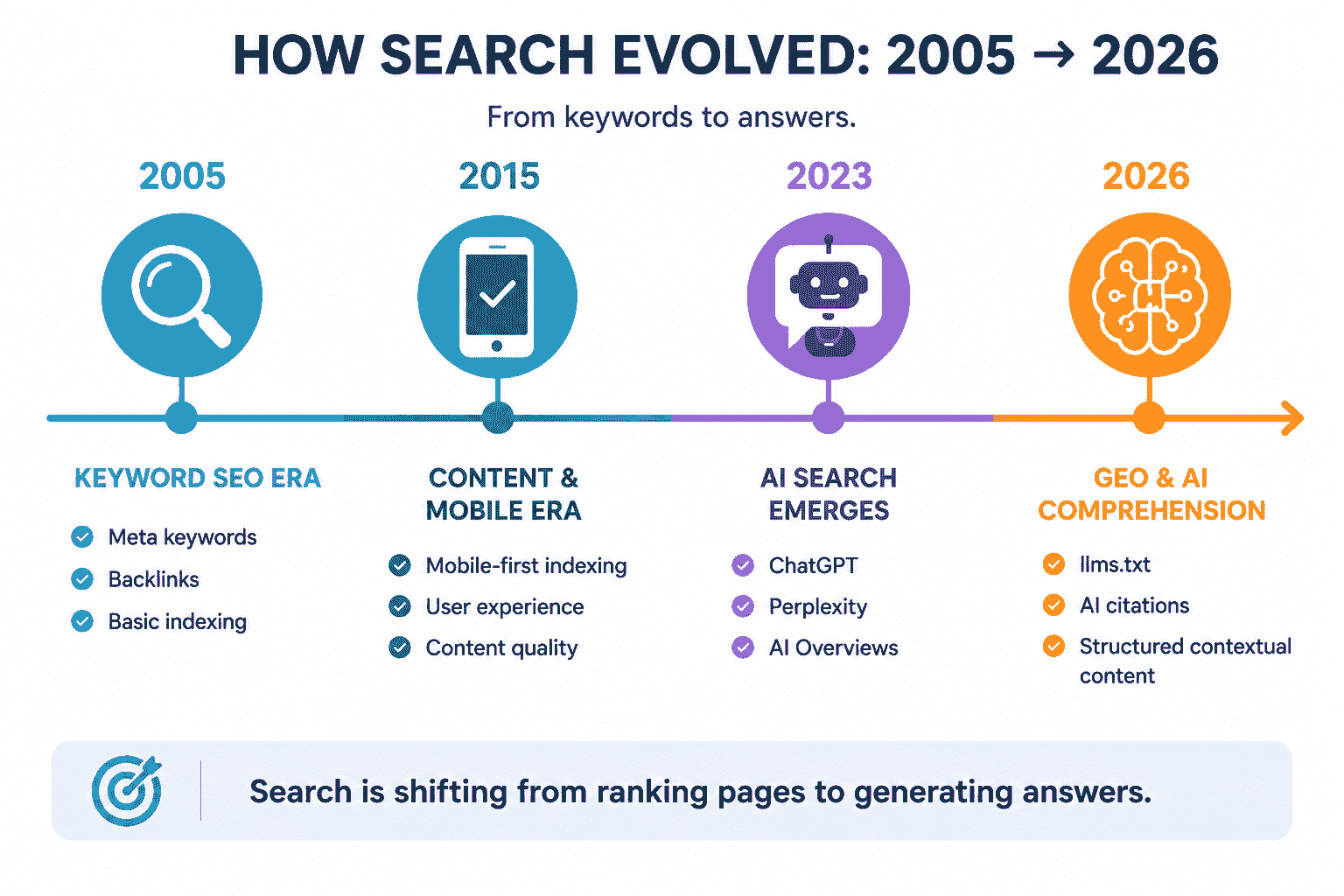
The Old Guard: What Robots.txt and Sitemaps Actually Do
Before we talk about what’s missing, let’s be precise about what these files do — because they’re often misunderstood.
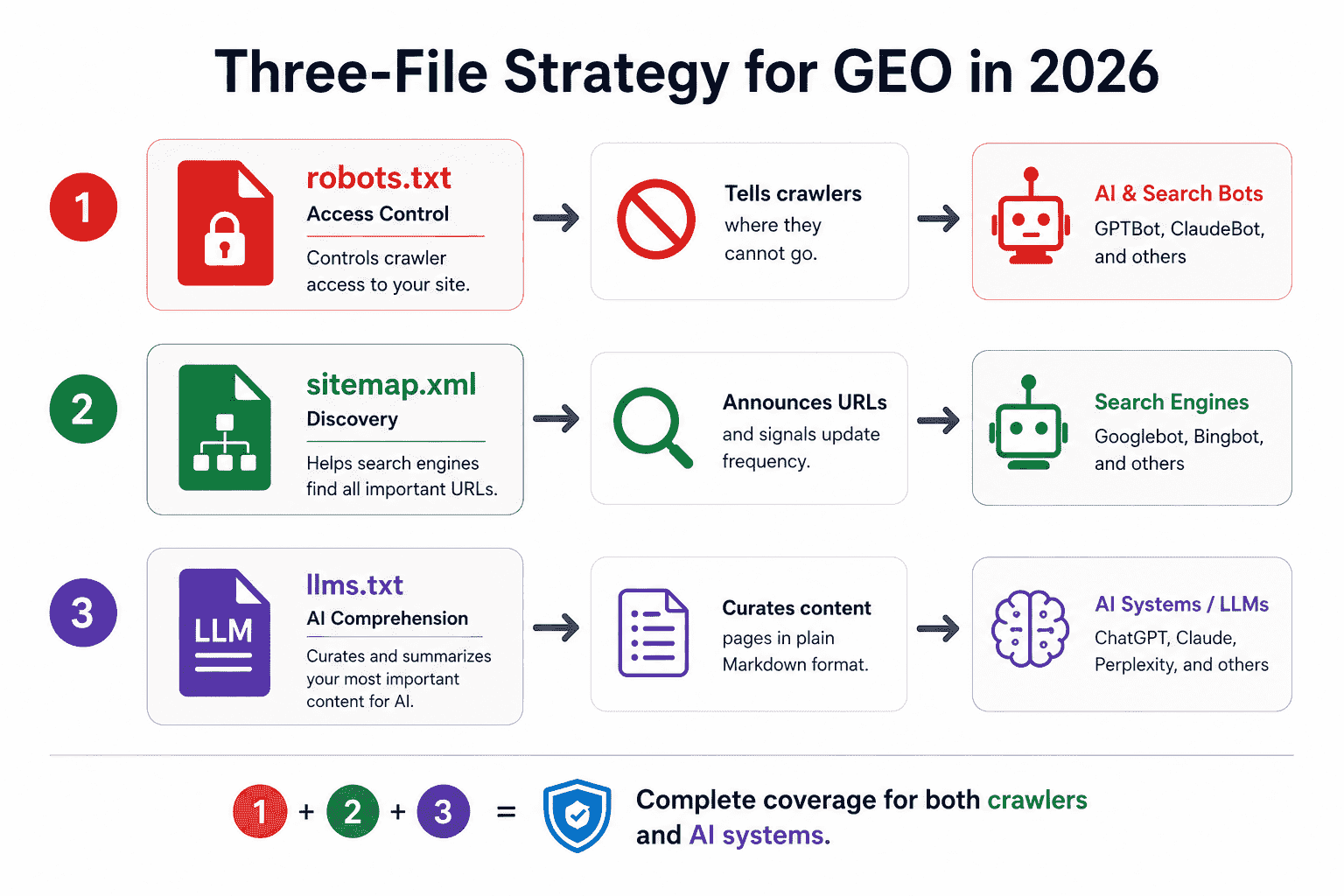
Robots.txt is a gatekeeping file. It tells web crawlers — including AI bots like GPTBot and ClaudeBot — which parts of your site they’re not allowed to access. It controls permissions, not discovery. If you’ve ever accidentally blocked Googlebot with a misconfigured robots.txt, you’ll know how damaging that mistake can be.
Sitemap.xml is a discovery file. It lists every important URL on your site and signals to search engines when pages were last updated. It’s about breadth — helping crawlers find all your content efficiently.
These two files form the backbone of technical SEO, and every reputable SEO company will make sure both are correctly configured as a baseline. But here’s the thing: neither of these files was built with AI in mind. They speak to crawlers, not to the language models that synthesise your content into answers.
The Gap Nobody Talks About: AI Crawlers vs. AI Comprehension
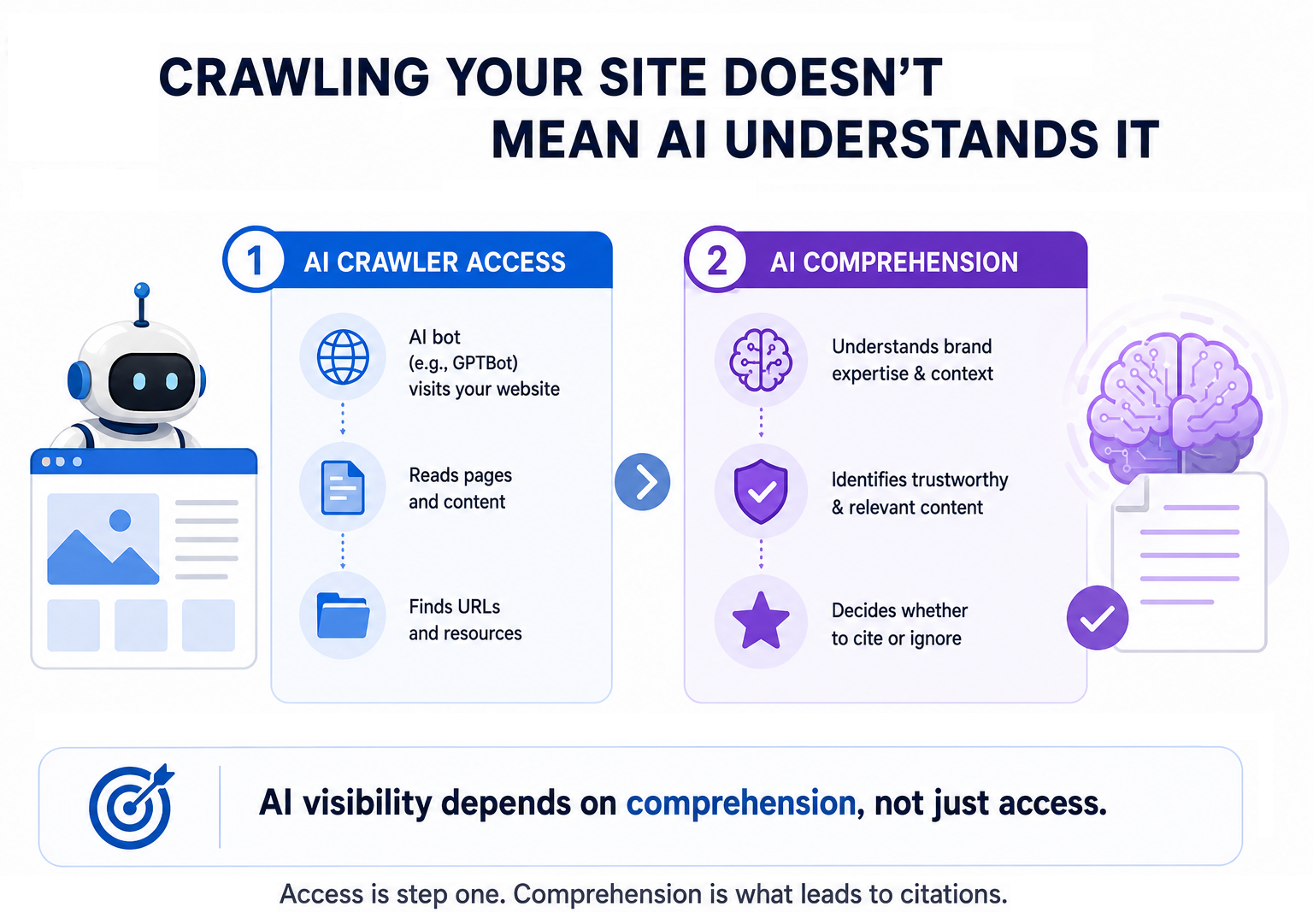
Here’s a distinction that most technical SEO guides completely overlook: there’s a big difference between allowing an AI bot to crawl your website and helping AI models actually understand your content well enough to mention or cite it. Robots.txt and sitemaps handle the first problem. They were designed for that. But comprehension — the ability of a language model to quickly identify what your brand does, what your most important pages say, and how your content is structured — is an entirely different challenge. And it’s one that neither of those files was ever built to solve.
According to Ahrefs data from early 2026, over 60% of websites that explicitly allow GPTBot via robots.txt still receive zero citations from ChatGPT. Simply giving AI bots access to your site isn’t enough. What really matters is whether the AI can quickly understand your content, recognize it as useful, trustworthy, and relevant, and decide whether to cite it or ignore it. This is the gap that Generative Engine Optimization (GEO) addresses — and specifically, it’s the gap that llms.txt was designed to close. It gives AI systems clearer context about your website, making it easier for them to identify important pages and understand your expertise.
AI comprehension also depends on how well your content is organized and explained. Clear structure, concise messaging, and strong topical relevance make it easier for language models to process and reference your content accurately. If you’re exploring ways to improve your visibility in AI-driven search platforms, working with a Generative Engine Optimization Agency can help you understand the difference between simply being crawlable and actually being understood by AI systems.
Enter llms.txt: A Sitemap Built for AI
The llms.txt file is a plain text file placed at the root of your website (e.g., yourdomain.com/llms.txt). It was proposed as a way to give AI systems a clean, curated, Markdown-formatted overview of your most important content — cutting through the noise of JavaScript, modal pop-ups, cookie banners, and complex HTML that can confuse language models when they try to parse your pages.
Think of the difference this way:
- robots.txt tells crawlers where they cannot go
- sitemap.xml tells crawlers what exists
- llms.txt tells AI models what’s important and how your content is structured
It’s a layered approach, and each file serves a distinct purpose. An llms.txt might include summaries of key pages, FAQ-style content, canonical brand messaging, or links to your most authoritative resources — all in a format that’s easy for an LLM to ingest without burning through computational resources interpreting your design layer.
The Honest Truth About llms.txt Right Now
Here’s where we need to be straight with you, because the AI SEO/GEO community is genuinely split on this.
A study of 300,000 domains found no statistical correlation between having an llms.txt file and being cited by LLMs. Analysis of over 515 million LLM bot traffic events showed that the share of requests actually touching /llms.txt from major crawlers — GPTBot, ClaudeBot, PerplexityBot — is statistically negligible.
Google’s own Gary Illyes confirmed in July 2025 that Google doesn’t support llms.txt and isn’t planning to. John Mueller compared it to the old keywords meta tag. At the start of 2025, only 0.015% of the top one million websites by backlink authority had adopted it.
So should you ignore it entirely? Not quite.
The file is trivial to implement — tools like Yoast and AIOSEO already auto-generate it, and setting one up manually takes around 30 minutes. Tech-forward companies including Anthropic, Vercel, and Hugging Face have already implemented it. And importantly, Google has been observed probing for it, even without officially supporting it.
The argument for implementing it isn’t that it definitively boosts AI citations today — it’s that it’s a low-cost bet on a standard that could gain widespread adoption. Businesses already investing in AI Development Services will find that adding llms.txt fits naturally into a broader strategy of making their digital infrastructure readable and actionable by automated systems — not just human visitors.
What Actually Does Move the Needle for GEO
If llms.txt isn’t a proven ranking factor yet, what is? The data points to a few clear signals:
- Domain authority and backlinks matter enormously. Sites with over 32,000 referring domains are 3.5x more likely to be cited by ChatGPT than those with fewer than 200, according to SE Ranking research from late 2025. The same fundamentals that a good SEO company has always focused on — building authoritative links and earning trust — remain central to GEO visibility too.
- Content freshness and topical authority signal trust to LLMs. A BrightEdge study from Q1 2026 found that pages updated within the last 90 days are 2.3x more likely to be surfaced in AI-generated responses than pages untouched for over a year.
More importantly, LLMs show a strong bias toward sites with consistent topical depth — meaning a site with 15 tightly related posts on a subject outperforms a site with one highly-optimised standalone page. A consistent Social Media Marketing presence reinforces this topical authority signal off-site, as social engagement and brand mentions across channels contribute to how AI systems gauge a brand’s credibility in a given subject area. - Content structure is critical — and llms.txt forces you to audit it. LLMs favour short paragraphs, clear H1–H3 headings, lists, defined topic scope, and direct answers. The process of building your llms.txt file is itself a useful exercise: it requires you to identify and summarise your most important pages in plain, structured language. Many teams find that this audit surfaces pages with thin, ambiguous copy that performs poorly for AI comprehension.
Pairing that structural audit with Google Analytics 4 custom channel groupings — specifically to isolate and track referral sessions from AI sources like chat.openai.com and perplexity.ai — gives you a feedback loop that connects content structure decisions to actual AI-driven traffic outcomes. - Fresh, accurate content wins. Some LLMs demonstrate a clear preference for recently updated material. Regular content audits, structured around the engagement and traffic data your analytics tools surface, are equally valuable for maintaining GEO visibility as they are for traditional search performance.
The Three-File Strategy for 2026
The most practical takeaway is this: don’t think of these as competing files. Think of them as layers working together.
Use robots.txt to control access — make sure you’re not accidentally blocking AI crawlers from content you want indexed. Use your sitemap.xml to ensure comprehensive discovery and keep it updated as your content grows. And add an llms.txt as a forward-looking investment — a curated guide that helps AI systems understand your brand’s most important surfaces, whether that’s your pricing page, service descriptions, or cornerstone blog content.
Each layer solves a different problem. Together, they give both traditional crawlers and modern language models the clearest possible picture of who you are and what you offer.
The Bottom Line
Robots.txt and your sitemap remain non-negotiable technical foundations. But they were built for a different era of search — one where the goal was ranking in a list of blue links. That era isn’t over, but it’s being rapidly augmented by one where AI systems synthesise answers and cite sources without the user ever clicking through.
Generative Engine Optimization is not a replacement for Search Engine Optimization. It’s what SEO grows into when the search bar learns to think. The brands that build for both discovery models — traditional and generative — in 2026 will have a meaningful advantage over those still optimising exclusively for the old game.
llms.txt may not be a proven citation driver today. But the cost of adding it is minimal, the upside is real if adoption grows, and the process of creating it forces you to think clearly about what your most valuable content actually is. That clarity alone is worth the thirty minutes.
At OpenSource Technologies (OST), we help businesses prepare for this shift through AI-focused SEO and Generative Engine Optimization strategies. From improving AI content comprehension to optimizing technical website structures for LLM visibility, our team works to ensure brands are not just crawlable, but understandable and cite-worthy in the evolving AI search ecosystem.
Want your brand to stay visible in the age of AI search? Connect with OpenSource Technologies to build an SEO strategy designed for both search engines and AI-driven discovery platforms.