

Part 2 of a two-part series. Part 1 covered the agentic protocol landscape — what UCP, MCP, ACP, and AP2 are, and how Shopify and WooCommerce each approach the agentic shift. Part 2 covers the decision framework, implementation lift, and what to do this quarter.
In Part 1, we walked through how AI agents now buy from ecommerce stores — the protocols, the architectural differences, and the trade-offs Shopify and WooCommerce each ask you to accept. The takeaway was that Shopify UCP vs woocommerce mcp isn’t a competition between equivalent products; it’s a fork between two philosophies. Shopify is the managed, standardized, speed-led path. WooCommerce is the open, composable, control-led path.
Now the question that actually matters: which one should you choose, and what does the work look like to get there?
Is Shopify or WooCommerce Better for Agentic Commerce in 2026?
The honest answer: neither platform is universally better. Each wins for a specific kind of brand.
Shopify wins when you want speed, standardization, and a managed agentic surface out of the box. The platform handles the protocol negotiation, the agent wallet handshake, the checkout embedding, and the payment routing for you.
WooCommerce wins when you want control, extensibility, and a fully composable agentic stack you can shape to your exact business model. You orchestrate MCP, ACP, schema, and payment routing yourself — which is more work, but lets you build something Shopify’s standard can’t accommodate.
Below, we get specific about who falls into each camp.
Can WooCommerce Match Shopify’s Out-of-the-Box Agentic Features?
Today, not entirely — and that’s intentional. WooCommerce is taking the open-protocol path rather than the managed-bundle path. The agentic storefront shopify experience is more polished out of the box. WooCommerce’s equivalent requires you (or your Ecommerce App development partner) to compose the stack.
Here’s the realistic 2026 picture for woocommerce mcp ai agents parity across the dimensions that matter:
| Capability | Shopify (UCP) | WooCommerce (MCP + ACP) |
|---|---|---|
| Native protocol support | UCP, MCP-compatible | MCP native, ACP rolling out, UCP via plugins |
| Agent discovery | Auto via Shopify Catalog | Via your feed + MCP endpoint |
| Checkout flow | Embedded (ECP) in agent surface | Redirect or ACP-mediated (Stripe) |
| Identity / wallet handshake | First-party (OAuth Identity Linking) | Custom or via partner integration |
| Payment routing | Any processor, Shop Pay native | Any processor, Stripe ACP native |
| Time-to-agent-ready | Days to weeks | Weeks to months |
| Customization ceiling | Bounded by UCP spec | Effectively unbounded |
| Customer data ownership | Shared with Shopify | Fully yours |
| Total cost of ownership | Higher recurring, lower lift | Lower recurring, higher lift |
| Best for | Speed-to-market brands | Customization-heavy or open-source-aligned brands |
Worth noting: WooCommerce’s gap is closing fast. Stripe ACP integration, ongoing WordPress Abilities API expansion, and community-built UCP plugins are filling in the managed-experience layer. By late 2026, expect parity on most core agentic capabilities.
For a $5M, $50M, or $500M+ Brand, Which Platform Is the Right Call?
Here’s an honest segmentation, based on what we see in the market:
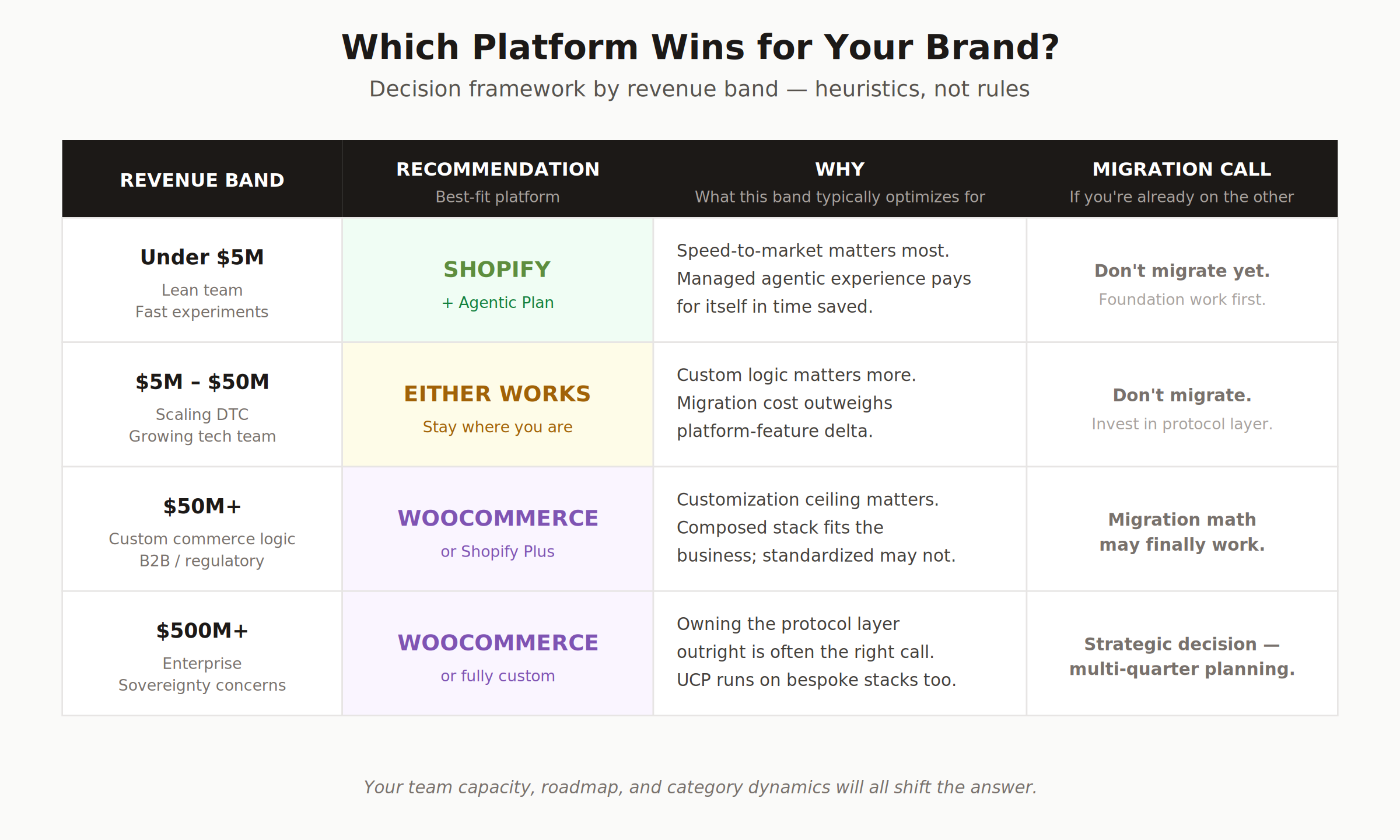
The headline recommendations are broken down:
Under $5M revenue, lean team, fast experiments: Shopify. The managed agentic experience pays for itself in time saved. Use Shopify Catalog and the Agentic Plan. Get agent-ready in weeks.
$5M–$50M, scaling DTC, growing technical team: Either works. If you’re already on Shopify and it’s serving you well, stay and adopt UCP-native features. If you’re already on WooCommerce, invest in MCP and ACP setup with a partner. Custom logic matters more in this band, and migration cost typically outweighs platform-feature delta.
$50M+ with custom commerce logic, B2B, or regulatory complexity: WooCommerce (or headless setups built on it) tends to win. The agentic stack you compose will fit your business; the standardized agentic stack you adopt may not. Shopify Plus is competitive here too, but the customization ceiling matters.
$500M+ enterprise with sovereignty and data-control concerns: WooCommerce or fully custom. UCP can be implemented on bespoke stacks; you don’t need a packaged platform to participate. At this scale, owning the protocol layer outright is often the right call.
These are heuristics, not rules. Your team’s technical capacity, your roadmap, and your category dynamics will all shift the answer. This is exactly the kind of decision an experienced Ecommerce App development partner should be helping you stress-test.
Do I Need to Migrate From WooCommerce to Shopify to Be Agent-Ready?
Almost certainly not. This is one of the most common — and most expensive — mistakes founders are making right now.
Migrating platforms is a six-to-twelve-month project that costs $50K–$500K+ depending on your catalog complexity, integration footprint, and customizations. Doing it purely to chase agentic readiness is rarely justified, because:
- WooCommerce already supports MCP natively, with UCP support actively being developed
- ACP integration with Stripe is live and rolling out across both platforms
- The foundation work that matters most — clean product data, complete schema, robust feeds — is platform-agnostic
The question worth asking is the inverse: are there other reasons your current platform is the wrong fit (scaling pain, dev velocity, app sprawl, transaction fee math) where agentic readiness is the tipping point that justifies a move you were already considering? If yes, the migration math may work. If agentic readiness is the only reason, your time and money are better spent on data quality and protocol layer work on your existing stack.
What’s the Actual Implementation Lift on Each Platform?
Here’s what the work looks like in practice, assuming an experienced team:
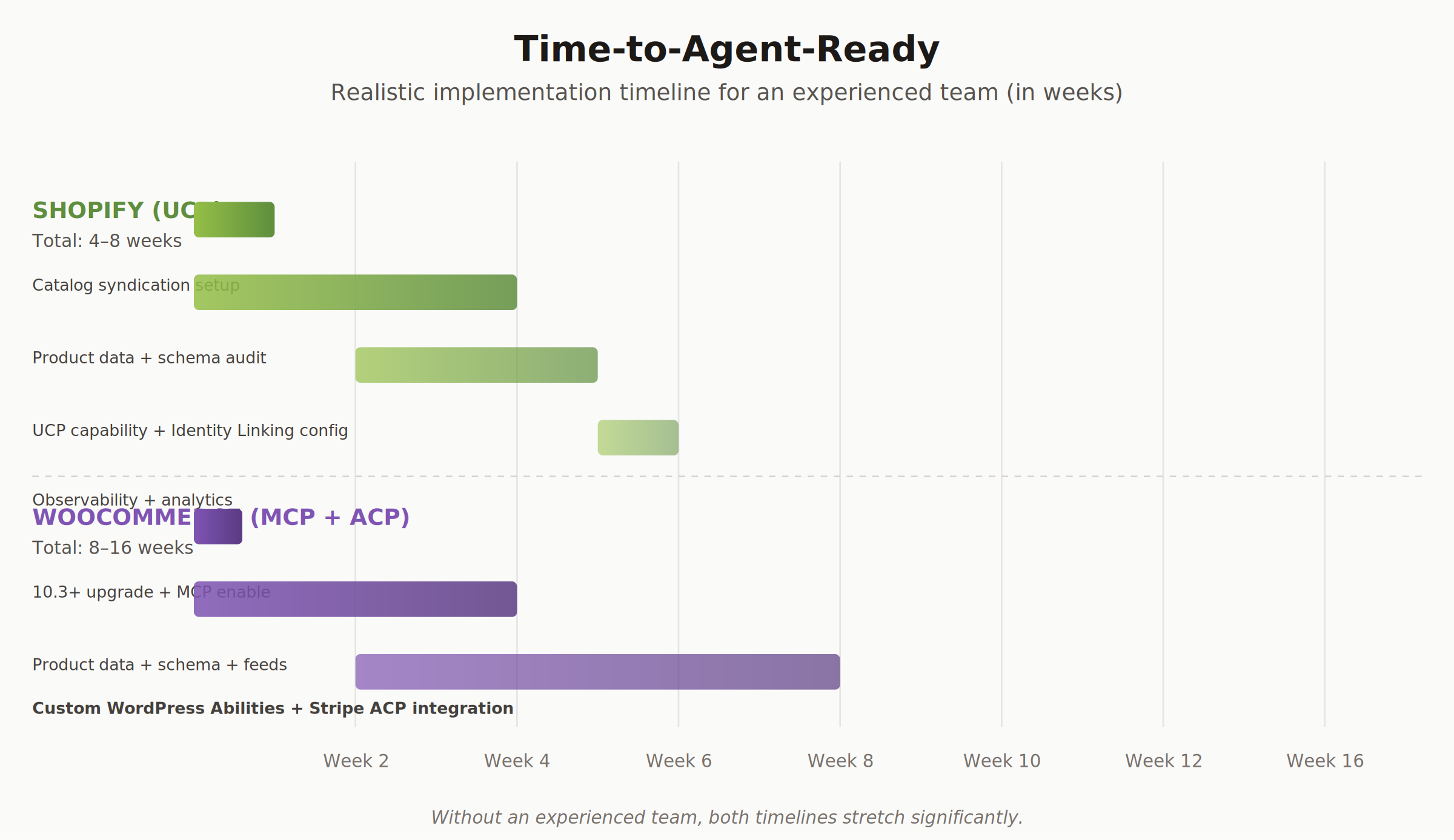
Shopify with the Agentic Plan typically gets to first measurable agent traffic in 4–8 weeks, broken down across:
- Catalog syndication setup (hours)
- Product data and schema audit (1–3 weeks — usually the biggest chunk)
- UCP capability declarations and Identity Linking config (1–2 weeks)
- Observability and analytics setup (1 week)
WooCommerce with MCP and ACP typically gets to first measurable agent traffic in 8–16 weeks:
- WooCommerce 10.3+ upgrade and MCP feature flag (hours to days)
- Product data, schema, and feeds (2–4 weeks)
- Custom WordPress Abilities for your business logic (2–6 weeks — varies most by complexity)
- Stripe ACP integration for agentic checkout (2–4 weeks)
- Observability, agent traffic separation, and analytics (1–2 weeks)
Without an experienced team, both timelines stretch significantly. The schema and product data work is the same regardless of platform — that’s where most of the value gets created on either side.
Can I Run a Hybrid Setup?
Yes — and for some brands, hybrid is the most defensible long-term posture.
Common hybrid patterns:
- Headless WooCommerce + UCP plugin layer: keep WordPress as your CMS and product source of truth, expose UCP-compliant endpoints to agents. Best of both worlds for content-heavy brands.
- Shopify for B2C, WooCommerce for B2B/wholesale: different agentic protocols for different buyer types. UCP handles consumer agents on Shopify; MCP handles procurement agents on Woo.
- WooCommerce backend + Shopify Catalog syndication via partner platforms: advanced setups where Woo is the system of record but you participate in Shopify’s agent discovery layer through middleware.
Hybrid is more complex and requires careful architecture. Don’t pursue it unless the strategic upside is clear. But for brands where neither platform alone is the perfect fit, hybrid is increasingly viable in 2026.
What Should I Be Doing Right Now Regardless of Which Platform I’m On?
This is the most important question in the post — because most of the work that drives ai-ready ecommerce platform 2026 outcomes is platform-agnostic.
The seven-step playbook:
- Get your product data complete. Every product needs full schema markup: name, brand, SKU, GTIN, price, availability, condition, dimensions, materials, category-specific fields, FAQ schema, and Review schema. Incomplete product data is the single biggest reason stores stay invisible to AI agents — on either platform.
- Make sure agent crawlers can reach you. Allow GPTBot, ClaudeBot, PerplexityBot, and Google-Extended in robots.txt. Check your WAF (Cloudflare, etc.) isn’t silently blocking them.
- Rewrite product copy for agent reasoning. Lead with a clear summary paragraph. Answer the questions customers actually ask. Explain the why behind specs, not just the specs themselves.
- Set up agent traffic separation in analytics. Agents convert at 5–10× the rate of human traffic, so blending them into one bucket contaminates your bidding algorithms and skews your reporting. Tag agent transactions distinctly server-side.
- Build presence in the conversations agents read. Reviews on Trustpilot and Google, Reddit threads, Quora answers, editorial coverage. Brand mentions across the web are the strongest predictor of AI citations.
- Connect to direct AI shopping channels. Shopify Catalog (auto on Shopify), Perplexity Merchant Program (free), Google Merchant Center (the doorway to UCP), Stripe ACP (rolling out on both platforms).
- Audit monthly. Ask the top 20 product questions your customers ask in ChatGPT, Gemini, Claude, and Perplexity. Note where you appear, where you don’t, and how you’re described when you do.
This is the universal playbook. Generative engine optimization shopify and generative engine optimization woocommerce are the same playbook executed against different platform constraints.
The Bottom Line
The Shopify-vs-WooCommerce decision in the agentic era isn’t Shopify is winning or WooCommerce is catching up. It’s a real philosophical fork:
Shopify offers a managed, opinionated, standards-led path. UCP, Catalog, Identity Linking, and the Agentic Plan get you to agent-ready faster than anything else on the market. The trade-off is depth of platform lock-in and a standardization tax on custom commerce logic.
WooCommerce offers an open, composable, control-led path. MCP shipped first, ACP is rolling out, and UCP support is being built into the platform. You’ll do more work to compose the stack, but you’ll own every layer of it — including the customer relationship, the data, and the margin.
Most brands shouldn’t migrate platforms in pursuit of agentic readiness. Most brands should invest in the foundation that wins on either side: clean data, complete schema, agent-readable content,
distributed authority signals, and proper agent traffic measurement. Then layer protocol work on top of the platform you’re already on.
The ones who do this in the next 6–12 months will compound an advantage their competitors can’t easily catch up to. The ones who wait will watch the gap widen.
Building Agent-Ready Stores on Both Shopify and WooCommerce
At OpenSource Technologies (OST), we’ve spent 14+ years building ecommerce stores that work — and now, building stores that work for both human shoppers and the AI agents shopping on their behalf.
Our Ecommerce App development team is one of the few in the market with deep, production-grade expertise across both Shopify (UCP, Agentic Storefronts, Shopify Catalog optimization, headless builds) and WooCommerce (MCP integration, custom WordPress Abilities, Stripe ACP rollout, headless commerce). That dual expertise matters in the agentic era — because the right answer often depends on the brand, not the platform.
We’re a women-led engineering team based in Lansdale, PA, with 500+ successful projects delivered across 35+ countries and a 100% on-time delivery record.
If you’d like a clear, honest assessment of where your store stands on agent-readiness — whether you’re on Shopify, WooCommerce, or weighing a platform decision — we’d love to talk. Reach out at [email protected] or visit www.ost.agency to book a free Agent-Readiness Audit.