
It's 9 p.m. A prospective student is three clicks deep into your financial aid pages, trying to figure out one thing: which form do I submit, and by when? The answer exists. It's on your site. But it's buried under a redesign, a PDF, and two subdomains. So they give up — and tomorrow your admissions inbox has one more email your website already answered.
Multiply that by every applicant, every parent, every returning student asking about registration deadlines and transcript requests. That's not a content problem. It's a findability problem — and it's quietly costing your institution enrollment, staff hours, and goodwill.
These are the questions arriving every single day, from every direction:
AI was supposed to handle these. For most schools, it hasn't. Here's why — and what a chatbot that actually works looks like.
Why most campus chatbots fail
Walk onto almost any college website and you'll find one of two things:
- A 2019-era FAQ bot. A decision tree someone built once and never updated. It drifts out of date the moment a page changes, and only answers the handful of questions its creator anticipated.
- A generic AI bot. Bolted on, trained on the open internet, and prone to hallucinating — confidently inventing a deadline, a phone number, or a program that doesn't exist.
The first is useless. The second is dangerous. For an institution, an AI that makes things up isn't a quirky bug — it's a brand-safety and compliance risk. A wrong financial-aid deadline or a made-up policy does real harm.
The fix: an assistant that only knows your content
The breakthrough isn't a bigger language model. It's a smaller, stricter scope.
A grounded AI assistant uses retrieval-augmented generation (RAG): instead of answering from general knowledge, it first searches your published content, then writes an answer using only what it found — and links the source on every reply.
That one design choice changes everything. Here's the same student question, answered the grounded way:
🔗 Financial Aid & Deadlines
- It can't go off-script. Ask about the best pizza in town and it redirects to what it's here for. Ask about a degree you don't offer and it says so, rather than inventing one.
- Every answer is traceable. No black box — each reply cites the exact page, verifiable in one click.
- It's always current. It re-reads your site on a schedule. When a page changes, the answers change — no separate FAQ to maintain.
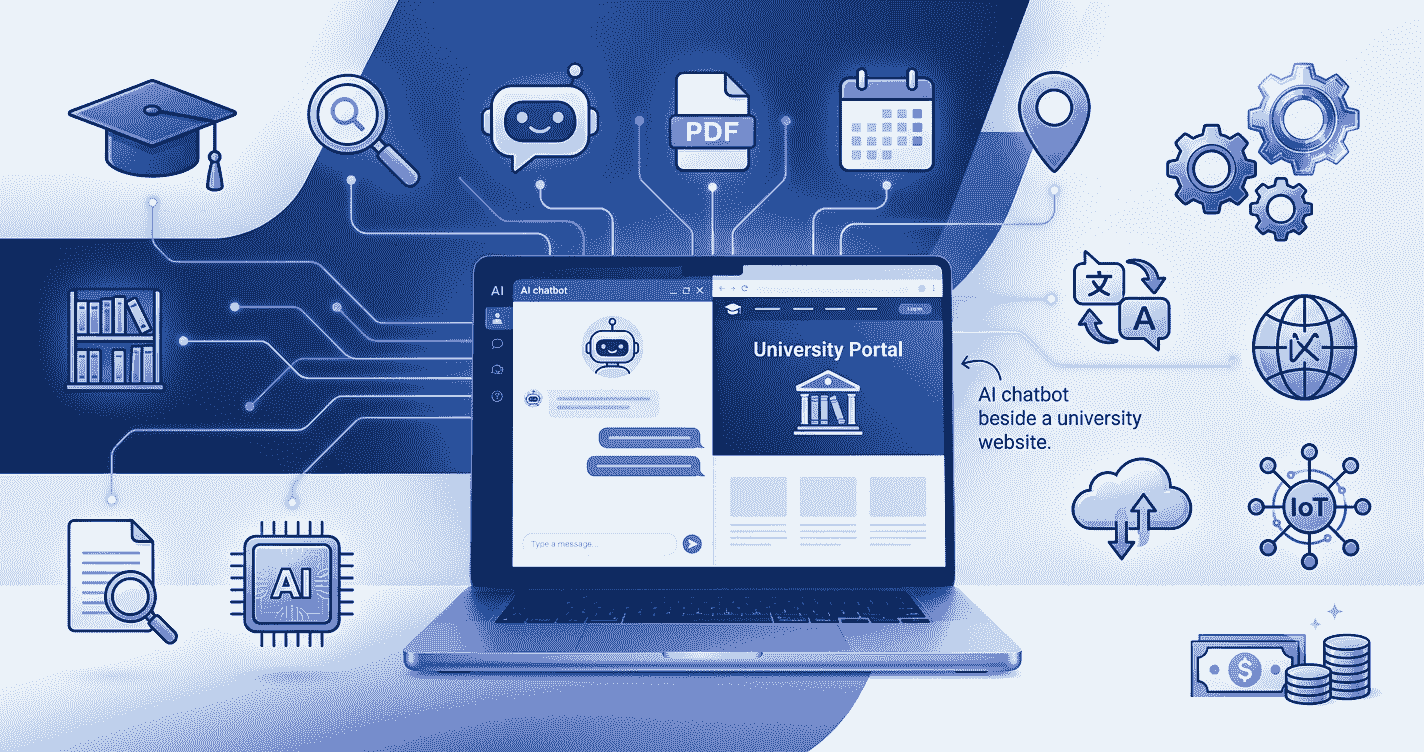
It reads everything you publish — including the PDFs
Higher-ed content never lives in one tidy place. It's spread across the main site, the catalog on one subdomain, the library guides on another, and a pile of PDFs — transfer agreements, aid forms, tuition tables.
Meet students where they actually are
Your applicants aren't all reading English on a desktop at 2 p.m.
- Any language. It auto-detects the language a visitor types in and replies in kind — no menu to hunt for. A student who writes "¿Cómo solicito ayuda financiera?" gets the answer in Spanish, and the cited page can open already translated.
- Accessible by design. Built to WCAG 2.2 AA — keyboard-operable, screen-reader friendly, adjustable text, and read-aloud. Not a procurement checkbox; how you actually serve every student.
- Always on. A large share of questions arrive nights and weekends, when no office is staffed — and it connects students to a real person (phone, contact form, the right department) the moment they need one.
Safe and private by design
For an educational institution, trust is non-negotiable. A serious assistant is built to respect it:
- It won't invent answers — the biggest fear with AI, solved by restricting it to your approved content.
- FERPA-aware. Public content only, never student records, with detection and redaction of personal identifiers if a student types them.
- Your data stays yours. Conversations and content belong to the institution, are never used to train AI models, and retention is configurable.
The part leadership actually cares about: proof
Here's where a modern assistant separates itself from a novelty. Every conversation is measured, so the tool stops being a cost and starts being a source of insight:
All of it built on anonymous conversation data — no personal information collected. The result is a monthly value report your team can put in front of leadership to show, in numbers, that the investment is working.
The assistant doesn't just answer questions. It tells you exactly where your website is failing students — and proves how many it's already helping.
Low lift to launch, easy to own
None of this matters if it takes a year and a developer to deploy. A well-built assistant installs with a single line of code on your existing CMS — no plugin, nothing to download. It crawls and brands itself to your institution, runs as a managed cloud service, and hands your team a browser-based admin panel to manage what it knows, pin exact answers, and read the analytics. Role-based access lets each department see only what's relevant.
In other words: IT installs one snippet, and your communications, enrollment, and student-services teams run it from there.
The bottom line
Your website isn't the problem. The answers are already there. The problem is that students can't find them — and the tools meant to help have either gone stale or can't be trusted.
A grounded, cited, multilingual, accessible AI assistant fixes the findability gap without introducing a hallucination risk. It serves students in their language, around the clock, and proves its value in the metrics that matter to your cabinet.
Students are going to ask. The only question is whether your institution answers — accurately, instantly, in any language — or sends one more email back to an overworked office.