
AI assistants have quietly become the fastest-adopted workplace tool in a generation. They draft emails, summarize contracts, debug code, and answer customer questions at 2 a.m. without complaint. The catch is that every one of those tasks involves handing a machine something you might not want the world to see: a pricing model, a patient record, a block of proprietary source code.
That tension — real productivity on one side, real exposure on the other — is where most businesses get stuck. The good news is that keeping control of your data and using AI aggressively are not opposing goals. They only feel that way when AI is adopted by accident instead of on purpose. Here is how to do it deliberately.
Where does your data actually go when you use an AI assistant?
Most people picture a data breach as a hooded attacker forcing their way in. Modern AI leakage looks nothing like that. It's an employee pasting a customer list into a chatbot to "clean it up," or dropping a confidential deck into a free tool to summarize it before a meeting. No alarm goes off. The data simply walks out the door in a prompt.
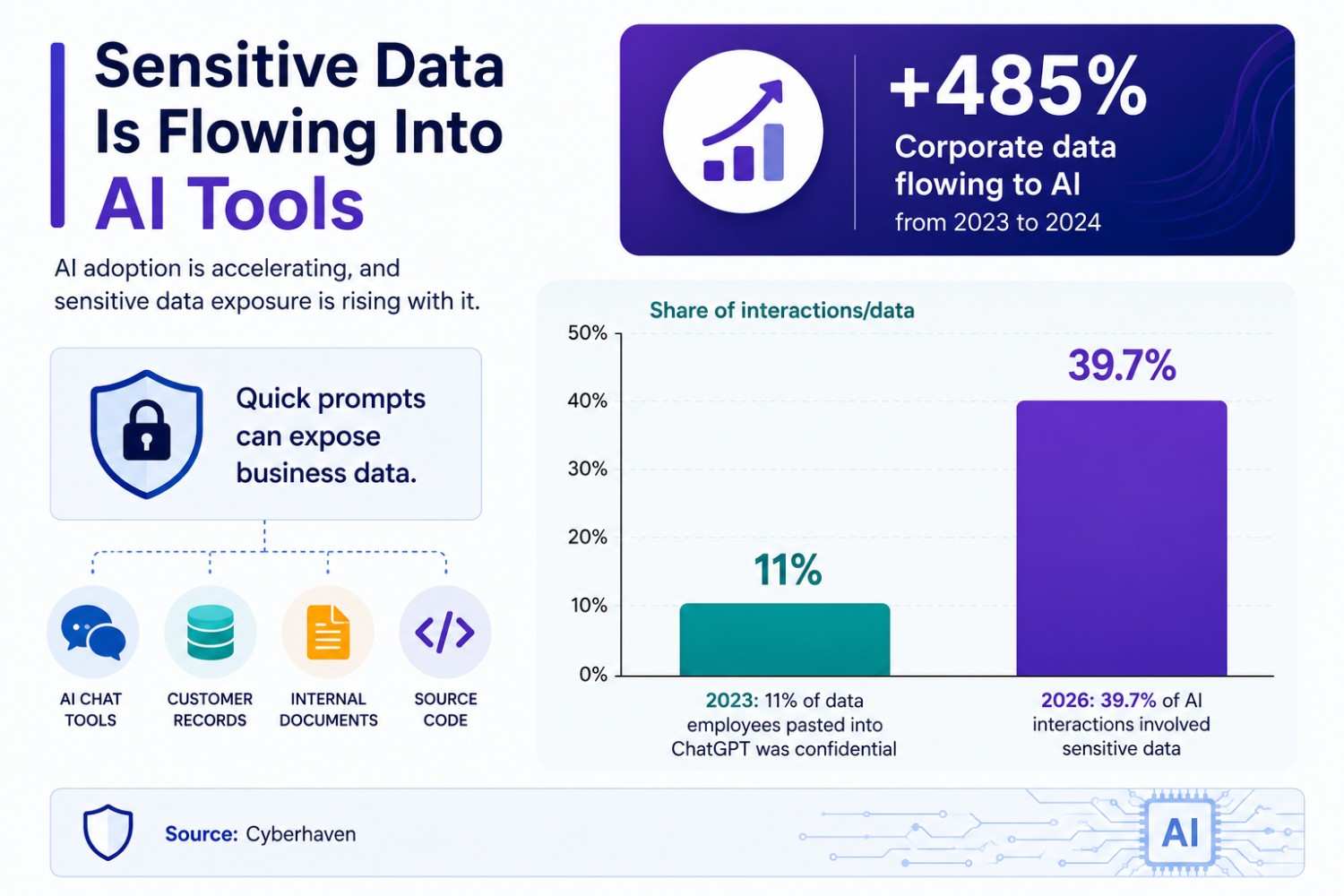
The scale is larger than most leaders realize. Between 2023 and 2024, the volume of corporate data pasted into AI tools jumped by 485%, and research from Cyberhaven found that more than one in ten employee prompts contains confidential information such as internal documents or customer records. Analysis of ChatGPT usage found that sensitive data now makes up roughly a third of what employees type into it, up from about 11% just two years earlier.
The bigger risk is that most of this happens on personal, unmanaged accounts that never touch your security stack. Security firm LayerX reported that the overwhelming majority of workplace AI access flows through consumer ChatGPT logins, outside any corporate control. This is what's now called shadow AI — tools adopted by well-meaning employees without IT's knowledge or approval. It isn't malicious. It's people trying to work faster. But the exposure is identical either way.
What does losing control of your data actually cost?
The numbers here are worth sitting with. IBM's 2025 Cost of a Data Breach Report, produced with the Ponemon Institute, found that one in five breached organizations suffered an incident tied to shadow AI — and those breaches cost, on average, $670,000 more than incidents without it. That premium was enough to push shadow AI into the top three costliest breach factors of the year, displacing the long-standing security skills shortage.
The report's most damning statistic is about basic hygiene: 97% of organizations that experienced an AI-related breach lacked proper access controls, and 63% had no AI governance policy at all. When shadow AI was involved, breaches were far more likely to expose customer personal information and intellectual property. In other words, the damage wasn't caused by exotic attacks. It was caused by AI being used in the dark, with no boundaries around who could reach what.
That's the real headline. The danger isn't the technology — it's ungoverned adoption. And ungoverned adoption is a solvable problem.
dir="ltr" style="text-align: center;">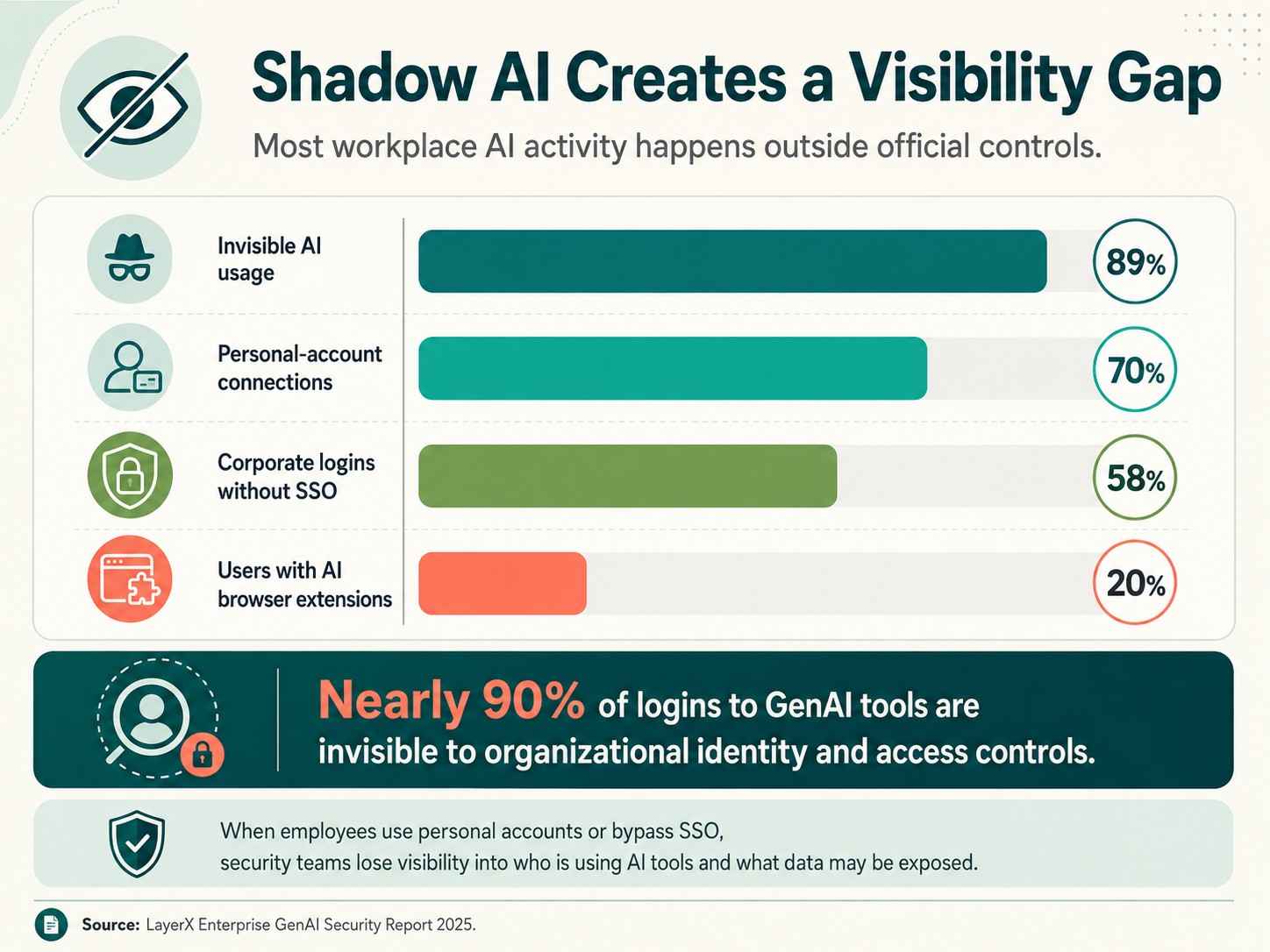
What's the difference between consumer and enterprise AI assistants?
If you remember just one thing from this article, remember this. The AI assistant you pick matters far less than the version and the way you use it.
Free and consumer tiers are built around a simple trade: you get the tool for free, and the provider may retain your inputs and, in many cases, use them to improve future models unless you opt out. Enterprise and API tiers flip that arrangement. By default, leading providers exclude business and API data from model training, offer data processing agreements to support GDPR and HIPAA compliance, and provide encryption at rest and in transit alongside independent certifications like SOC 2.
Two related but separate controls are worth knowing by name:
-
No-training policies mean the vendor won't use your data to improve its models.
-
Zero data retention (ZDR) means your inputs and outputs are deleted after processing rather than stored — often for the 30-day window most providers otherwise keep for abuse monitoring.
These are not the same thing, and having one does not guarantee the other. A vendor can promise never to train on your data while still storing it for a month — and stored data can be subpoenaed, breached, or exposed. For finance, healthcare, and legal work, you generally want both. The practical takeaway: read the contract for the specific channel you're using, because the guarantees on an enterprise plan can differ sharply from the consumer app carrying the same brand name.
How can businesses stay in control of their AI data?
You don't need to slow adoption to govern it. You need a handful of deliberate choices.
Pick the right deployment. Route sensitive work through enterprise or API channels with no-training and, where possible, zero-retention terms — never the free consumer app. Better still, build the assistant on infrastructure you control, so your knowledge base never leaves your environment in the first place. This is exactly the difference between a public chatbot and a purpose-built AI assistant grounded in your own data. Moving from a quick pilot to that kind of hardened deployment is what AI prototype-to-production work is built to handle.
Write an AI usage policy people can actually follow. A clear, human-readable policy that says what data can and can't go into which tools is the cheapest control you'll ever deploy — and its absence is what IBM found in nearly two-thirds of breached firms. (Ours is public if you'd like a model to start from: see OST's AI usage policy.)
Enforce least-privilege access. Treat AI agents like any other identity: give them access only to the specific data and systems a task requires, nothing more. Permission-aware retrieval that mirrors your existing access rules stops an assistant from surfacing something a given user was never allowed to see.
Classify and minimize before you send. Not every field needs to reach a model. Redact or tokenize personally identifiable information (PII), and keep prompts scoped to the task. Data that never leaves your perimeter can't leak from it.
Integrate deliberately, not sloppily. Most exposure comes from careless connections — an over-permissioned API, an unvetted plugin. Thoughtful systems integration and disciplined API development are what keep an assistant useful without turning it into an open door.
Monitor and audit. You can't govern what you can't see. Log AI interactions, watch for anomalies, and audit for unsanctioned tools — a step only a third of organizations with policies actually perform.
dir="ltr" style="text-align: center;">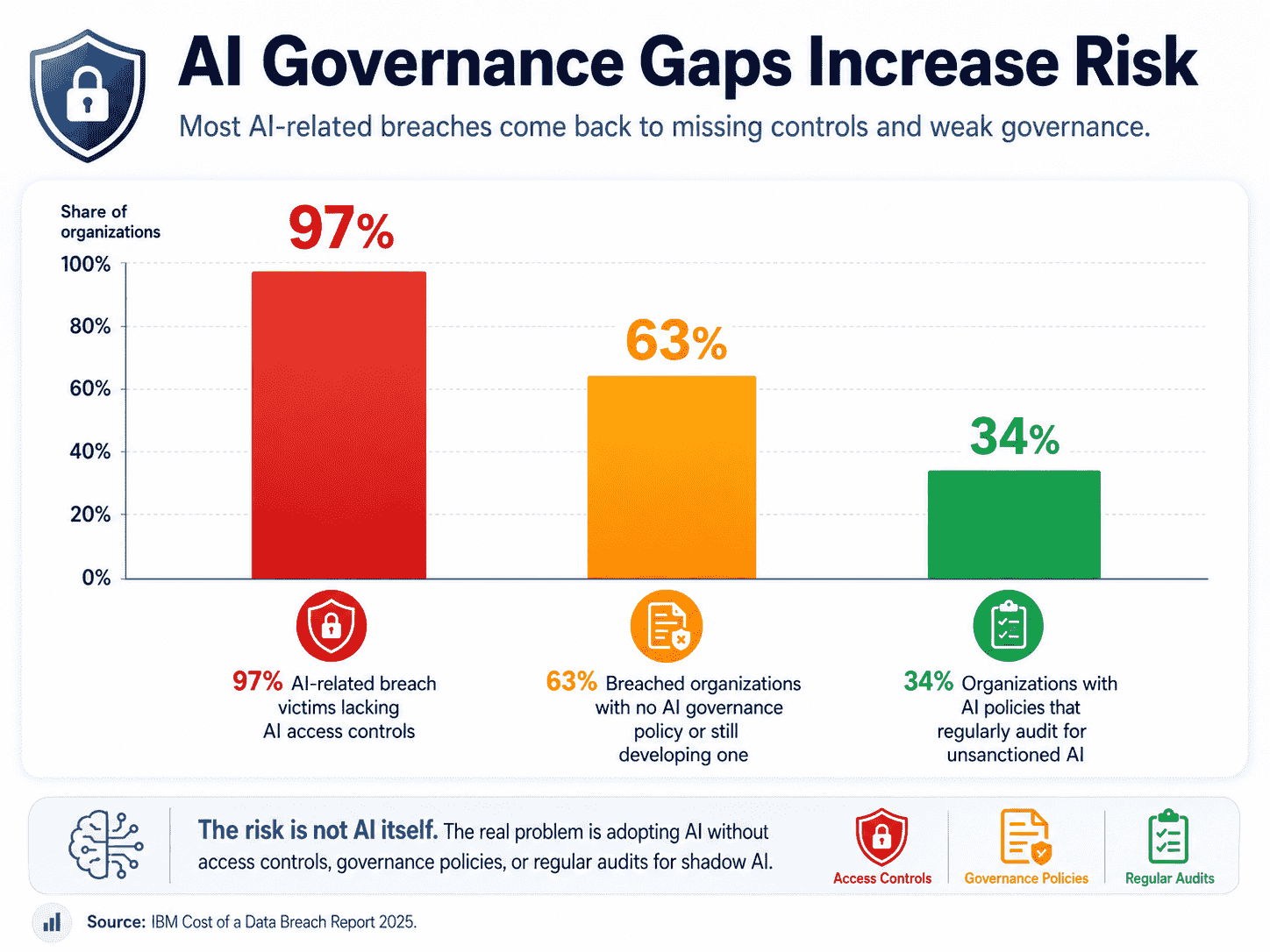
Do you need a formal AI governance framework?
None of this has to be invented from scratch. Established frameworks like the NIST AI Risk Management Framework and ISO 27001 already lay out how to classify data, assign accountability, and monitor systems across their lifecycle. Mapping your AI use to one of them turns a vague worry into an auditable process, backed by documented security practices — the kind regulators and enterprise customers increasingly expect to see.
The organizations pulling ahead aren't the ones that banned AI, and they aren't the ones that let it run wild. They're the ones that made adoption intentional: right channel, clear policy, tight access, real monitoring. That's what separates a competitive advantage from a $670,000 lesson.
If you want a hand getting there, that's the work the team at OpenSource Technologies (OST) does every day, from AI consulting and implementation through software security and secure, production-ready builds. That might mean standing up a private assistant that runs on infrastructure you own, wiring permission-aware access into the systems your team already uses, or putting a governance setup in place that holds up when an auditor comes knocking.
We handle the security review, the integration work, and the deployment, so you get the productivity without handing your data to a tool you can't see into. Wherever you're starting from, the aim is the same: AI that moves the business forward and keeps your data exactly where it belongs.
AI should make your business faster. With the right controls, it can do that without ever costing you control of your data.