
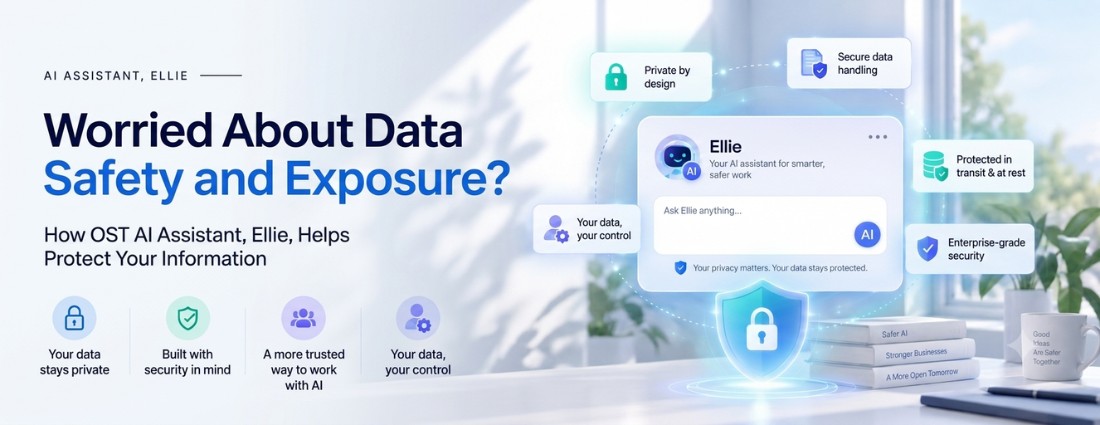
AI Assistants become far more useful when they can connect to the systems businesses already use—CRMs, ecommerce platforms, internal databases, scheduling systems, customer portals, and knowledge bases.
But greater access should not mean greater exposure.
At OpenSource Technologies (OST), we designed Ellie, an AI Assistant, around a simple principle: the AI should receive only the information it genuinely needs to complete the task. Just because a CRM, database, or business application contains sensitive information does not mean Ellie needs access to all of it.
The better question is: What is the minimum information Ellie needs to complete this specific task?
Personally identifiable information, or PII, can include obvious identifiers such as Social Security numbers, but it can also include financial, medical, employment, education, biometric, and other information that can identify or be linked to a person.
Our approach is to reduce unnecessary data exposure from the beginning: start with no access, then intentionally provide only the information required for the approved workflow.
How this works can look different across industries.
Ecommerce: Keep Payment Data Out of the Conversation
An ecommerce AI Assistant may need to help customers check an order, understand a refund, confirm shipment status, or find the right product. That does not mean it needs access to full payment information.
For example, Ellie may need to know:
Payment status: Successful or Refund status: Pending
It does not need to see the customer's full credit-card number, PIN, CVV, or other sensitive authentication information. The payment system should complete the secure transaction. Ellie should receive only the result required to continue helping the customer.
The same principle applies to ecommerce customer profiles. If someone asks: “When will my order arrive?” Ellie needs an order number, shipping status, and expected delivery date.
It does not need the customer's complete profile, payment history, every previous purchase, or other unrelated personal information.
For ecommerce implementations, we recommend giving Ellie transaction results and relevant order details—not payment credentials or unnecessary customer data.
Healthcare: Limit the Patient Information Ellie Can Access
Healthcare organizations often manage some of the most sensitive information in their systems. Patient records may contain medical conditions, medications, diagnoses, insurance information, treatment history, payment information, and personal identifiers.
A public-facing AI Assistant does not need access to most of that information.
If a patient asks: “What time is my appointment?”
Ellie only needs: Appointment: Cardiology, 2:30 PM
It does not automatically need the patient's complete medical chart. Questions about office locations, visiting hours, insurance policies, appointment preparation, or available services may be answered entirely from approved knowledge sources without accessing individual medical records at all.
At OST, we recommend separating clinical systems from conversational systems wherever practical. If an authorized healthcare system can perform the sensitive action and return a limited result, Ellie can use that result instead of accessing the complete underlying record.
Instead of: Full patient record
Give Ellie: Appointment confirmed
The objective is simple: help the patient without unnecessarily exposing additional medical information.
Education: Protect Student and Family Information
Schools, colleges, universities, and education platforms manage a wide range of personal information. This may include student records, grades, disciplinary information, financial-aid information, parent details, addresses, dates of birth, and other education records.
Ellie can help students and families find information about admissions, enrollment, programs, schedules, policies, campus services, events, deadlines, and academic resources.
Most of these questions do not require access to a student's entire record.
If a student asks: “Has my enrollment application been received?”
Ellie only needs: Application status: Received
There is no reason to expose financial records, grades, disciplinary history, or unrelated student information just to answer that question.
For education implementations, we recommend defining exactly what information is needed for each workflow and keeping everything else outside the AI conversation.
The goal is for Ellie to receive the answer needed for the task—not unrestricted access to the student's file.
Government & Civic Services: Reduce Exposure of Identity Data
Government and civic organizations often manage sensitive information related to identity, benefits, permits, applications, taxation, licensing, and public services.
A resident might ask: “Has my application been approved?”
Ellie does not need access to every document submitted with that application.
A connected government system can return: Application status: Approved
Similarly, if eligibility is determined by another system, Ellie only needs: Eligible or Additional review required
Rather than receiving an applicant's Social Security number, passport information, driver's-license details, or complete application file, we recommend designing civic AI workflows around status, eligibility, routing, and next-step information.
This helps organizations make AI useful while keeping sensitive information in the systems where it belongs.
Nonprofit & Community Organizations: Protect Donor and Participant Data
Nonprofits may not always think of themselves as data-heavy organizations, but many maintain sensitive information about donors, volunteers, members, program participants, and the communities they serve.
A donor database may contain contact details, contribution history, payment information, household information, preferences, or internal notes.
Community organizations may also manage information about people seeking food assistance, housing support, senior services, financial assistance, or other programs.
If someone asks: “When is the next volunteer orientation?” Ellie does not need access to the organization's complete constituent database.
If a donor asks: “Did you receive my contribution?” the connected system simply returns: Donation received: Yes
We recommend separating public program information from private constituent information so Ellie can help people discover services, volunteer opportunities, events, campaigns, and donation options without exposing data that is not necessary for the conversation.
Employee & HR Systems: Do Not Open the Entire Employee Record
Internal AI Assistants can help employees quickly find policies, benefit information, leave balances, onboarding materials, and internal procedures. But HR systems usually contain far more information than the AI needs.
Suppose an employee asks: “How many vacation days do I have left?”
Ellie only needs: Employee ID + Available Leave Balance
It does not need salary details, banking information, Social Security numbers, medical-benefit claims, disciplinary records, emergency contacts, or performance reviews.
One important part of reducing data exposure is avoiding broad application-level access when only a few specific fields are required.
We recommend working at the field level wherever possible. Give Ellie what it needs to answer the approved question—and nothing more.
Technology & Internal Systems: Keep Credentials Out of AI Conversations
Some information should never be passed to an AI Assistant.
- Passwords
- Database credentials
- Private encryption keys
- MFA recovery codes
- API secrets
- Authentication tokens
- OAuth client secrets
These are not ordinary business records. They are credentials that can provide access to other systems.
Even when employees use Ellie for technical assistance, logs, configuration files, screenshots, and code should be reviewed before they are submitted.
Do not send:
STRIPE_SECRET_KEY=sk_live_...
Send instead:
The payment API is returning HTTP 401 during authentication.
Ellie can still help explain the problem without ever receiving the credential itself.
Give Ellie the Result, Not the Raw Data
Across industries, one of the most practical ways to reduce unnecessary data exposure is to let the underlying business system perform the sensitive operation.
Ellie can then receive only the result required to continue the conversation.
| Business Need | Avoid Giving Ellie | Give Ellie Instead |
|---|---|---|
| Verify identity | SSN or passport | Verified / Not Verified |
| Confirm payment | Full card information | Paid / Failed / Pending |
| Track an order | Complete customer profile | Shipping status + ETA |
| Check eligibility | Full application file | Eligible / Review Required |
| Check vacation | Full HR record | Available leave balance |
| Confirm appointment | Full medical record | Date, time & department |
| Find local service | Detailed location history | ZIP code or service area |
This approach allows Ellie to remain useful without turning the AI layer into a collection point for unnecessary sensitive information.
What If Someone Types Sensitive Information Directly Into Ellie?
Restricting system access solves only part of the problem. Visitors may voluntarily type sensitive information into a conversation, even when Ellie never requested it.
Someone might enter a Social Security number, credit-card number, medical-record number, password, or other confidential information.
That is why we design AI Assistant implementations with this possibility in mind.
Sensitive-data detection — Identify common sensitive-data patterns before further processing.
Redaction — Replace detected values with placeholders.
123-45-6789
can become:
[SSN REDACTED]
User guidance — Tell visitors when certain information should not be entered into chat.
Logging controls — Reduce the possibility of sensitive values appearing unnecessarily in conversation transcripts, analytics, or debugging information.
Secure handoff — Move workflows requiring sensitive information to an approved portal, form, system, or human representative.
Data safety therefore needs to address both directions of information flow: what your systems provide to Ellie and what users provide during conversations.
Our Data-Safety Checklist Before Connecting Ellie to a Business System
- Does Ellie actually need this information to complete the task?
- Can the source system perform the sensitive action and return only the result?
- Can a personal identifier be replaced with an internal ID or token?
- Can the information be reduced—for example, ZIP code instead of a full address?
- Could sensitive information accidentally appear in the AI response?
- Could the information appear in transcripts, logs, or analytics?
- Can sensitive information entered by users be detected or redacted?
- Is there a clear business reason for every sensitive field Ellie receives?
If the answer to the last question is no, that data should generally remain outside the AI workflow.
Data Safety Starts With a Smaller Data Map
When businesses start discussing AI integration, the first question is often: “Which systems can Ellie connect to?”
We prefer to start with: “What exact information does Ellie need from each system?”
That small change in thinking can significantly reduce unnecessary exposure.
Instead of connecting an entire CRM, we can expose selected fields. Instead of giving Ellie a complete healthcare record, we can return an appointment status. Instead of passing payment credentials, we can return a payment result.
Instead of opening an entire employee database, we can expose only the information required for an approved HR workflow.
The purpose is not to make Ellie less useful. It is to give our AI Assistant enough information to perform its role without giving it unnecessary access to sensitive information.
How OST AI Assistant Ellie Helps Reduce Unnecessary Data Exposure
Data safety cannot be achieved with one feature alone. It depends on how the AI Assistant, integrations, permissions, knowledge sources, logs, and surrounding business systems are designed to work together.
At OST, we configure Ellie around your organization's approved data, business rules, workflows, and security requirements.
Depending on the engagement, this can include:
- Limiting which systems and fields Ellie can access
- Keeping sensitive transactions inside the appropriate business system
- Using approved knowledge sources instead of unrestricted information
- Applying role-based access controls
- Redacting or reducing sensitive information where appropriate
- Controlling what information appears in conversations and logs
- Routing sensitive workflows to secure systems or human teams
- Maintaining traceability around AI conversations and responses
Whether Ellie supports ecommerce customers, healthcare patients, students and families, government residents, nonprofit communities, employees, or B2B users, our approach remains the same:
Give the AI access to what it needs—not everything your organization knows.
No AI system can promise that a data breach will never happen. But thoughtful architecture, limited access, controlled integrations, and data minimization can significantly reduce unnecessary exposure.
That is the approach behind OST AI Assistant Ellie: make AI useful while keeping control of your business information where it belongs.