
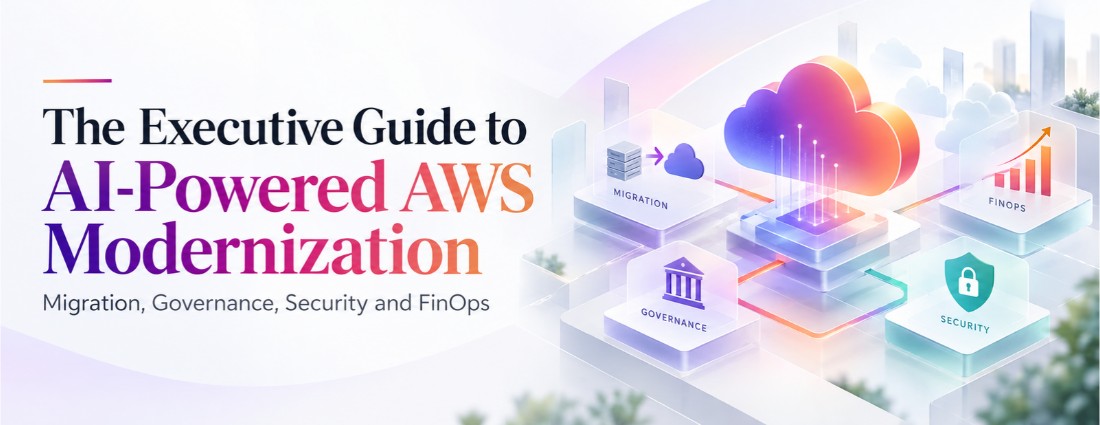
Moving workloads to AWS is no longer the hardest part of cloud modernization. The harder challenge is building an operating model that can make good decisions at cloud speed. AI-powered AWS modernization uses AI to help teams assess, plan, improve, and operate AWS systems while keeping governance, security, and cost controls in place.
AI can speed up discovery, analyze large codebases, uncover dependencies, draft documentation, and flag unusual spending. It can also produce incomplete recommendations, expose weaknesses in access controls, and accelerate the wrong migration plan. The executive question is not simply, “Where can we add AI?” It is:
“Where can AI reduce uncertainty, which decisions must remain with people, and what evidence is required before the organization moves forward?”
That question connects four areas that are often managed separately: migration, governance, security, and FinOps. Managing them as one program helps leaders move faster without creating unnecessary risk.
Executive Summary
An effective AI-powered AWS modernization program should:
- Start with measurable business outcomes, service-level expectations, data boundaries, and cost baselines—not a list of AWS services.
- Use AI to speed up analysis and repeatable engineering work, while keeping architecture, access, exceptions, and production changes under accountable human control.
- Establish the AWS governance foundation before migration volume increases.
- Treat AI agents like controlled operators, with a clear identity, limited permissions, approved tools, and defined data access.
- Measure the cost of a successful business outcome, not only the AWS bill or the price of model tokens.
- Release investment in stages as evidence improves.
OpenSource Technologies (OST) helps organizations connect these areas in one practical roadmap. Its teams bring together AWS migration, application modernization, DevOps, software security, and AI implementation so strategy and execution do not become separate projects.
Modernization Is an Operating-Model Decision
A hosting move changes where an application runs. Modernization changes how the organization builds, governs, secures, funds, and improves that application. This distinction matters because a technically successful migration can still disappoint the business. An application may reach AWS on schedule but remain expensive to update, difficult to monitor, or dependent on manual processes. An AI feature may work in a demo but lack a clear audit trail, a reliable backup process, or an acceptable cost per transaction.
Executives should define success before teams select services or migration approaches. For each workload, answer five questions:
- Business capability: What customer, employee, or operational outcome must improve?
- Service commitment: What availability, latency, recovery, and support expectations apply?
- Risk tolerance: Which failures are recoverable, and which are unacceptable?
- Data boundary: What data may be used, retained, transferred, or exposed to a model?
- Cost per outcome: What is an acceptable cost per order, case, user, document, or successful AI task?
These inputs guide architecture and investment decisions. They also stop a program from treating technical activity as proof of business progress.
Where AI Changes the Modernization Equation
AWS describes AWS Transform as an agentic AI service that can speed up modernization work, including assessment, planning, documentation, and transformation. This illustrates the broader opportunity: AI can help teams review evidence and make informed decisions faster.
It should not eliminate accountable review. A useful division of responsibility is:
| Modernization activity | AI can assist | A person must approve |
|---|---|---|
| Application discovery | Summarize inventory, group patterns, and flag missing information | Whether the inventory is complete enough for planning |
| Dependency analysis | Suggest relationships from monitoring data, configuration, and code | Criticality, business ownership, and acceptable downtime |
| Migration planning | Compare options, draft migration waves, and identify blockers | Target architecture, sequencing, and production cutover |
| Code modernization | Explain legacy code, suggest changes, and generate tests | Design intent, code quality, security, and release readiness |
| Cloud governance | Detect drift and recommend remediation | Policies, exceptions, and enforcement scope |
| Security operations | Correlate signals and prioritize investigations | Risk acceptance, containment, and destructive actions |
| FinOps | Detect anomalies, forecast trends, and suggest optimizations | Commitments, service tradeoffs, and budget changes |
The principle is simple: AI may prepare evidence and propose actions. Accountable owners decide when those actions affect production, permissions, regulated data, customer commitments, or major financial commitments.
A real engagement illustrates why this distinction matters. We found a video transcoding pipeline that had been dead for 14 months while monitoring still reported it as healthy. AWS had deprecated the underlying service, and the function calling it failed silently. The pipeline generated thumbnails before the transcoding step, so monitoring saw a successful thumbnail and reported success. The development team had been manually transcoding the occasional broken video without realizing the automated pipeline had stopped working entirely.
We ultimately backfilled 65 videos on the replacement service for about $0.50. The lesson is important: no amount of AI analysis based only on the available system signals would necessarily have identified the problem, because the monitored components were behaving exactly as designed. Teams still need people who can challenge whether a technically “healthy” system is actually completing the intended business outcome.
Migration: Use AI to Reduce Uncertainty, Not Bypass It
Migration delays rarely come from a single technical obstacle. They come from incomplete inventories, undocumented dependencies, unclear ownership, and decisions based on outdated information. AI can help teams review a large technology environment faster. It can summarize application portfolios, identify recurring code patterns, suggest possible dependencies, draft test cases, and keep technical documentation current. During execution, it can compare actual system behavior with expected results and direct engineers to issues that need attention.
The quality of the result still depends on the information available. Logs may not reveal an integration that runs only at month-end. Code analysis may miss a manual business process. A recommended architecture may be technically valid but unable to meet an agreed recovery requirement.
On one migration, two deployments of the same application sat side by side on a server, each containing a controller with the same name. The framework silently skipped registering the duplicate route.
There was no error, no warning, and nothing useful in the logs. The dashboard simply redirected to an error page after login, and it took hours to trace because every normal diagnostic looked clean. This is an important limitation of AI-assisted discovery: when the evidence itself is absent, incomplete, or misleading, analyzing that evidence faster does not automatically produce the right answer.
For that reason, every AI-generated migration recommendation should carry five pieces of context:
- The evidence used
- The confidence level and known gaps
- The accountable workload owner
- The validation required before execution
- The actual usage frequency of low-volume or infrequently executed functionality
Low-volume systems deserve particular attention. On the same engagement, a failure went unnoticed for 30 days because the feature was used roughly twice a month. Teams cannot safely assume that something “worked yesterday” when the functionality may not actually have executed for weeks or months.
OST's AWS migration and application modernization services help teams turn discovery findings into workload-specific plans. We coordinate application, data, integration, and operational requirements so the move to AWS supports the business—not just the infrastructure. Executive leaders still define the evidence required and who has authority to approve each decision.
Governance: Create a Foundation That Enables Scale
Governance is sometimes treated as an approval function added after teams begin moving workloads. At scale, that approach creates two bad outcomes: slow manual reviews and inconsistent exceptions.
A better governance foundation gives teams an approved path by default. AWS Control Tower supports a governed, multi-account environment through a landing zone, account structure, and controls. Its role is more than technical housekeeping. It gives leaders a consistent way to set organizational boundaries and confirm that those boundaries are working.
Before increasing migration volume, leadership should expect the following to be defined:
- AWS account and organizational structure based on workload sensitivity and ownership
- Central identity, privileged-access controls, and separation of duties
- Workload and data classification rules
- Policy enforcement and a time-bound exception process
- Approved deployment paths using infrastructure as code
- Central logging, configuration visibility, and named operational owners
- Required tags and other information for assigning costs
This is the difference between governance as a queue and governance built into daily operations. Teams can move quickly inside known boundaries, while unusual changes receive deliberate review.
Through its DevOps and cloud consulting services, OST can turn governance requirements into reusable infrastructure, automated deployment workflows, access controls, monitoring, and operating practices instead of relying on memory and manual checks.
Security: Treat AI Like a Controlled Operator
AWS operates under a shared responsibility model: AWS protects the underlying cloud infrastructure, while customers remain responsible for how they configure and use AWS services. AI does not change that model. An AI agent becomes an operator when it receives access to business data, tools, and APIs.
Executives should therefore ask the same questions of an AI agent that they would ask of a privileged employee or service account:
- Which identity does it use?
- Which data can it read, and how long can that data be retained?
- Which tools and APIs can it call?
- What is the maximum impact of a wrong action?
- Which actions require confirmation?
- Can every important action be traced and reversed?
At OpenSource Technologies (OST), we classify actions by their blast radius.
Local and reversible changes can proceed more freely. Changes to shared state—such as firewall rules, access policies, or DNS—are confirmed first. Irreversible actions, such as deleting storage or writing to a production database, require explicit sign-off and a documented rollback or recovery approach.
Before deleting 11 orphaned storage volumes on one engagement, we documented an audit trail confirming that each volume was left over from an earlier migration, reviewed metrics showing zero activity, and created safety snapshots. Only then did we proceed with deletion.
The cost of pausing to confirm is seconds. The cost of an unwanted deletion can be hours or worse.
Credential management provides another practical lesson: rotating a credential is usually the easy part; identifying every place where that credential was used is the real work. After a rotation, teams should search the full deployment environment rather than assuming the credential existed only in the most obvious configuration files.
For generative AI workloads, Amazon Bedrock Guardrails can apply configurable safeguards, including content and sensitive-information controls. Guardrails should be treated as a tested safety layer, not a guarantee.
For new agentic systems, Amazon Bedrock AgentCore provides managed capabilities for identity, policy, and monitoring. AgentCore Policy, for example, can apply fixed, testable access rules before a tool is used.
AWS CloudTrail and model activity logs can help teams trace what happened. However, logging must follow data-minimization and retention rules. Recording every prompt and response without clear limits may create a new store of sensitive information.
The safest pattern is limited, controlled authority. Give an AI system only the data, permissions, and tools required for a defined task. Separate recommendations from execution. Require explicit approval for production changes, higher access privileges, deletion, large purchases, regulated-data movement, and security exceptions. Design fallback and rollback procedures before giving the system more authority.
OST connects identity, application security, and incident readiness with production controls for AI workloads. Its engineers can help define permissions, approval steps, audit trails, fallback behavior, and incident procedures before an AI system receives wider access.
FinOps: Make Economics Part of the Architecture
FinOps is the operating practice that gives engineering, finance, and business teams shared accountability for cloud value.
Cloud cost reflects technical decisions. In an AI-enabled system, one business transaction can use computing power, storage, data transfer, information retrieval, model processing, and external tools.
Traditional totals remain important, but they do not tell leadership whether the platform is becoming more efficient. A better question is: What does it cost to produce one successful outcome at the required quality and service level?
Depending on the workload, the unit might be a completed customer request, a processed document, a resolved support case, or an approved code change. A useful unit-cost view is:
This metric reveals tradeoffs that a monthly bill cannot. A lower-cost model that requires more retries may cost more overall. A more expensive design may be justified if it significantly reduces failures, review time, or customer abandonment.
FinOps also needs to account for the cost of not modernizing.
On one engagement, remaining on an end-of-life database version carried an extended-support penalty of more than $10,000 per year. In that case, the cost of continuing to defer the upgrade exceeded the cost of doing the work.
Other waste can remain hidden because it initially looks like a saving. On another review, 23 instances had been stopped—some since 2023—but their attached storage was still generating charges. We also identified 11 orphaned storage volumes left from a platform migration completed years earlier.
Neither appeared immediately problematic because a stopped instance looks like a cost-saving action. Together, however, the unused resources accounted for several hundred dollars per month that had no active owner.
Some modernization changes produce an even simpler result: better performance at lower cost. Moving storage volumes to a newer generation gave the workload greater performance while also reducing its storage cost—a useful reminder that optimization does not always require a tradeoff.
AWS Cost Explorer, AWS Budgets, Cost Anomaly Detection, and Cost Optimization Hub can provide visibility, thresholds, anomaly signals, and prioritized recommendations.
They do not remove the need for judgment. Anomaly detection depends on billing data that may lag, budgets are alerts rather than hard real-time spending caps, and optimization estimates must be checked against workload demand. These tools become more valuable when every cost has an owner and alerts lead to a defined response.
At minimum, leaders should require:
- Cost allocation by product, environment, and accountable owner
- Budgets and anomaly thresholds tied to action playbooks
- Forecasts that include migration overlap and AI demand variability
- Separate visibility for model processing, data retrieval, storage, and tool usage
- Unit-cost and business-value trends reviewed together
- Purchase commitments approved against credible demand, not optimism
Detailed techniques for reducing model and API spend belong in a dedicated AI inference and API cost optimization plan. OST can combine cost data with engineering context to help leaders decide which architecture, capacity, and AI usage changes will improve efficiency without weakening reliability or customer experience.
A Five-Gate Modernization Model
A fixed multiyear plan becomes unreliable as application information, AI capabilities, and business priorities change. Stage-by-stage checkpoints allow leaders to approve more investment as the evidence becomes stronger.
| Gate | Evidence required | Accountable decision owner | Release condition |
|---|---|---|---|
| 1. Baseline | Business KPI, service levels, architecture inventory, risk, and current unit cost | Business sponsor and technology owner | A measurable problem and named owners exist |
| 2. Controlled pilot | Representative workload, data boundary, target design, test plan, and budget | Architecture, security, and finance leads | The pilot can run inside approved limits |
| 3. Migration wave | Validated dependencies, operational readiness, recovery evidence, and cutover authority | Workload owner | Risk is understood and recovery is proven |
| 4. Production AI | Quality evaluation, access scope, action limits, monitoring, fallback, and incident plan | Product owner and CISO delegate | AI behavior is measurable, controlled, and ready for production |
| 5. Scale | Outcome improvement, policy coverage, reliability trend, and cost per outcome | Executive sponsor | Benefits are repeatable and controls operate without exceptional effort |
These gates can add elapsed time, and that is sometimes exactly what should happen.
Technical work that takes two hours may wait two weeks for approval, particularly when the proposed action is irreversible. That is the control process working rather than failing.
In our experience, the issues that genuinely make migrations difficult are undocumented dependencies, jobs that execute only at month-end, end-of-life package repositories that have disappeared, and the time required to verify data properly.
A single application modernization can sometimes be completed in days. A data-heavy migration that requires a parallel verification period may run two to six weeks.
On one engagement, we kept the old and new environments operating side by side for about a month before retiring the original environment. That approach was slower, but the additional verification is also why the final cutover was clean.
A “no” at a checkpoint is useful information, not a program failure. It prevents the organization from expanding an unresolved risk or a design that does not provide enough value.
The Executive Scorecard
The steering group should receive a small number of decision-ready measures, not a dashboard of cloud activity. A balanced scorecard can include:
- Business: Cycle time, conversion, case resolution, or another workload-specific outcome
- Delivery: Lead time, change failure rate, and migration forecast confidence
- Reliability: Whether systems meet agreed performance and availability targets, recovery-test results, and operational workload
- Governance: Workloads within policy, open exceptions, and exception age
- Security: Privileged exposure, unresolved critical findings, and time to contain
- AI quality: Successful-task rate, human override rate, and unsafe-output rate
- Economics: Forecast variance and cost per successful outcome
Review these measures together. Cost reduction that degrades reliability is not optimization. Faster releases with rising security exceptions are not modernization. Higher AI accuracy may not create value if human review time and per-task cost also rise.
A Practical First 90 Days
Leaders do not need to solve the entire estate before learning. They need one representative workload, clear decision owners, and a controlled way to test the model.
Days 1–30: Establish the Baseline
Select a workload important enough to matter but contained enough to govern. Document the business outcome, service expectations, dependencies, data sensitivity, current cost, and named owners. Identify where the evidence is incomplete.
Days 31–60: Build and Exercise the Controls
Establish the target account boundary, identity model, deployment process, monitoring data, cost allocation, and AI permissions. Use AI for analysis and engineering assistance, but record the information it used, its recommendations, and the human approvals. Test failure, recovery, and escalation paths.
Days 61–90: Decide Whether to Scale
Compare the pilot with its baseline. Assess business improvement, reliability, security exceptions, operational effort, and cost per outcome. Expand only the patterns that produced repeatable results; revise or stop the rest.
The goal of the first 90 days is not the largest possible migration count. It is a trustworthy modernization system that can support the next ten workloads without reinventing governance each time.
The Leadership Questions That Matter
Before approving a broader program, executives should be able to answer:
- Which business outcome will improve, and how will we measure it?
- What evidence is AI allowed to use, and where are the gaps?
- Which decisions may AI recommend, and which actions always require human approval?
- Are identity, logging, policy, and recovery controls operating before scale begins?
- Can we connect spend to an owner and a successful business outcome?
- What evidence would cause us to pause, redesign, or stop?
AI-powered AWS modernization is not about handing the cloud environment to autonomous agents. It is about making useful information available sooner, giving teams safe ways to act, and keeping people accountable for important decisions.
Organizations that connect migration, governance, security, and FinOps from the beginning can build a more adaptable business system without obscuring risk or economics.
OpenSource Technologies can assess your application portfolio, identify practical modernization priorities, and help implement the AWS, DevOps, security, and AI controls needed to scale with confidence.
Ready to build a controlled AWS modernization roadmap?