
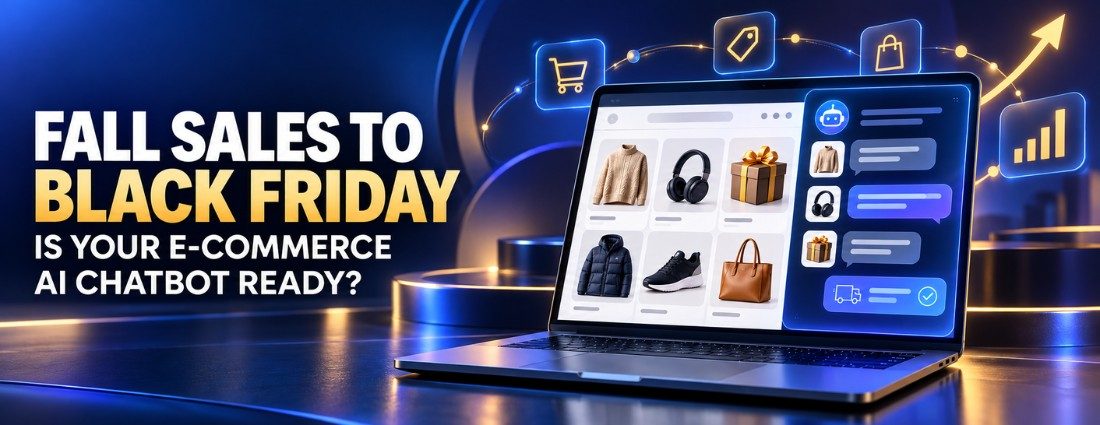
Fall is when holiday shopping plans turn into real buying decisions. Customers compare products online, watch prices, check delivery dates, and build gift lists before Black Friday. For e-commerce leaders, that creates a window to make product discovery and customer support easier before traffic reaches its peak.
Adobe reported that U.S. consumers spent a record $257.8 billion online during the 2025 holiday season, up 6.8% from the previous year. Black Friday generated $11.8 billion, while Cyber Monday reached $14.25 billion. During Cyber Monday’s busiest two hours, shoppers spent $16 million every minute.
For online retailers, the real challenge is not simply attracting holiday traffic—it is helping high-intent shoppers find accurate answers about products, promotions, availability, delivery, and returns before they abandon the purchase or choose a competitor.
Holiday Shopping Starts Before Black Friday
Black Friday is no longer the beginning of the holiday season. Fall promotions, early-access events, and inventory encourage shoppers to research sooner and return before purchasing.
The National Retail Federation found that a record 202.9 million U.S. consumers shopped from Thanksgiving through Cyber Monday in 2025. Online participation reached 134.9 million shoppers, up 9% year over year. By Thanksgiving weekend, 84% had already started shopping—yet 53% of their holiday purchases still remained.
That decision period creates repeated questions: Which product is the better fit? Is my size available? Does this discount apply? Will the order arrive before Christmas? What happens if the gift needs to be returned?
A conventional search bar or static FAQ makes customers find the answer themselves. A well-built e-commerce AI chatbot can understand a question naturally, use approved store information, recommend relevant options, and guide the shopper toward the next step.
AI Is Becoming Part of Product Discovery
Customers are already using AI to research purchases. Adobe measured a 693.4% year-over-year increase in traffic from generative AI tools to U.S. retail websites during the 2025 holiday season.
Salesforce now predicts that 20% of 2026 holiday e-commerce traffic will originate from AI chat agents and that one in three e-commerce sites will offer a site-specific AI personal shopper by Cyber Week.
These numbers do not mean every retailer should install a chatbot. They show that conversational shopping is moving into the customer journey. Your website assistant must offer something a public AI tool cannot: accurate answers based on your current catalog, prices, inventory, promotions, shipping rules, and return policies.
What Your Chatbot Must Handle Before Peak Season
1. Product Discovery and Comparison
Holiday shoppers often know the recipient but not the product. They may ask for “a gift for a beginner runner under $100” or want to compare two similar items. The chatbot should understand intent, apply useful filters, explain differences clearly, and suggest in-stock alternatives without overwhelming the customer.
2. Live Prices, Promotions, and Inventory
Peak-season information changes quickly. An assistant that relies on an old spreadsheet or outdated page may quote the wrong price or recommend an unavailable item. Connect it to the approved catalog and commerce systems so it can use current data. Define exactly how it should explain discount rules, exclusions, coupon stacking, and limited-time offers.
3. Shipping, Returns, and Order Support
Delivery confidence can decide whether a shopper completes an order. Your chatbot should explain shipping options, cutoff dates, pickup availability, returns, exchanges, and gift receipts. If it can access order information, give it only the minimum customer data required and keep payment credentials outside the conversation.
4. Mobile Conversations
Adobe found that smartphones produced 56.4% of online holiday sales in 2025. A chatbot that covers the product page, uses small buttons, or forces long replies can create more friction than it removes. Test it on phones, with short messages, slower connections, screen readers, and common checkout paths.
5. Human Handoff
AI should not improvise when the answer is uncertain or the customer needs an exception. Set confidence limits and escalation rules. Send billing disputes, unusual returns, high-value purchases, complaints, and sensitive requests to a person with the conversation context attached.
Prepare for Traffic, Not Just Conversations
A successful demo does not prove holiday readiness. Load-test the chatbot and every system it depends on, including product search, inventory, CRM, order tracking, and help-desk integrations. Set limits for response time, retries, tool calls, and model spending. Create fallback messages for unavailable services and make sure shoppers can still reach essential pages or human support.
Before launch, build a test set from customer questions. Include misspellings, vague gift requests, expired promotions, out-of-stock products, conflicting policy questions, and delivery deadlines. Our guide on testing an e-commerce AI chatbot provides a starting point.
Measure Business Results, Not Chatbot Activity
Conversation volume alone does not show value. Leadership should monitor assisted conversion rate, revenue influenced, product clicks, add-to-cart actions, checkout completion, support resolution, human handoffs, response time, abandonment, and cost per resolved conversation.
Compare performance by campaign, device, product category, and question type. These findings can also reveal unclear product descriptions, missing size guidance, confusing promotions, or policies that create avoidable support demand. Use the OST AI Assistant ROI Calculator to estimate the business case using your own traffic, conversion, and support data.
Make the Decision Before the Rush
Waiting until Black Friday week leaves little time to connect systems, organize content, test answers, train employees, or fix weak handoffs. Fall is the time to select a focused use case, define success measures, and pilot the experience with real shoppers.
OpenSource Technologies builds AI assistants and e-commerce platforms around the systems retailers use. Ellie, the OST AI Assistant, can support product discovery, multilingual questions, current catalog information, shipping and return guidance, human escalation, and performance reporting.
Your holiday chatbot does not need to answer everything. It needs to answer the questions that influence purchases, use information customers can trust, and know when a person should take over.
Contact us now to prepare your e-commerce experience before fall traffic becomes the Black Friday rush.