
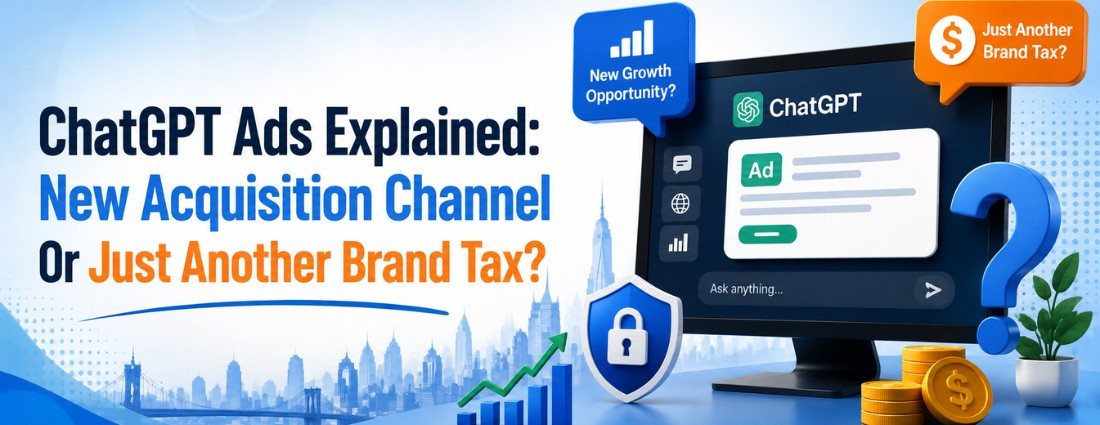
For two years, the pitch for AI chatbots was simple: they work for you, not for an advertiser. That pitch changed in February 2026, when OpenAI started placing sponsored results inside ChatGPT. Almost overnight, the tool hundreds of millions of people use to plan trips, compare products, and troubleshoot problems became advertising real estate.
If generative AI is the future of how people search, shop, and decide, then advertising inside it was probably inevitable — but "inevitable" and "worth your budget" are not the same thing.
For marketers, that raises an uncomfortable question. Is ChatGPT a genuinely new acquisition channel — a place to reach high-intent buyers before they ever touch Google — or is it shaping up to be another brand tax: budget you spend just to be present on the buzzy new platform, without a measurable return? Below is what the data actually says.
What "brand tax" means, and why ChatGPT ads invite the label
In marketing, a brand tax is money you spend to stay visible on a channel — often because competitors are there, or because it's the shiny new thing — without a clear, provable payoff. It's the cost of FOMO dressed up as a strategy.
New channels almost always start out looking like a brand tax, because the measurement infrastructure lags the hype. The honest test isn't "is everyone talking about it?" It's "can I tie spend to incremental customers?" ChatGPT ads sit right on that line: enormous reach on one side, unproven economics on the other.
The audience is too big to wave away
Whatever you conclude about the ads, the scale behind them is real. Sam Altman said ChatGPT reached 800 million weekly active users in October 2025, and usage has kept climbing into 2026. Pew Research found that 34% of U.S. adults had used ChatGPT by mid-2025, roughly double the share from two years earlier. This is mainstream behavior, not an early-adopter niche.
There's also a clear reason OpenAI is doing this. The company crossed roughly $20 billion in annualized revenue in 2025, but AI development — bigger models and more computing power — is brutally expensive to sustain. Advertising is how OpenAI plans to make a free product that costs a fortune to operate and pay for itself.
How ChatGPT ads actually work right now
OpenAI has been unusually specific about the mechanics, and the details matter for anyone weighing a test.
Ads appear only for free logged-in adults and "Go" tier subscribers. Paid Plus, Pro, Business, Enterprise, and Education accounts see no ads at all.
The format is deliberately restrained. Ads show up below the end of an answer, clearly labeled as "sponsored" and visually separated from ChatGPT's response. There are currently no video units, banners, or rich media.
Targeting draws on the topic of your current chat plus general location and language. If personalization is enabled, targeting may also use past chats, memory, and prior ad interactions.
Crucially, OpenAI states that ads do not influence the answers ChatGPT gives you and that they run on separate systems from the chat model. The company also says it does not sell user data and shares only aggregated, non-identifying performance data with advertisers.
From $50K pilots to self-serve: The door just opened for everyone
The bigger news for marketers arrived on May 5, 2026, when OpenAI launched a self-serve ChatGPT Ads Manager.
During the pilot, ChatGPT ads were reportedly sold on a CPM basis with a $50,000 minimum spend. The self-serve platform changed the economics by moving to a cost-per-click model, eliminating the minimum spend, and adding pixel and Conversions API tracking.
This opens the channel to SMBs, startups, and independent brands for the first time. The catch is that it remains a U.S. beta, third-party measurement isn't live yet, and creative options remain limited.
The bull case: This really could be a new acquisition channel
Start with intent. People don't just search on ChatGPT — they deliberate with it. They describe budgets, constraints, and use cases in full sentences before deciding. Reaching a buyer mid-deliberation can be more valuable than a keyword match.
For any SEO company watching discovery migrate from ten blue links to a single AI answer, that shift is impossible to ignore.
The early money supports optimism. OpenAI's ad pilot reportedly generated $100 million in annual recurring revenue in under two months. A pay-per-click model means advertisers are not paying for empty impressions, while early participation could provide access to less competitive inventory.
The bear case: Why it may just be another brand tax
Now the other side — and it's substantial.
The revenue story is contested. eMarketer estimates OpenAI could miss its own forecast by about 90%, projecting under $1 billion in 2026 versus OpenAI's much larger expectations.
Then there's trust. eMarketer found that 63% of consumers say ads decrease their trust in AI outputs. That's the central tension of the whole model: the more OpenAI monetizes the answer, the more it may chip away at the reason people trusted the answer in the first place.
The practical problems are just as real for performance marketers. The format is minimal, targeting is coarse, and third-party measurement isn't available yet. The audience is also limited because some high-value prospects use ad-free paid tiers.
Other platforms, including Perplexity, Google, and Microsoft Copilot, are also introducing advertising into AI experiences. This could fragment AI advertising budgets rather than consolidate them.
New channel or brand tax? A practical way to decide
The answer isn't the same for every business — it depends on how you approach it. It's exactly the kind of judgment that good digital marketing services are for: matching a channel to a goal instead of chasing headlines.
Treat ChatGPT ads as a legitimate acquisition channel if you sell products with clear, describable intent, have conversion tracking properly configured, and can run a small, ring-fenced test measured on incremental cost per acquisition rather than vanity clicks.
You're probably paying a brand tax if the main reason for the buy is "a competitor is doing it" or "it's ChatGPT," you can't attribute conversions, or you're reallocating budget from proven channels based on hype.
The bottom line
ChatGPT ads aren't a gimmick, and they aren't going away. The scale, investor expectations, and OpenAI's cost structure all point to advertising becoming a durable part of the platform.
But "durable" isn't the same as "proven for you." Right now, this is a genuine new channel in its awkward, unmeasurable adolescence.
The smart play is neither to ignore it nor to pour budget in on hype. Run a small, well-instrumented test, measure it honestly against what already works, and let the numbers — not the FOMO — tell you whether ChatGPT is acquiring customers or simply collecting a tax.