
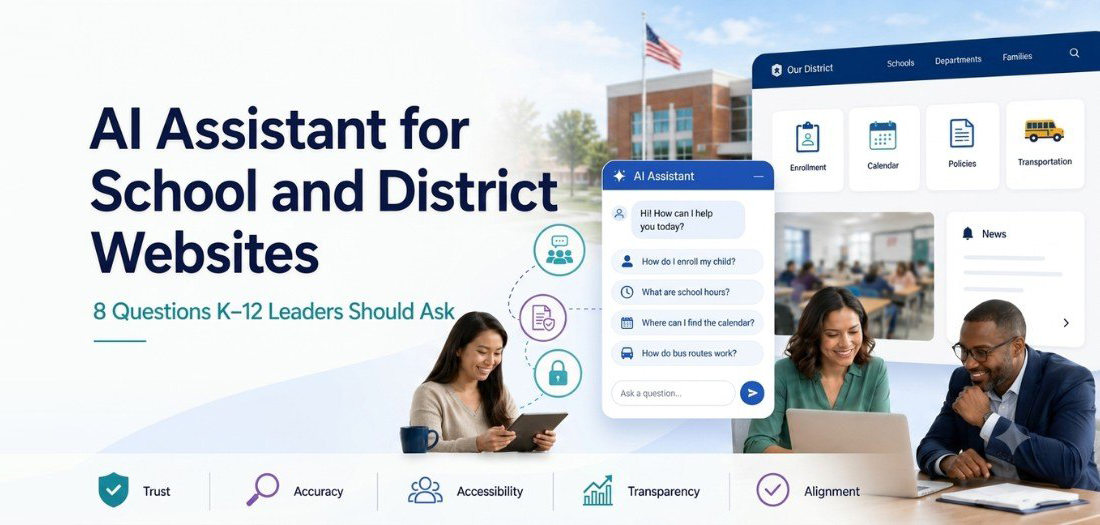
AI is becoming part of everyday technology decisions in K–12 schools. But putting an AI assistant on a school or district website should not begin with: “Which chatbot should we buy?”
A better question is: “What problem are we trying to solve, who will be responsible for the AI Chatbot, and how will we know whether it is helping our families and staff?”
Once parents, guardians, students, and community members begin relying on an AI assistant for answers, it becomes another communication channel for the school district. That means district leaders need to think beyond features. They need to consider content ownership, governance, procurement, accuracy, measurement, and what happens to the technology if the vendor relationship eventually ends.
Here are eight practical questions K–12 leaders should ask before choosing an AI assistant for their school or district website.
1. Are K–12 Schools Really Adopting AI, or Is It Hype?
AI is no longer a fringe topic for school districts.
CoSN's 2026 State of EdTech report surveyed more than 600 K–12 technology leaders across 44 states. Nearly 80% reported that their district had established AI guidelines, showing how quickly districts are moving from experimentation toward formal governance. The same research found that cybersecurity and data privacy remain the top priorities for district technology leaders.
That combination is important. School districts are not simply asking whether they can use AI. They are increasingly asking:
Can we use it responsibly? Can we control it? Does it solve a real school or district problem?
Can we explain the decision to parents, staff, administrators, and the school board?
The U.S. Department of Education has also emphasized responsible AI adoption and specifically highlighted the importance of involving parents and teachers when schools make decisions about new AI technologies. So the question is no longer whether AI will appear in K–12 environments. The more useful question is which applications deserve a permanent place in district operations.
2. What Problem Are You Actually Trying to Solve With an AI Chatbot?
Before scheduling product demos, write down the actual problems your school or district wants to solve.
For example:
- Parents repeatedly call about enrollment requirements.
- Families cannot find transportation or bus information.
- The district receives the same questions about school calendars and closings.
- Registration instructions are spread across several pages.
- Families do not know which department handles a particular request.
- Important information exists online but is difficult to locate.
- District staff cannot easily see which parts of the website confuse visitors.
None of these problems starts with: “We need artificial intelligence.”
AI is one possible solution. A stronger business case might be:
“We want to reduce repetitive enrollment questions and identify the website information families have the most difficulty finding.”
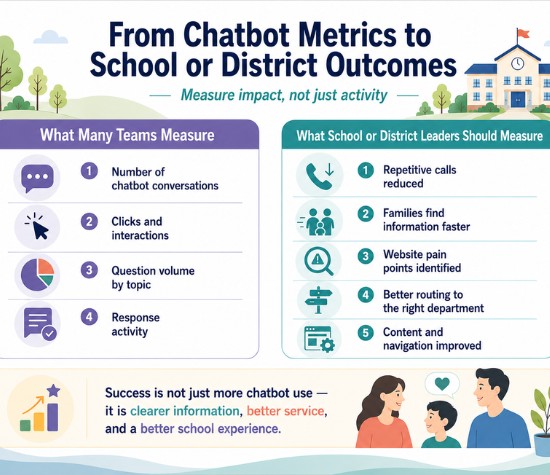
That gives the district or a school something measurable. Instead of measuring how many chatbot conversations occurred, you can ask whether repetitive calls declined, whether families reached important information more easily, and whether the website improved because of what the district learned from those conversations.
3. Who Should Own the AI Assistant Inside the School District?
An AI assistant may be a technology product, but it should not automatically become the sole responsibility of the IT department. The technology team can manage infrastructure, security, integrations, and technical access. But IT usually does not own enrollment requirements, transportation policies, meal-program information, student handbooks, district calendars, or school communications.
| Responsibility | Possible Owner |
|---|---|
| Platform and integrations | Technology/IT |
| Enrollment information | Enrollment/Registration |
| Website content | Communications/Web Team |
| Student policies | Student Services/Administration |
| Transportation information | Transportation Department |
| Accessibility | School / District Accessibility / ADA Lead |
| Analytics | Communications + Technology |
| Overall governance | Cross-functional district team |
Someone should be clearly responsible for answering questions such as:
-
Who approves a new information source?
-
Who investigates an incorrect answer?
-
Who decides that an old PDF should no longer be used?
-
Who reviews what parents and families are asking?
The Department of Education's AI guidance emphasizes stakeholder involvement, particularly parents and teachers, when schools adopt AI technology. For a public-facing AI assistant, governance should reflect that same principle.
4. Who Is Responsible for Keeping the AI's Knowledge Accurate?
Imagine a parent asks: “When does kindergarten registration close?”
Your school/district website contains three answers:
Enrollment webpage: March 15, Old registration PDF: March 1, Archived FAQ: February 28
Which answer should the AI use? That is not primarily an AI problem.
It is a content-governance problem. Before deploying a custom AI chatbot for education, school districts should decide which sources have authority.
A simple Information Authority Map can help:
| Information | Official Source | District Owner | Review |
|---|---|---|---|
| Enrollment | Enrollment pages | Registration Office | Each enrollment cycle |
| School calendar | District calendar | District Administration | Each school year |
| Transportation | Transportation site | Transportation | Ongoing |
| Student policies | Current handbook | Student Services | Annual |
| Meal programs | Food Services pages | Food Services | Ongoing |
| School closings | District alerts | Communications | Real time |
This map tells the AI which information should take priority when sources conflict. It also forces the school or district to identify something valuable: who owns each piece of public information.
The OST AI Assistant supports connected websites and documents, scheduled or on-demand content reindexing, citation links, and source-of-truth versioning. Those capabilities become much more valuable when the district has first decided what its actual source of truth is.
5. Could Your AI Chatbot Become a Website Improvement Tool?
Most schools/districts initially think about an AI chatbot as a way to answer questions.
There is another valuable use: Learning why people need to ask those questions in the first place.
Suppose parents repeatedly ask: “Where can I find my child's bus route?”
The assistant can provide the answer. But the communications team should also investigate why hundreds of families could not find it themselves. Maybe transportation information is buried several levels deep in the website. Maybe schools use different terminology.
Maybe the information works well on a desktop but is difficult to find from a phone. Maybe an important answer is hidden inside a PDF.
Chat conversations can create a useful website-improvement cycle:
Family asks → Pattern appears → School / District investigates → Website improves → Questions are monitored again
That changes the role of the assistant. It is no longer just answering questions. It is giving your web and communications teams direct insight into the language families use and the information they struggle to find. Sometimes success should actually mean the chatbot receives fewer questions about a topic because the school/district website became easier to use.
6. Do We Own This, or Are We Renting It Forever?
This is an important question for school district procurement. Before signing a contract, ask:
-
Who owns the application?
-
Can we export our conversation data?
-
Who owns the AI configuration?
-
Can the system be moved into our district's cloud environment?
-
Can another vendor maintain it later?
-
What happens if the underlying AI provider changes?
-
What happens when the contract ends?
-
Is source code available?
CoSN's 2026 survey also highlights why districts need stronger technology procurement practices. Although 55% of surveyed districts require vendors to provide product-safety information, fewer require information covering other important factors such as usability, inclusivity, interoperability, and evidence-based design.
An AI assistant adds another consideration: portability.
OpenSource Technologies (OST) offers both managed-cloud and self-hosted options. Under the self-hosted model, OST provides Docker images, infrastructure definitions, and full source code on final payment. The platform can also work with different underlying AI providers instead of permanently tying the deployment to a single model vendor.
The district should understand whether it is purchasing access to a service or investing in a technology asset it can control long term.
7. Where Should a School or District Leader Actually Begin?
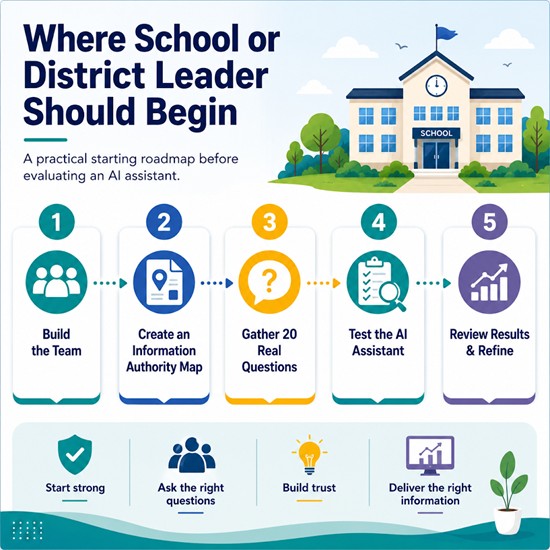
Don't begin with a vendor demonstration. Begin with a short internal meeting. Bring together representatives from District technology, Communications, Enrollment/Registration, Student Services, Transportation, Accessibility, and School administration.
First, create your Information Authority Map. Then gather around 20 real questions parents and families regularly ask.
Include difficult examples:
-
A question whose answer changed this school year
-
A question where two district webpages disagree
-
A question based on an outdated PDF
-
A question requiring staff judgment
-
A question the website currently cannot answer
-
A question that should be routed to a specific school or department
You now have something much more useful than a generic feature checklist. When reviewing custom AI chatbot development services or talking with an AI assistant development company, use those questions to test the product against your district's real environment.
8. A 15-Minute Stress Test Before You Buy
A polished vendor demonstration will naturally show what the assistant does well. Your school/district should deliberately test what happens when things are not easy.
The Easy Question
Ask something clearly available on your school/district website. Can the assistant answer correctly and show where the information came from?
The Conflict Test
Ask about something where an old document and current webpage disagree. Which source does it trust?
The Missing-Information Test
Ask something your district has never published. Does it admit that it doesn't have enough information?
The Judgment Test
Ask for an exception to a district policy. Does the assistant recognize that a staff member needs to make that decision?
The Update Test
Change information on a test webpage. How quickly does the assistant begin using the new information?
The Ownership Test
Ask the vendor: “If we end our contract, exactly what can our school district take with us?”
The Admin Test
Have a nontechnical district staff member review an incorrect response, identify where the answer came from, and determine how it should be corrected.
A good school AI assistant should occasionally say: “I don't have enough information to answer that.”
For a school district, knowing when not to guess can be just as important as answering quickly.
Make the Decision Around Your School’s / District's Problem, Not the Technology
AI use across K–12 school districts is growing, and nearly four out of five technology leaders surveyed by CoSN now report having district AI guidelines. But every school does not need the same AI solution.
Instead of asking: “Does our school/district need an AI chatbot?”
Ask: “Can an AI assistant solve a clearly defined problem for our families and staff within a governance model our district is comfortable owning?”
Define the problem. Assign responsibility. Identify your official information sources. Decide what success looks like. Understand what the school district owns. Then stress-test the product with the questions your parents and families actually ask.
At that point, you are no longer adopting AI simply because it is the latest technology trend. You are making a practical district technology decision based on an identified need.
See How the OST AI Chatbot Handles Your School District's Real Questions
The OST AI Assistant is designed for organizations that need greater control over public-facing AI conversations. It supports defined knowledge sources, source-of-truth management, conversation review, human handoff, flexible hosting, and a self-hosted ownership option.
Instead of judging it with generic demonstration questions, bring the difficult ones your district receives every week.
See how the OpenSource Technologies’ AI Assistant handles your school district's actual website content, conflicting information, unanswered questions, and governance requirements before deciding whether it belongs on your website.