Most AI initiatives in ecommerce don’t fail at the model layer. They fail at the data layer. Here’s what unified commerce actually means, and why CTOs are putting it back on the 2026 roadmap.
Three quiet patterns we keep seeing in client audits this year.
An AI chatbot quotes a price three weeks old. A “personalization” engine recommends a product the customer returned last month. An agentic checkout flow fails because the inventory system says “in stock” while the warehouse says “sold out.”
In each case, the AI did exactly what it was built to do. The problem was the data underneath it.
This is why 52% of organizations cite data quality as the biggest blocker to AI deployment – and Gartner predicts more than 40% of agentic AI projects will be canceled by the end of 2027 due to unclear ROI and inadequate foundations. (Gartner, 2026)
The fix has a name. It’s called unified commerce – the layer most ecommerce businesses skipped on their way to deploying AI.
What Is Unified Commerce – and How Is It Different from Omnichannel?
Omnichannel is multiple channels, loosely connected. Your website, store POS, Instagram shop, email platform, warehouse system, B2B portal – each runs on its own database, syncing through APIs, webhooks, batches, and the occasional CSV export. It works for humans because humans forgive small inconsistencies.
Unified commerce is different: every system – not just your storefront, but your warehouse, your CRM, your B2B portal, your support tool, your marketing platform – reads from one canonical source per data type. One inventory record. One customer profile. One pricing engine. One order history. Every channel – web, store, app, social, AI assistant – queries the same data in real time.
For humans, the difference is invisible most days. For AI, it’s the difference between a system that works and one that quietly fails.
In our earlier post on agent-ready ecommerce, we covered the seven things your storefront needs to do to handle AI agents. This post goes one layer deeper – into the data architecture underneath all of that. Without unified data, the agent-readiness checklist breaks down before you finish it.
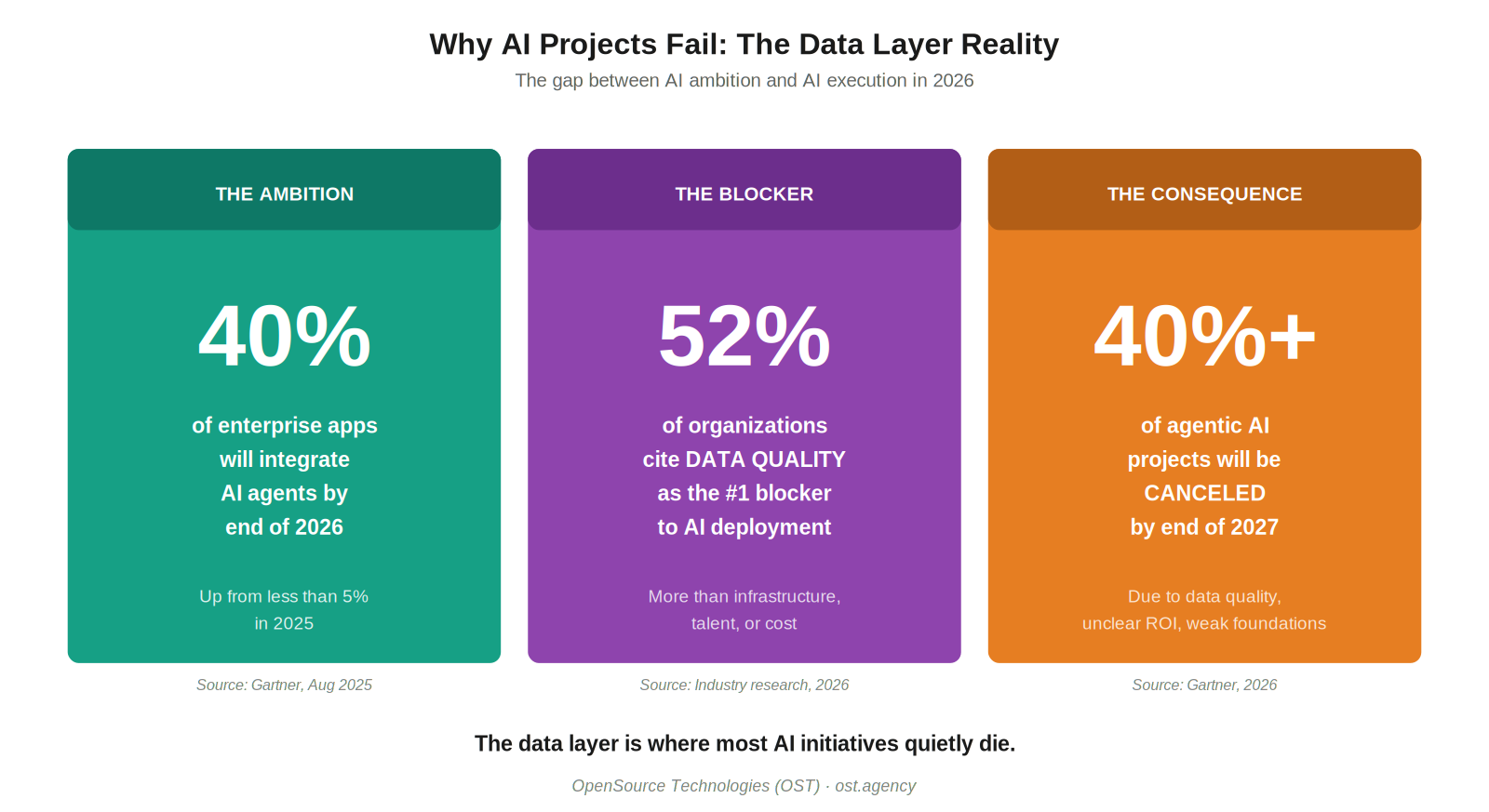
The gap between AI ambition and AI execution in 2026 is widening – and the data layer is where it shows up first.
Why Most AI Chatbots and Agents Fail in Production
Three reasons:
- The AI reads stale data. Vector database from last week. Price changed yesterday. (Covered in our RAG for Product Catalogs deep-dive.)
- The AI reads conflicting data. Two systems disagree about stock. The AI confidently picks one.
- The AI can’t act because data lives in silos. An agentic checkout flow needs to read inventory, apply pricing, check fraud, and write an order – across four systems – in under two seconds.
In production at scale, this is the difference between revenue and refund tickets.
What “One Source of Truth” Actually Requires
In a typical mid-market ecommerce stack, six data types need to be unified:
- Inventory – what’s in stock, where, and when it’s coming back
- Pricing – including B2B tiers, promotions, regional variants
- Customer profile – identity, preferences, segment, lifetime value
- Order history – across every channel the customer has ever used
- Product catalog – descriptions, attributes, media, variants
Fulfillment status – what’s been picked, shipped, delivered, returned
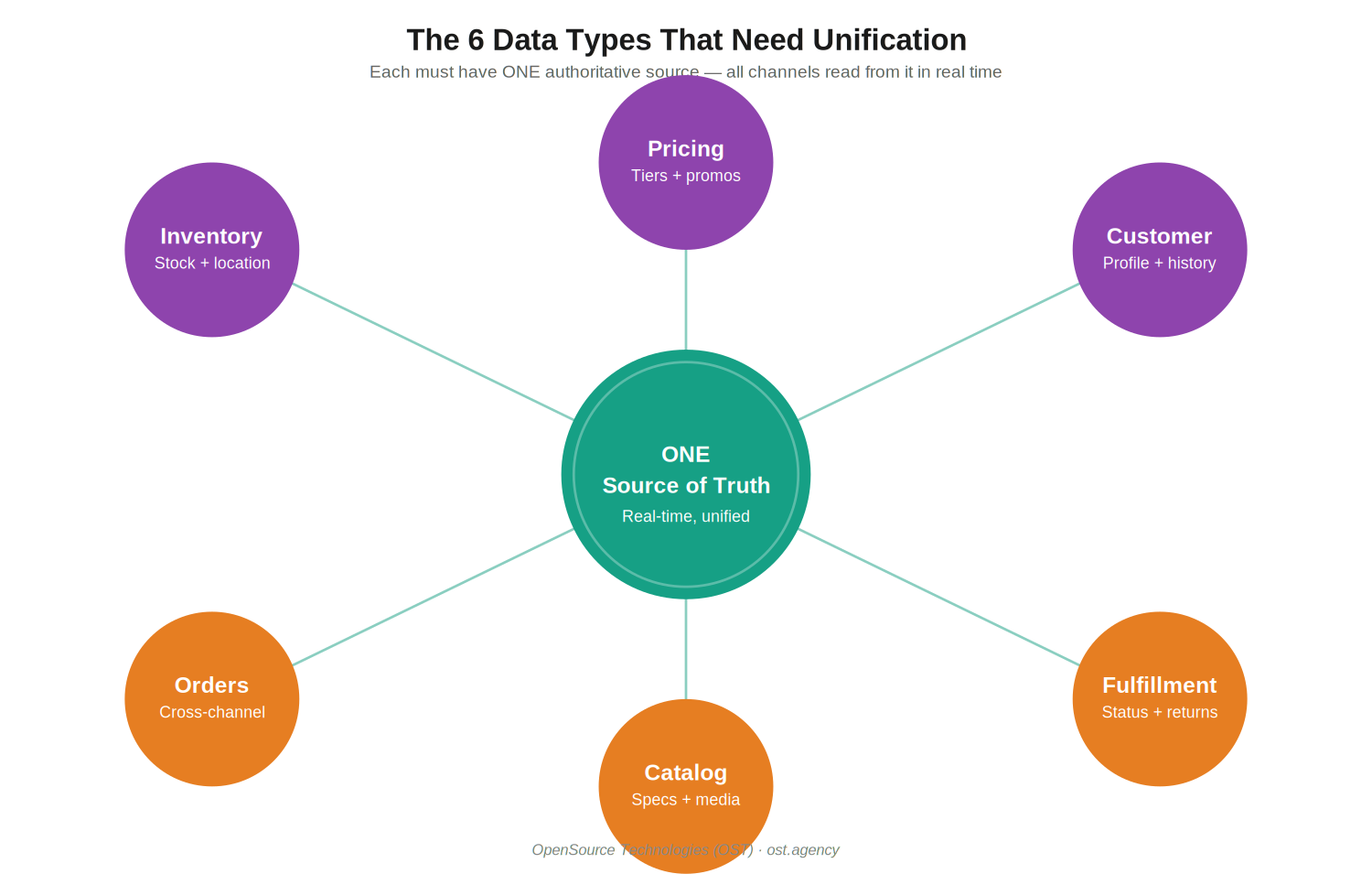
Unified commerce isn’t about replacing your systems – it’s about making one of them authoritative for each data type, and connecting the rest to read from it in real time.
Each of these typically lives in 2–4 different systems today. Unification doesn’t mean replacing them – it means establishing one system as authoritative for each data type and connecting the rest to read from it in real time.
How Do You Actually Unify Data Across Shopify, NetSuite, Klaviyo, and Your Warehouse System?
Three architectural patterns dominate in 2026:
- Middleware layer (iPaaS or custom API gateway). Tools like MuleSoft, Workato, or a custom gateway sit between systems and translate between them. Best for 5–15 disconnected systems.
- Event streaming. When something changes in one system, it broadcasts an event (via Kafka, AWS EventBridge, or webhooks). Other systems subscribe and update. Best for real-time use cases.
- Composable architecture. Each function (cart, search, checkout, content) is a separate service talking through standardized APIs. This is what the headless commerce shift enables.
Most real implementations use all three. This is the layer the agent-readiness conversation doesn’t usually reach – it’s not about your product page or checkout flow. It’s about which system is authoritative for each data type, and how the others stay in sync.
Do I Need to Replace My Current Ecommerce Platform?
No – this is the most common misconception we encounter.
You don’t replace Shopify, WooCommerce, or Magento. You integrate around them. The platform becomes the storefront layer. Inventory truth might live in NetSuite, customer profile in a CDP, pricing in a dedicated engine. The storefront reads from each via API.
The exception: if your platform can’t expose the data you need through APIs, replacement may be cheaper than working around it.
Is Your Data AI-Ready? A 5-Question Self-Check
- If a customer asks your AI chatbot “is this in stock?” – can it answer correctly in under 500ms?
- If your AI recommends a product, does it know the customer’s return history?
- If an AI agent tries to checkout, can it apply the right B2B tier price?
- If inventory drops to zero in your store, does your website reflect it within 30 seconds?
- If a customer messages on Instagram, does your support agent see their web purchase history?
If you answered “no” to two or more, your data layer isn’t ready for AI – and any AI project you launch will hit the same wall.
How OST Approaches Unified Commerce
We’ve spent 14+ years doing integration work – long before “unified commerce” became the 2026 label for it. Our approach:
- Engineering-led, not platform-led. We pick the right authoritative system per data type – no vendor lock-in.
- Incremental, not big-bang. Unifying one data type at a time (usually inventory first) delivers value in weeks, not an 18-month replatforming nightmare.
- No black boxes. You own the integration code and documentation. Same principle behind OST’s AI-Powered Ecommerce Chatbot.
Questions Ecommerce CTOs Ask Us
“How long does it take to get to unified commerce?”
Phased correctly, 8–12 weeks for the first data type. A complete program for a mid-market store usually runs 6–12 months.
“Is this affordable for a mid-market store, or only enterprise?”
Affordable. Enterprise vendors price like enterprise, but the underlying engineering is the same work agencies have always done. A mid-market program typically costs less than 12 months of misfiring AI pilots.
“What’s the difference between unified, composable, and headless commerce?”
Headless separates frontend from backend. Composable means each function is a swappable service. Unified means the data underneath is consistent. Most modern stacks use all three.
The Bottom Line
Gartner expects 40% of enterprise apps to integrate AI agents by end of 2026. IDC predicts a 15% productivity loss by 2027 for companies that deploy without an AI-ready data foundation.
The companies winning with AI in 2026 aren’t the ones with the best models. They’re the ones that did the unglamorous work of cleaning up their data layer first.