

There is a quiet revolution happening in how startups bring products to life. It does not make headlines every day, and it is not happening in boardrooms. It is happening in the earliest, most fragile stage of a startup’s existence — the moment a founder decides to turn an idea into something real. And artificial intelligence is fundamentally changing what that moment looks like.
Not long ago, building even a basic product required months of planning, a skilled development team, significant capital, and a considerable tolerance for uncertainty. Today, AI is compressing timelines, reducing costs, democratizing technical capability, and — most importantly — helping startups make smarter decisions before a single line of production code is written. For founders who understand this shift, the advantage is enormous. For those who do not, the risk of falling behind is very real.
This is not a story about AI replacing developers or making product-building effortless. It is a story about what becomes possible when intelligent tools are woven into every stage of how a startup creates, tests, and launches its first product.
The Old Way of Building Was Expensive — and Broken
To understand why AI-powered MVP development matters so much, it helps to look honestly at how costly the traditional approach has been.
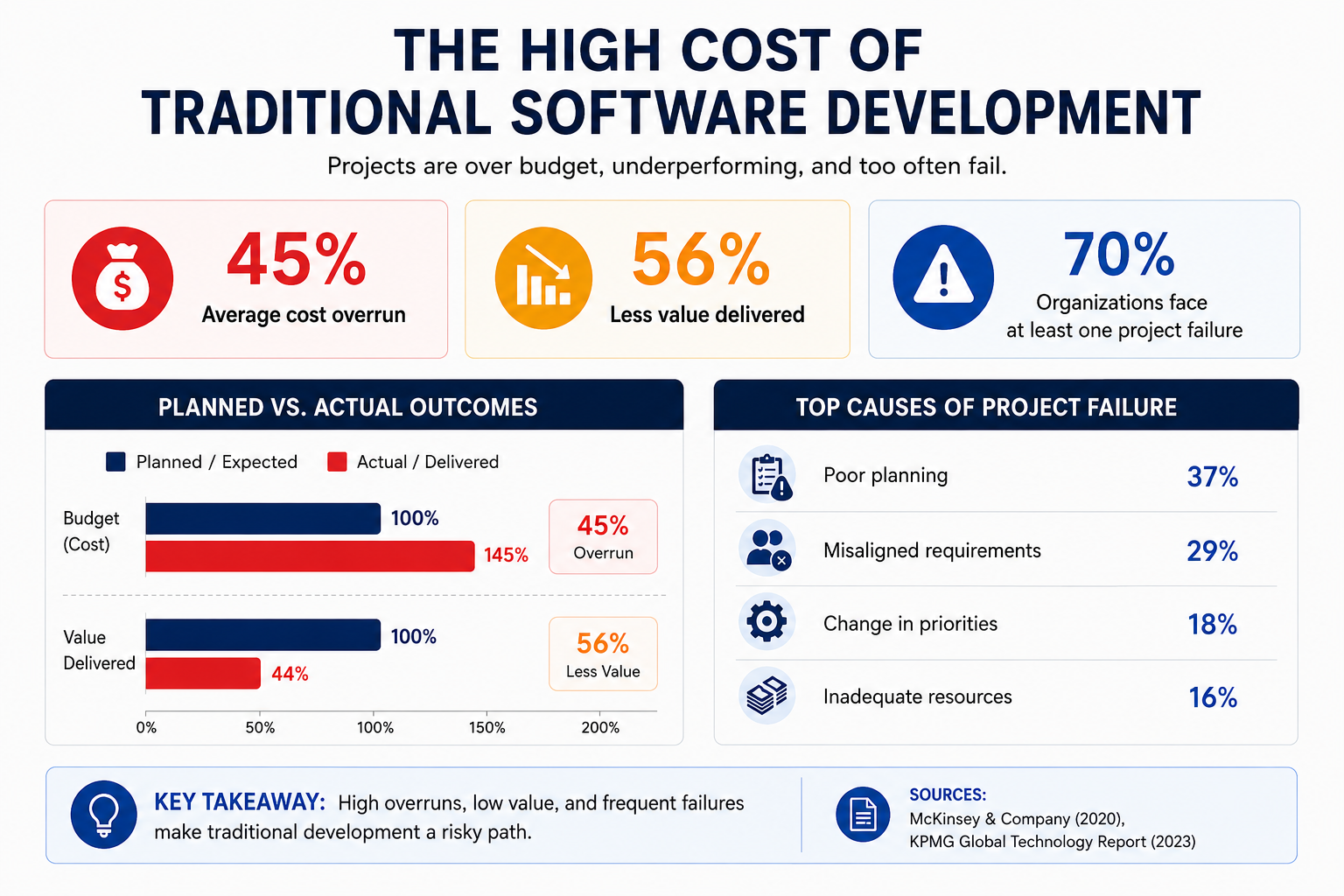
According to McKinsey & Company, large software projects run over budget by an average of 45% and deliver 56% less value than originally projected. While these numbers reflect enterprise-scale projects, early-stage startups suffer from a version of the same problem — they build too much, too slowly, with too little information about whether what they are building will actually work.
The KPMG Global Technology Report found that nearly 70% of organizations have experienced at least one project failure in the past year — with poor planning and misaligned requirements among the top causes. For a startup operating with a limited runway, a single major miscalculation at the product stage can be fatal.
The traditional MVP process, even when done lean, was still heavily dependent on human capacity — developers available for hire, designers with bandwidth, project managers to keep everything coordinated, and weeks of discovery work before anything tangible could be tested. AI does not eliminate the need for any of these people. But it dramatically changes how much they can accomplish and how quickly.
What AI Actually Does at the MVP Stage — And Why It Changes Everything
The most visible impact of AI on MVP development is speed. But speed alone misses the more important story. What AI tools genuinely change is the quality and cost of early-stage decision-making — and that is where startups win or lose before most people are even paying attention.
Intelligent requirement generation is one of the earliest and most underappreciated applications. Founders often struggle to translate a vision into clear, buildable specifications. AI-assisted tools can now take a business concept, user research inputs, and competitive context, and generate structured product requirement documents, user stories, and feature prioritization frameworks in a fraction of the time it previously took. This means development teams spend less time in back-and-forth clarification meetings and more time actually building.
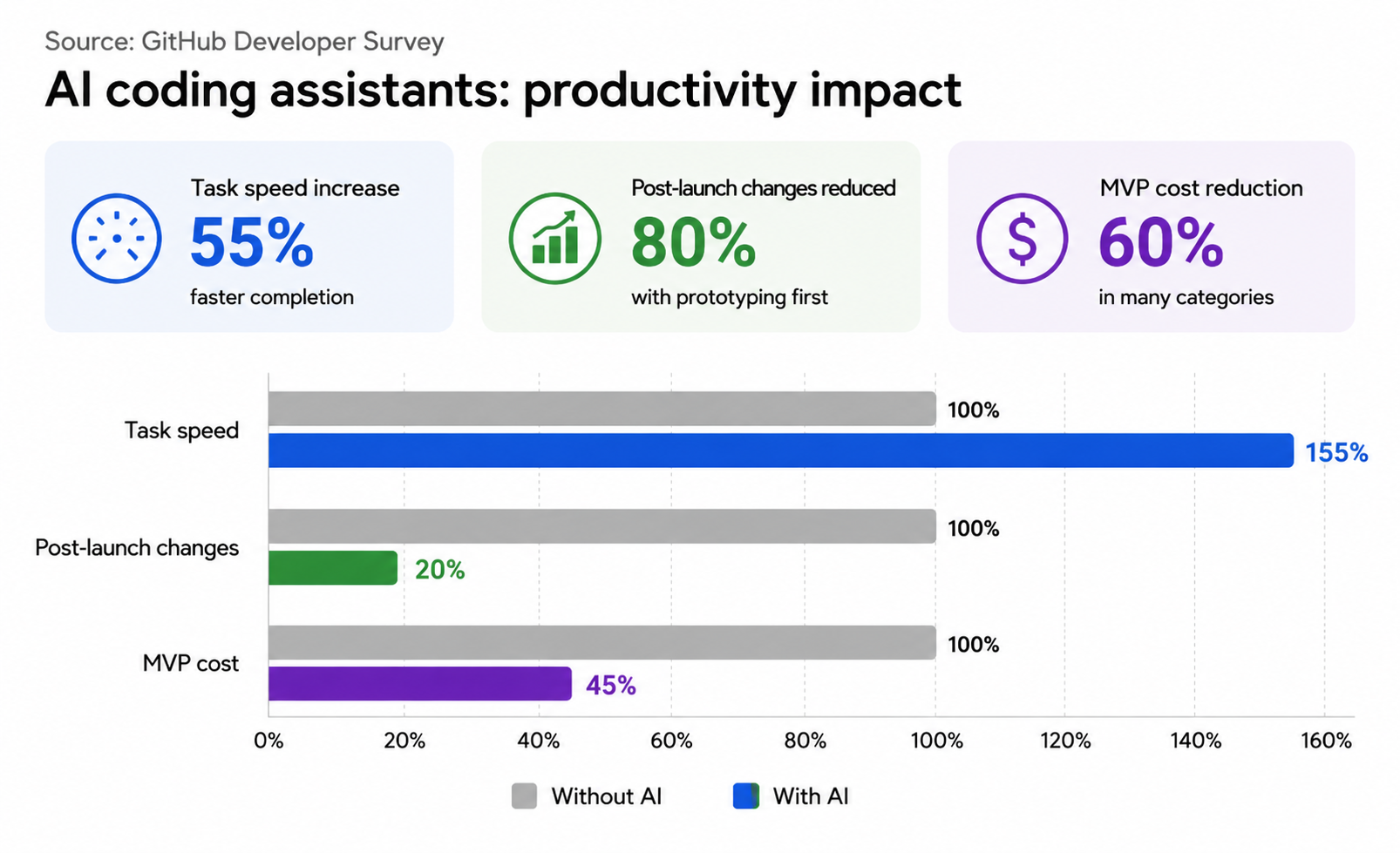
AI-generated prototyping and wireframing has also matured significantly. Tools powered by generative AI can now produce interactive prototypes from natural language descriptions — meaning a non-technical founder can visualize a product flow, share it with potential users, and gather feedback before a single line of code exists. According to a 2024 report by Forrester Research, organizations that invest in prototyping and user testing before development reduce their post-launch change requests by up to 80%. For a startup, 80% fewer expensive revisions after launch is a profound competitive advantage.
Automated code generation and AI-assisted development environments mean that experienced engineers using AI pair-programming tools are completing tasks at a pace previously unimaginable. A GitHub survey found that developers using AI coding assistants complete tasks up to 55% faster and report significantly higher satisfaction with their work. For an MVP where every week of development represents a meaningful portion of a startup’s runway, this acceleration is not just convenient — it is strategic.
most underutilized application of AI in early-stage product development is not in the building phase at all. It is in the validation phase — the period before development begins, when the most important questions are still unanswered.
Historically, validating a product idea required surveys, focus groups, manual competitor research, and often weeks of waiting for results. AI has made this process dramatically faster and far more nuanced.
Sentiment analysis tools powered by natural language processing can now scan thousands of reviews, social media posts, forum discussions, and customer complaints to identify unmet needs in a market with remarkable precision. A startup can enter a potential product category and, within hours, have a data-backed picture of what existing users love about current solutions, what frustrates them most, and where the clearest opportunity gaps exist. This kind of intelligence used to require expensive market research firms and months of turnaround time.
AI-driven competitive intelligence platforms can now map an entire competitive landscape — pricing, feature sets, positioning, user sentiment, and recent product changes — automatically and continuously. Startups that use these tools before committing to a product direction enter their development phase with a level of market clarity that simply was not accessible to early-stage founders a decade ago.
The implications for MVP scope are significant. When you know with precision what the market is missing and which user frustrations are most acute, the decision about what to include in your first product becomes far more evidence-based and far less dependent on founder intuition alone.
The Rise of AI-Native Startups: A New Competitive Category
Something important has emerged from the convergence of accessible AI tools and lean startup methodology — a new class of company that is sometimes called the AI-native startup. These are not companies building AI products. They are companies that use AI natively throughout their entire operation from day one, including how they build their first product.
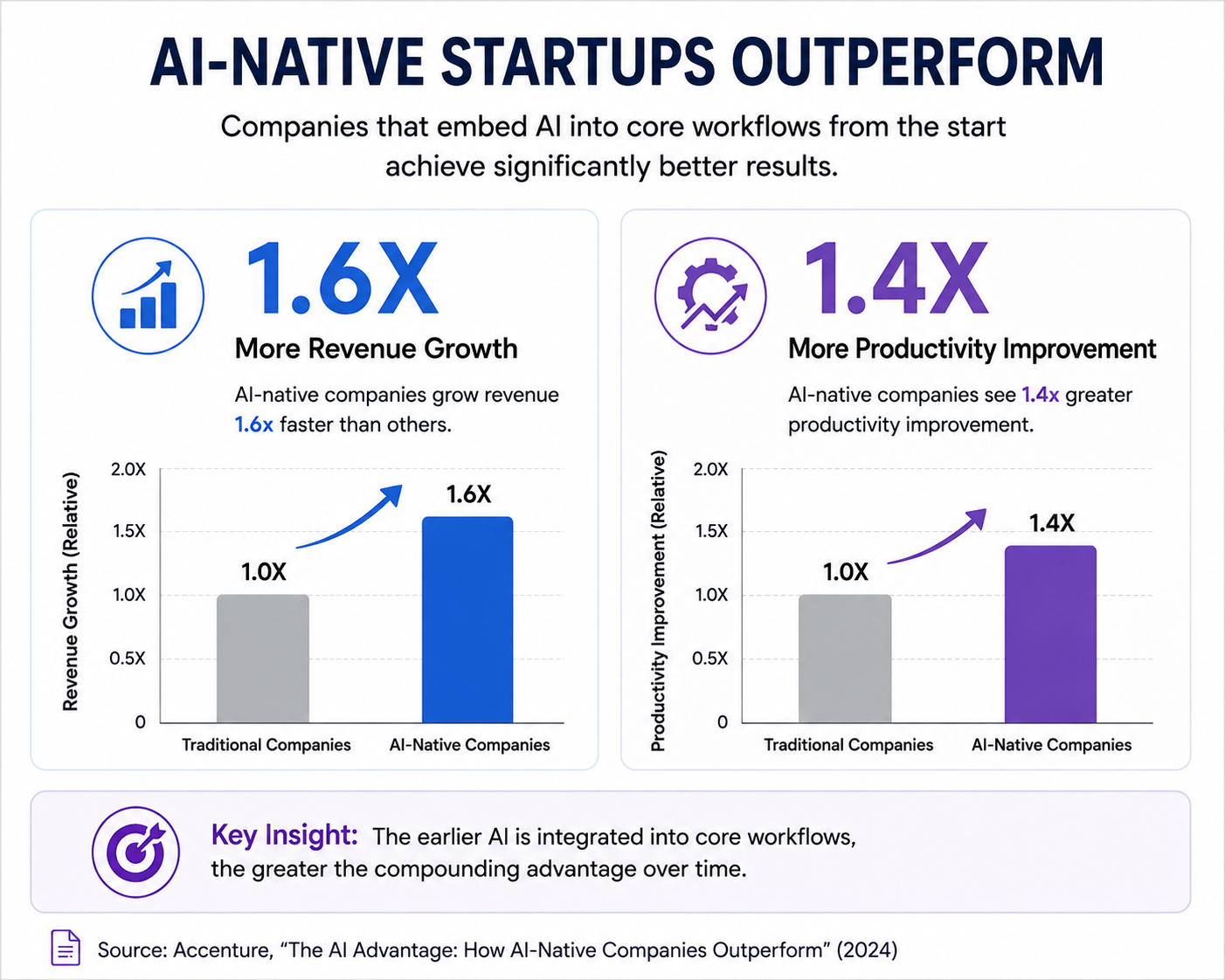
The data on these companies is striking. According to a 2024 study by Accenture, companies that embed AI into their core workflows from the start achieve 1.6 times more revenue growth and 1.4 times more productivity improvement than companies that adopt AI later as an add-on. This advantage is compounding — the earlier AI is integrated into how a team works, the more data and process intelligence it accumulates, and the greater the operational advantage over time.
For startups specifically, being AI-native from the MVP stage means several things in practice. It means using AI not just to write code faster, but to generate and test hypotheses before building, to monitor user behavior from the first day of launch, to identify patterns in feedback that human reviewers might miss, and to make product decisions based on real-time behavioral data rather than periodic reporting.
The Y Combinator 2024 batch saw more AI-native startups than any previous cohort in the accelerator’s history — a signal that the investor community has recognized this structural advantage and is actively backing founders who build this way from the start.
What AI Cannot Replace in the MVP Process?
Honesty matters here because the enthusiasm around AI in product development can sometimes obscure what still requires deep human judgment and experience.
AI tools are exceptionally good at processing large amounts of structured and unstructured data, generating options, automating repetitive tasks, and accelerating execution. They are not good at determining whether a product vision is genuinely meaningful, whether a founding team’s values align with their market, or whether the strategic bets being made are the right ones for a specific competitive context.
The product decisions that matter most in an MVP — what single problem to solve first, which user segment to target initially, how to position the product against existing alternatives, and when to pivot versus persist — still require experienced human judgment, deep empathy for the user, and honest interpretation of what the data is actually saying versus what founders want it to say.
According to First Round Capital’s research on startup performance, the quality of founder decision-making in the first twelve months is one of the strongest predictors of long-term company success. AI accelerates the inputs to those decisions. It does not make the decisions themselves.
This is why the most effective AI-powered MVP development processes are not fully automated — they are human-directed and AI-accelerated. Experienced product leaders and engineers still define the strategy, set the priorities, interpret the results, and course-correct when something is not working. AI makes all of those people more capable, more efficient, and better informed. But it does not replace the strategic intelligence they bring to the process.
How AI Changes the Economics of Launching a Startup
The financial implications of AI-powered MVP development deserve direct attention, because they are reshaping who can realistically build a startup — and how.
Building an MVP traditionally required a minimum of $50,000 to $150,000 in development costs for even a moderately complex product, according to venture capital research from Kruze Consulting. That barrier excluded a significant portion of founders who had great ideas and real market insight but lacked access to capital or technical co-founders.
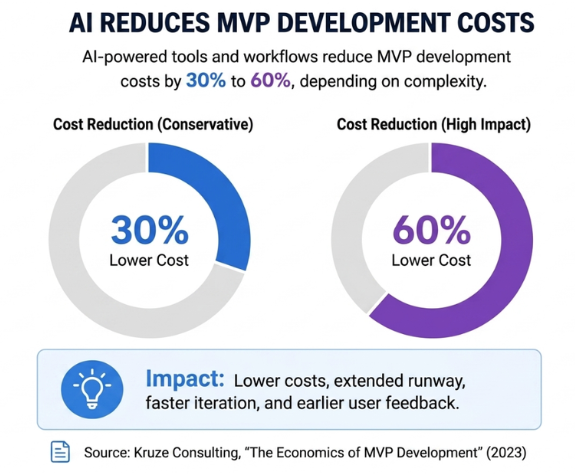
AI has materially altered this equation. Development time compression, lower prototyping costs, automated testing, and AI-generated documentation have collectively reduced MVP development costs for many product categories by 30% to 60%, depending on complexity. This is not a theoretical saving — it reflects real shifts in how long experienced teams take to deliver working software when AI tools are embedded in their workflow.
For founders, this has two important implications. First, a given amount of capital now goes meaningfully further in the development phase, extending the runway and reducing the pressure to raise large rounds before product-market fit is established. Second, the time from idea to first user feedback has compressed to a degree that fundamentally changes the pace of iteration — and iteration speed is one of the most reliable predictors of startup success.
Reid Hoffman, co-founder of LinkedIn, famously said that if you are not embarrassed by the first version of your product, you launched too late. AI-powered development tools are making it easier than ever to launch earlier, learn faster, and build the next version with genuine user intelligence rather than educated guesswork.
What Founders Should Actually Do With This Information
Understanding the shift toward AI-powered MVP development is only useful if it changes how founders act. Here is what that looks like in practice.
Before writing a single specification, use AI-powered market research and sentiment analysis tools to build an evidence base for your product assumptions. Identify the user frustrations that existing solutions have failed to address, and let that evidence shape your MVP scope from the beginning rather than building based on assumptions you validate later.
During development, work with teams that have genuinely integrated AI into their engineering workflow — not teams that use AI as a marketing talking point. Ask specifically how AI tools are being used in their development process, what time savings they produce, and how AI-generated code is reviewed and quality-controlled by experienced engineers.
After launch, instrument your product from day one. AI-powered behavioral analytics tools can now surface patterns in user behavior that would take human analysts weeks to identify manually. The startups that iterate fastest in response to real user data are the ones that build sustainable products. This capability starts on launch day, not six months later when you finally have enough data to analyze.
Finally, remember that the goal of an MVP was never to ship something minimal. The goal was always to learn something maximum — the maximum amount of validated information about your market with the minimum expenditure of time and capital. AI does not change that goal. It makes achieving it more attainable than it has ever been.
The Future Belongs to Founders Who Build Smarter, Not Just Faster
The Future Belongs to Founders Who Build Smarter, Not Just Faster. The conversation around AI in startup development is evolving rapidly. New tools are emerging every day, workflows are becoming more intelligent, and the capabilities that seem groundbreaking today will soon become standard expectations. Throughout every major technological shift, the companies that adapted early gained the greatest advantage — and AI is no different.
What will always remain constant, however, is the challenge of building something people truly want. Successful startups are not created by speed alone; they are built through validation, smart decision-making, and the ability to identify real market demand before exhausting time and resources on the wrong product.
This is where partnering with an experienced AI development company becomes a game changer. AI is no longer just a support tool for automation — it has become one of the most powerful resources startups can use to validate ideas, accelerate MVP development, improve customer experiences, and make smarter product decisions from day one.
The question is no longer whether startups should integrate AI into their product strategy. The real question is whether founders will learn how to leverage AI effectively while competitors move ahead faster, smarter, and more efficiently.
The startups shaping the future are not simply building faster. They are building smarter with the help of the right AI development company, strategic AI implementation, and data-driven innovation. And that shift is already redefining what ambitious product launches look like today.