
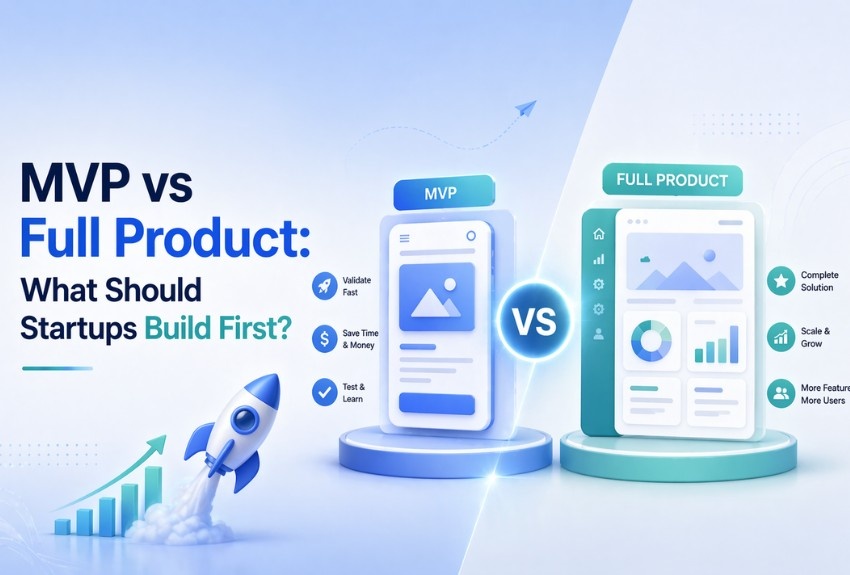
Every founder, at some point, faces the same crossroads: do we build it all, or do we build just enough? It sounds like a tactical question, but it’s actually the most strategic decision your startup will make in its first year. To answer it well, you need to understand not just what an MVP is — but why the sequence of decisions after that first question determines everything.
That sequence — from idea to validation to scale — is exactly what Startup and MVP Services are designed to support. Because the difference between a startup that survives its first two years and one that rarely comes down to the idea. It comes down to how disciplined the team was about what they built, when they built it, and who they built it with. This blog walks you through that entire decision — question by question, stage by stage — so that by the end, you’re not just informed. You’re ready to move.
So, what exactly is an MVP — and why does it still matter?
A Minimum Viable Product is the leanest version of your product that still delivers real, tangible value to a real user. Not a mock-up. Not a concept deck. A working product stripped down to its single most important function. The concept was popularized by Eric Ries in The Lean Startup, but its relevance has only intensified. According to CB Insights, 35% of startups fail simply because there was no market need for their product. An MVP is your earliest, cheapest way to find out whether you’re building something people actually want — before you’ve spent everything finding out they don’t.
And yet, despite all the evidence in favor of starting lean, thousands of founding teams still spend 12 to 18 months building a full product in silence, convinced that more features mean more value. That conviction is expensive. According to the Standish Group’s CHAOS Report, 64% of product features built are rarely or never used. That’s not a rounding error — that’s most of what your team is about to build.
Alright, but how different is an MVP from a full product, really?
The difference is not just in scope — it’s in intent. An MVP asks: should we build this? A full product asks: how do we scale this? They are fundamentally different questions, and trying to answer the second before the first is where most startups go wrong.
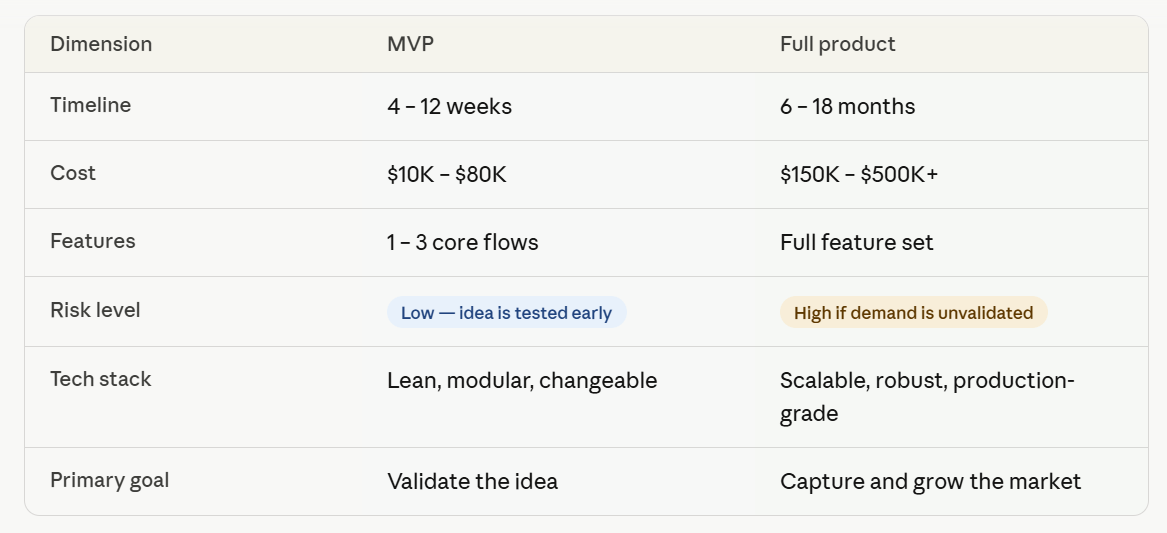
The cost difference alone is worth sitting with. A failed full product can cost half a million dollars and 18 months of your team’s best energy. A failed MVP costs a fraction of that — and if you’ve run it correctly, it doesn’t feel like failure at all. It feels like data.
That raises the obvious follow-up: what does the data actually say about MVPs working?
The numbers are hard to argue with. IBM Systems Sciences research has shown it is roughly 7 times cheaper to fix a problem at the MVP stage than after a full launch. Startup Genome’s 2023 report puts the overall startup failure rate at 90%. Most of those failures had one thing in common: they never validated demand before building. They assumed.
35%
of startups fail due to no market need
CB Insights, 2024
7x
cheaper to fix a bug at MVP stage vs post-launch
IBM Systems Sciences
64%
of product features are rarely or never used
Standish Group, CHAOS Report
90%
of startups fail — most without validating demand first
Startup Genome, 2023
The 64% figure from the Standish Group is especially damning. Nearly two-thirds of everything your development team is about to build may never be meaningfully used. That’s not a reason to be paralyzed — it’s a reason to be deliberate about what you build first.
Once you’ve decided to build an MVP, how has AI actually changed the process?
Significantly — and this is where the conversation around AI-Powered Development vs Manual Coding gets real. It’s no longer theoretical. GitHub’s 2024 Octoverse report found that AI coding assistants can compress development timelines by 30% to 50%. For an MVP, that compression is transformative. What used to take three months can now take six weeks. What used to require a team of eight can be handled by a team of four.
But the impact of AI goes beyond speed. When you build your MVP with the right instrumentation — behavioral analytics, session tracking, in-app feedback loops — you can literally turn every chat into business intelligence. Every click, every drop-off, every support message becomes a data point that shapes your next sprint.
This is the real shift in modern development. It’s no longer just about building faster—it’s about learning faster. An experienced custom app development partner that integrates AI from the outset doesn’t just accelerate delivery; they create a feedback loop that was once only accessible to companies with large data teams.
As a result, teams can iterate with far greater precision. Instead of relying on assumptions or delayed reporting, decisions are guided by real-time insights. By the start of each day, you already have a clearer understanding of what’s working, what isn’t, and where to focus next—making the entire development process more responsive, efficient, and outcome-driven.
A lot of founders ask at this stage: can’t we just use no-code tools to build the MVP even faster?
It’s a fair question, and the honest answer is: sometimes yes, but more often than founders expect — no. Why low-code/no-code isn’t enough is a real conversation worth having before you commit to a platform.
For a simple landing page, a waitlist form, or an internal workflow tool, no-code platforms like Bubble or Webflow are perfectly reasonable shortcuts. But the moment your product involves custom logic, multi-platform support, third-party API integrations, or any complexity in data handling, no-code tools hit a ceiling — and they hit it fast.
The deeper problem is what happens next. If your MVP gains traction and you need to scale, the technical debt from a no-code foundation can be more expensive to unwind than if you’d built properly from day one. A seasoned Web application development agency that understands scalable architecture will help you choose a stack that can evolve from MVP to full product without a full rebuild. That’s not a nice-to-have — it’s a strategic advantage.
So what should actually be in an MVP? Where do founders draw the line?
This is where most founding teams struggle, because building less feels counterintuitive. The rule is simple, even if it’s hard to follow: include only the one action that delivers your core value proposition. For a B2B SaaS, that’s the workflow your paying users will perform every single day. Everything else — admin panels, user role management, advanced reporting, settings pages — those are full-product concerns. Ship them after you’ve confirmed that people want the core.
What founders often underestimate is that performance and reliability must be non-negotiable even at the MVP stage. A slow, crash-prone MVP doesn’t just frustrate users — it permanently damages your brand before you’ve had a chance to prove yourself. Understanding the Fundamentals of Mobile App Testing matters here: broken flows and unexpected crashes destroy trust the first time, and there often isn’t a second time.
Similarly, improving your website’s page load speed isn’t something to address after launch—it’s a foundational requirement. Research on Google’s Core Web Vitals shows that even a one-second delay in load time can reduce conversions by up to 7% (Akamai). Performance should be built into the product from day one, not treated as an afterthought in later iterations.
Are there cases where skipping the MVP and building the full product first actually makes sense?
Yes — but the circumstances are narrow. Regulated industries like healthcare, fintech, and legal tech often require full compliance infrastructure before a single user can legally interact with the product. An MVP that can’t process payments securely or store health data compliantly isn’t useful — it’s a liability.
Deep tech products face a similar structural reality. If your product is a hardware device, a trained AI model, or foundational infrastructure software, the concept of an MVP is fundamentally different. You may need a fully functional version before the product is meaningful at all. In these cases, working with an experienced AI Development Company with deep domain expertise doesn’t just reduce risk — it replaces the validation role that an MVP would otherwise serve.
There’s also a third scenario: a well-funded team with a proven track record building in the exact same space, backed by conclusive market research. If all three of those conditions are true, you can compress validation and move faster. But notice how specific those conditions are. For most early-stage startups, none of them apply.
Let’s say the MVP is live. What happens next — and how does that lead to a full product?
Launch is not the finish line. It’s mile marker one. The moment your MVP is live, your job shifts from building to listening.
Set up event tracking before you launch — not after. Know exactly which features users touch, where they abandon the flow, and what they search for that doesn’t yet exist. This is how you go from turning clicks into customers — not through guesswork, but through a feedback loop that tells you precisely what to build next. Every session is a signal. Every support ticket is a product requirement in disguise.
Then comes the honest conversation most founders avoid: does the data tell you to double down, pivot, or stop? The MVP only works if you’re willing to act on what it reveals. If the data is positive, that’s when you bring in a Custom Web Application Development Company to architect the full product — hardening your infrastructure, building the features your early users asked for, and designing for the scale you’re now confident is coming.
What’s the final answer, then — MVP or full product?
For the vast majority of startups, the answer is the same: MVP first, always. Build the leanest version of your core value, put it in front of real users within 60 to 90 days, and let the market tell you what to build next.
The startups that win are rarely the ones that built the most. They’re the ones that learned the fastest — and then built with precision, not assumption.
Ready to Build Smarter? OpenSource Technologies (OST) Is Your MVP-First Partner.
The decision between an MVP and a full product isn’t just about budget or timeline — it’s about building with intention. At OST, our dedicated Startup & MVP Services are designed to take you from idea to a live, validated product in as little as six weeks. Whether you need a lean MVP to test your market, an AI-powered application to outpace the competition, or a full-scale custom product once your idea is proven, our team is built for every stage of that journey.
From day-one architecture decisions to post-launch iteration, we bring together expertise in Artificial Intelligence Development Services, Custom App Development, and scalable Web Application Development to make sure you’re never building blind. If you’re a founder sitting at that crossroads right now, the best time to move was six months ago. The second best time is today. Let’s build something worth scaling — together.