
A Q&A blog for food business owners, product managers, and tech decision-makers
Food used to be personal by default — the neighbourhood restaurant that remembered your table, the butcher who knew your order before you opened your mouth, the bakery that set aside your usual on Saturday mornings. Technology scaled food businesses beyond what any human memory could manage, but in doing so, it stripped out that intimacy entirely. For years, customers were treated as transactions rather than individuals. Now, AI is giving food businesses the ability to rebuild that personalization at scale — and the ones moving fastest are redefining what customer loyalty looks like in the digital age.
The shift is no longer on the horizon. It is already happening inside the apps customers open every day, in the recommendations that feel surprisingly accurate, in the promotions that arrive at precisely the right moment, and in the menus that seem to reorganise themselves around individual taste. Behind all of it is a deliberate technical infrastructure — data pipelines, behavioral models, and custom-built platforms designed to turn every customer interaction into intelligence. Increasingly, food businesses are investing in Custom Food Technology Software Development to build that infrastructure around their specific operations, rather than forcing their needs into off-the-shelf tools that were never designed with them in mind. This blog breaks down how that infrastructure works, why it matters for foo/industries/food-and-nutritiond businesses of every size, and what operators and product teams need to understand to stay ahead of a market that is moving faster than most realise.
What does “personalization” actually mean in the context of food technology today?
Personalization in food is no longer just printing a customer’s name on a coffee cup. It is the ability of a platform to anticipate what a customer wants — sometimes before they know it themselves. Using behavioral data, purchase history, browsing patterns, dietary signals, and contextual cues like time of day or weather, modern food tech platforms build a living profile of each user and serve recommendations, menus, and promotions tailored specifically to them.
According to McKinsey & Company, organizations that excel at personalization generate 40% more revenue from those activities than average players. In food, where margins are thin and competition is fierce, that number is a competitive lifeline.
How does AI actually “read” customer behavior in a food app or platform?
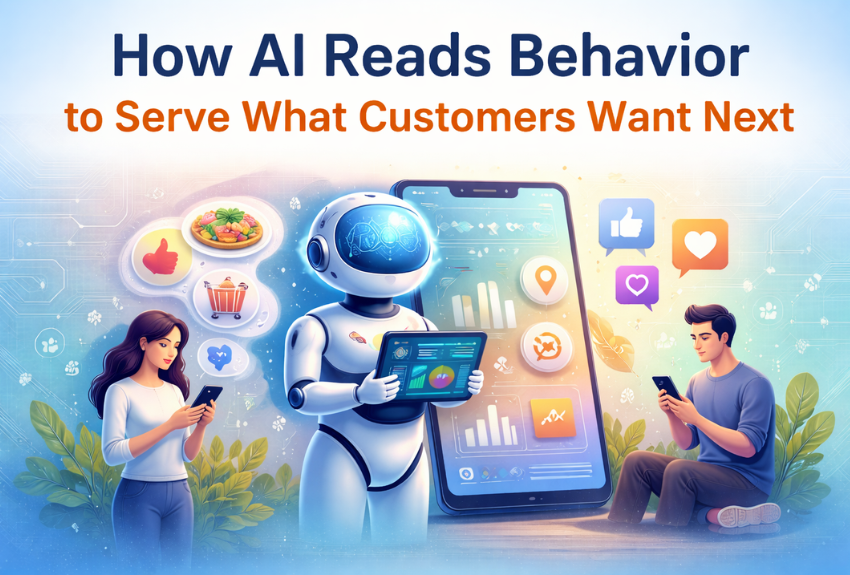
The process begins the moment a user opens the app. Every tap, scroll, search, skip, and purchase is a data point. AI models — particularly recommendation engines and natural language processing layers — parse this data in real time. They look for:
- Frequency patterns: Does a user order on Monday mornings? Do they tend toward lighter meals in summer?
- Substitution signals: When an item is out of stock and they choose X over Y, that reveals a preference hierarchy.
- Abandonment cues: What did they browse but not buy? That is often more revealing than what they purchased.
- Social and contextual data: Time, location, device, even local weather conditions feeding into a recommendation model.
This is precisely where Food & Nutrition Custom Software and App Development becomes critical. Generic, off-the-shelf platforms cannot handle the specificity of these signals. Custom-built systems are designed around the unique data architecture of a particular food business.
What role does custom technology play — why not just use existing platforms?
This is one of the most common questions food entrepreneurs and operators ask. The honest answer: generic platforms are built for the average use case. If your business has a unique customer profile, a differentiated menu structure, or a loyalty mechanic that does not fit a standard template, you will always be fighting the platform.
Custom food technology software development allows you to own the data model, define the personalization logic, and integrate systems — from kitchen management to loyalty to delivery — in ways that truly reflect how your business operates. Rather than bending your operations to fit a vendor’s assumptions, the technology bends to fit yours.
Statista reports that the global food tech market is projected to reach $342 billion by 2027. Businesses investing in proprietary infrastructure now are positioning themselves to own the customer relationship at scale, not rent it from a third party.
How does AI personalization actually improve the customer experience at a practical level?
Consider a customer who orders a plant-based burger on a Friday evening. An AI-powered platform notices this pattern over six weeks. On the seventh Friday, before they open the app, a push notification arrives: “Your usual? The new oat-based burger has landed.” That is not a gimmick. That is conversion.
But personalization goes deeper than recommendations. It touches:
- Dynamic menus: Items appear in different orders for different users based on relevance scoring.
- Pricing and promotion targeting: A discount offered precisely when the AI detects order hesitation, not blasted to the entire database.
- Dietary intelligence: Automatically surfacing allergen-free or nutritionally relevant items based on historical choices, without requiring the customer to filter manually.
Understanding from Data to Decisions — the process of turning raw behavioral signals into actionable product changes — is what separates food businesses that grow with data from those that merely collect it.
What kind of companies are building this technology, and how should food businesses choose a partner?
The landscape ranges from large enterprise software houses to specialist boutique agencies. The right partner depends on whether you are building a consumer-facing ordering app, a B2B wholesale procurement platform, or an internal kitchen intelligence tool.
Custom Mobile App Development Agency with food sector experience will understand the specific UX constraints of ordering under time pressure, the importance of image-led browsing, and the need for offline resilience in delivery contexts. A generalist developer will not have those defaults baked in.
Similarly, a cross platform mobile app development company can ensure that your iOS and Android experiences are consistent without doubling your development cost — something that becomes particularly important when your personalization logic needs to sync across devices in real time.
Questions to ask any prospective partner:
- Have you built recommendation engines for food or retail specifically?
- How do you handle data privacy and GDPR compliance in your architecture?
- What does your post-launch QA and monitoring process look like? (This matters — Quality Assurance matters far more in food tech than most operators realise, especially when dietary data is involved.)
What is the risk of getting personalization wrong?
Significant. A poorly calibrated recommendation engine does not just fail to convert — it actively erodes trust. If a platform repeatedly suggests items a customer has explicitly avoided, or misreads a one-time occasion order as a permanent preference, customers disengage.
Research from Salesforce shows that 76% of consumers expect companies to understand their needs and expectations. When technology fails to deliver that, 52% will switch to a competitor.
Most food businesses collect a ton of data — orders, complaints, chat messages, reviews — but never actually do anything useful with it. It just sits there. That’s data laziness.
The real opportunity is treating every single customer interaction as a lesson. Someone complained about cold fries? That’s a signal. A certain dish gets ordered every Friday night? That’s a pattern. A customer stopped coming after a bad experience? That’s a warning.
The idea of turning every chat into business intelligence goes beyond just chatbots. It means building a habit where every piece of information — a message, a rating, a return visit, an abandoned cart — gets fed back into how you run the business. Your menu, your staffing, your promotions, your service — all of it should be slowly shaped by what your customers are actually telling you, not just what you assume.
The businesses that win aren’t the ones with the most data. They’re the ones that actually listen to it.
How does AI personalization connect to revenue, not just experience?
The two are inseparable. Better experience drives repeat orders. Repeat orders drive lifetime value. Lifetime value is what food businesses are actually selling when they pitch investors or franchise partners.
But more concretely: personalization reduces the friction between intent and purchase. When the right item is in front of the right customer at the right moment, average order value increases. When promotions are targeted rather than broadcast, redemption rates go up while discount spend goes down. This is the core logic behind turning clicks into customers — and in food, the moment between browsing and buying is rarely more than a few seconds.
According to Deloitte, personalization-driven businesses see 5–8x return on investment on marketing spend. In food delivery specifically, where customer acquisition costs are high and loyalty is fragile, that multiplier is material.
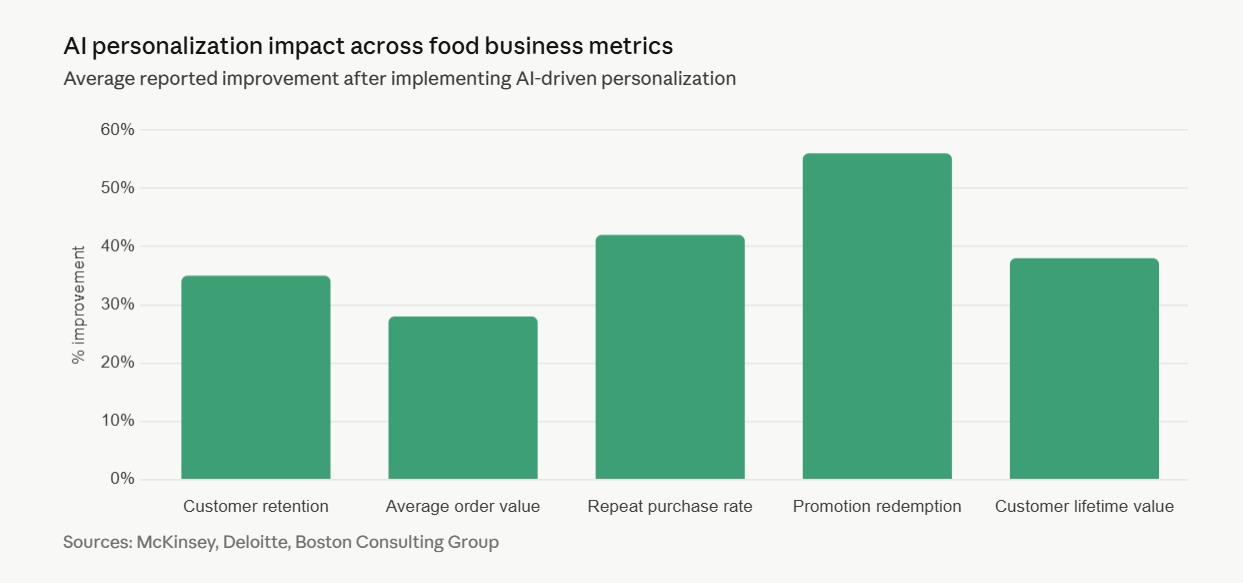
* Business impact chart — shows average percentage improvements across retention, order value, repeat purchases, and promotions after AI personalization is implemented.
What does the near-term future look like for AI and food personalization?
Several trends are converging:
Multimodal AI will allow platforms to process not just clicks but images — a customer sharing a photo of a meal they enjoyed, for instance, could seed a recommendation engine directly.
Voice and conversational ordering will become more prevalent, particularly in quick-service contexts. The AI will not just respond to explicit requests but infer mood, energy level, and occasion from conversational cues.
Predictive stocking and menu planning will close the loop between front-end personalization and back-end operations. The system will not just recommend what customers want — it will ensure those items are available, fresh, and priced appropriately.
Custom AI Software Development sits at the centre of all of this. Off-the-shelf AI tools will not accommodate the vertical specificity of food — ingredient databases, nutritional APIs, real-time supply chain data — the way purpose-built systems can.
The food businesses that will lead in 2027 are the ones making platform decisions in 2025. The gap between businesses that own their customer intelligence and those that outsource it to aggregators will only widen.
Where should a food business start if they want to build towards personalised AI experiences?
Start with data infrastructure, not features. Before you can personalise, you need to capture and organise behavior cleanly. That means:
- A unified customer identity across ordering, loyalty, and CRM
- Event tracking that records not just purchases but browsing, abandonment, and search
- A data layer that is accessible to analytics tools and ML models
Once that foundation exists, the right development partner can begin layering personalization features incrementally — starting with recommendations, moving toward dynamic pricing and predictive engagement.
That is where OpenSource Technologies (OST) comes in. As a full-service software and app development company with deep expertise in custom food tech solutions, OST helps food businesses move from fragmented data to intelligent, revenue-driving platforms. Whether you are building your first customer-facing ordering app or re-architecting a legacy system around AI-powered personalization, OST brings the technical depth and food sector understanding to do it right — on time, at scale, and built to grow with your business.
The businesses winning in food right now are not the ones with the biggest menus or the most locations. They are the ones that make every customer feel like the platform was built specifically for them. That is no longer a luxury feature. It is the baseline expectation — and with the right partner, it is entirely within reach.
Ready to build a smarter food platform? Partner with OpenSource Technologies and turn your customer data into your most powerful competitive advantage.
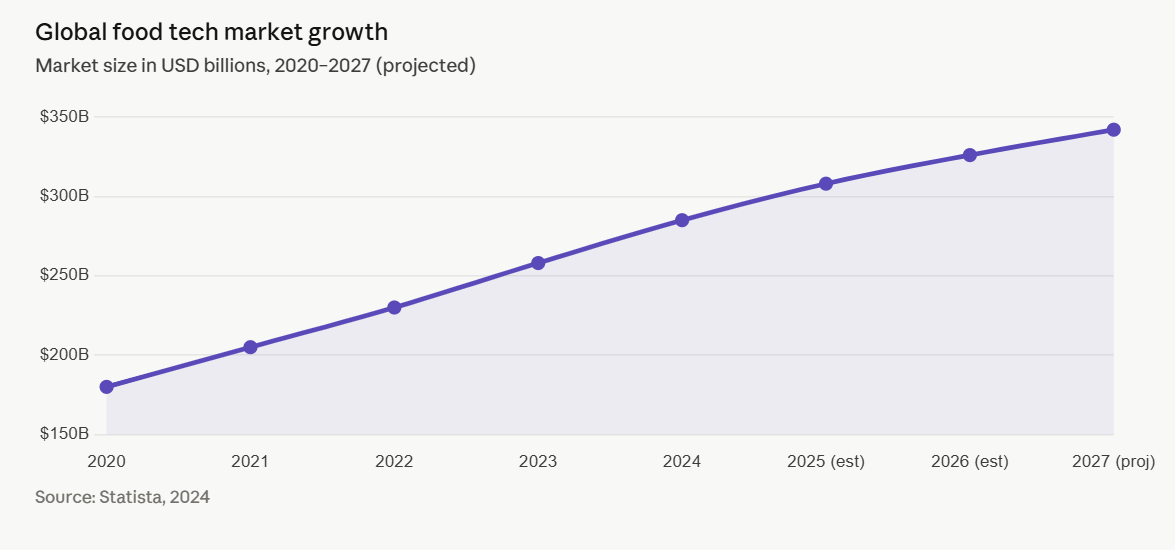
Market growth line chart — the global food tech market trajectory from 2020 to 2027 by Statista.