
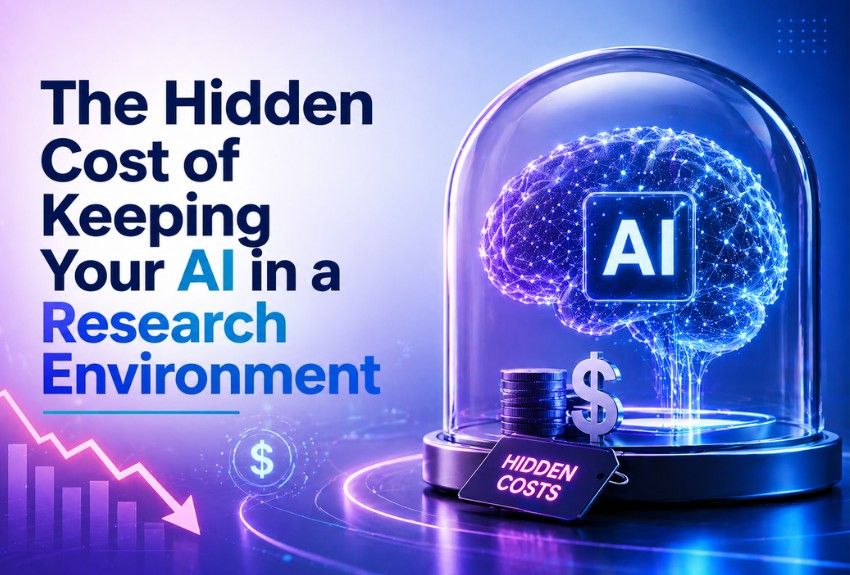
There is a version of this story playing out in research labs, data science teams, and innovation departments all over the world.
A team spends months — sometimes years — developing and validating a machine learning model. It works. The results are impressive. Leadership is exciting. And then… it sits. Running manually, accessible only to the people who built it, generating value for almost no one outside the room where it was created.
This is one of the most common and most expensive problems in enterprise AI today. And it is entirely solvable.
Research Isn’t a Product. Production Is.
When data scientists build models, they build them to be correct. When engineers build platforms, they build them to be reliable, scalable, and usable by people who didn’t build them. These are different disciplines, and the gap between them is where most AI initiatives stall.
A model that lives in a Jupyter notebook — however accurate, however well-validated — is not a product. It is a proof of concept waiting for an engineering team to take it seriously.
That handoff, from research to production, is where OST operates.
What the Productionization Problem Actually Looks Like
In practice, taking a validated ML model and turning it into a live, scalable platform involves a specific set of hard engineering problems that most research teams are not built to solve:
1. Environment Fidelity
Research models are trained and validated in controlled environments with specific library versions, preprocessing steps, and input formats. The moment you move them into production, subtle differences in environment, data shape, or execution order can cause outputs to drift. A model that predicts X in a notebook must predict X in production — every time, without exception. Achieving that is not trivial.
2. Latency and Async Architecture
Many ML workloads — especially those involving external AI APIs, large file processing, or multi-step pipelines — take too long to run synchronously. A user cannot wait 45 seconds staring at a loading spinner. Production systems need to accept work, process it asynchronously, and surface results when they are ready — with proper job tracking, status polling, and failure recovery.
3. Scale Without Idle Cost
Research environments scale to one user: the researcher. Production environments need to handle one user or ten thousand, without charging you for capacity you are not using. Serverless, cloud-native architectures solve this elegantly — but they require deliberate design from the start.
4. Access, Auth, and Auditability
Research models have no access controls. Production platforms need to know who is making requests, log every job, enforce authentication, and give teams an audit trail they can rely on. Security cannot be an afterthought.
5. Deployment and Iteration
Once a model is live, it will need to be updated. New model versions, new features, infrastructure changes — all of these need to reach production without downtime, without manual steps, and without breaking anything. A solid automated deployment pipeline is not optional; it is the foundation of a maintainable system.
How OST Approaches ML Productionization
When we take on a research-to-production engagement, we are not just building infrastructure around a model. We are treating the model as the product and engineering everything else to serve it faithfully.
Containerized Model Deployment
We package models and their full dependency environment into containers, eliminating the works-on-my-machine problem entirely. The model that runs in production is the same model, in the same environment, that the research team validated.
Async Job Architecture
We design systems around an async submit-and-poll pattern: a client submits work, receives a job ID immediately, and polls for results. This pattern handles arbitrarily long-running AI workloads without timeouts, without degraded UX, and with full visibility into processing state.
Regression Test Suites
Every deployment validates that the model produces mathematically identical outputs to known baselines. If something drifts, the pipeline fails before it ever reaches production.
API-First Design
We expose model capabilities through clean, documented REST APIs with proper authentication. This means the platform is not just a dashboard — it is a capability that any downstream system, enterprise integration, or partner can consume programmatically.
Serverless Cloud Infrastructure
We build on serverless-first architectures that scale from zero to enterprise load with no manual intervention and no idle infrastructure cost.
The Result: Research That Actually Gets Used
When this is done well, the outcome is straightforward: the work your research team spent months validating is now accessible to everyone who should have access to it — not just data scientists, but business users, enterprise clients, and downstream systems — reliably, securely, and at scale.
The model does not change. Science does not change. What changes is who can use it, and how confidently they can rely on it.
That is the difference between a research asset and a product.
Is Your AI Stuck in a Research Environment?
If your team has validated models, promising prototypes, or proof-of-concept results that have not made it into production, the bottleneck is not the science. It is engineering.
OST has productionized ML systems across industries including market research, ad tech, healthcare analytics, and financial services. We specialize in the handoff that most teams find hardest: taking something that works in a research environment and making it work in the real world.
Get in touch: ost.agency