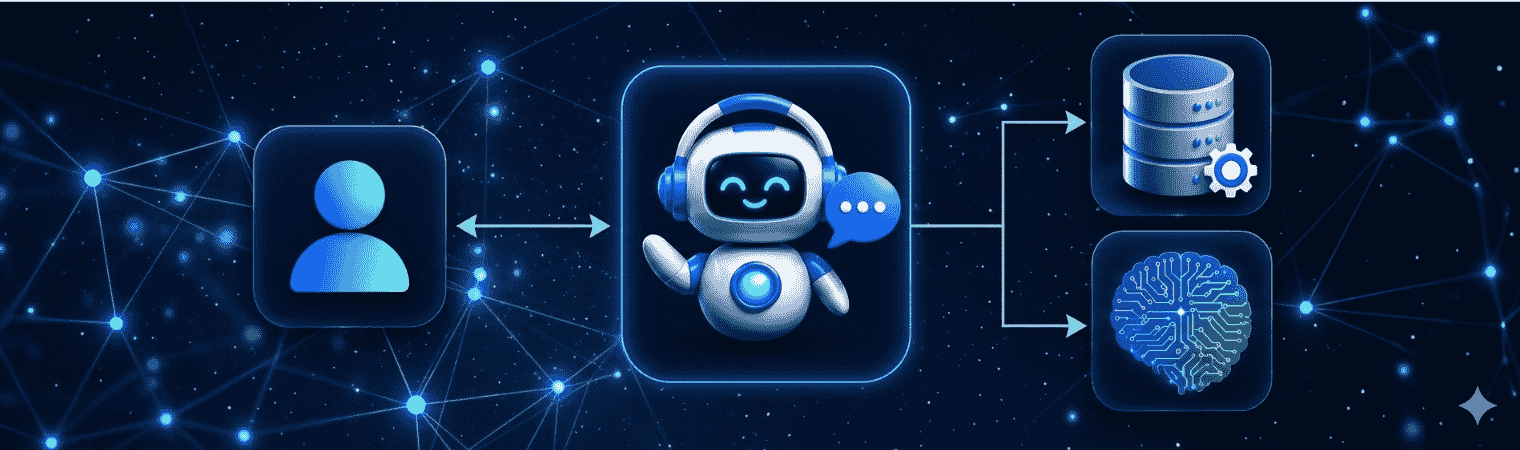
How catalog-aware RAG actually has to be built — and why most chatbots get it wrong.
Here’s a scene we see almost every week when we audit an ecommerce chatbot.
A shopper asks, “Do you have the 12-inch cast iron skillet in stock?” The chatbot pulls up the right product page. It even shows the right image. Then it confidently says, “Yes, $42.99.” The shopper clicks through and finds the real price is $54.99 — and the item is out of stock.
The chatbot didn’t fail to find the product. It failed to tell the truth about it.
This is the hidden gap most ecommerce owners don’t see. The chatbot looks like it’s working. But the answers are quietly wrong — and shoppers are bouncing or placing orders based on bad information.
The technology behind these chatbots is RAG — Retrieval-Augmented Generation. A good idea, badly implemented in most stores. Here’s why.
What RAG Actually Does
RAG works in four steps:
- Ingest — your product catalog gets loaded into a special database
- Embed — each product is converted into a mathematical fingerprint that captures its meaning
- Retrieve — when a shopper asks something, the system finds the products whose fingerprints best match the question
- Generate — the AI writes an answer using those products as context
This works beautifully for static FAQs and policy docs. But ecommerce catalogs aren’t static. Prices change. Stock changes. New variants get added. That’s where things break.
The 5 Reasons “Right Product, Wrong Answer” Happens
1. Chunking Destroys the Product
Most RAG systems chop documents into small pieces before embedding them. Fine for an article. A disaster for a product page. Title in one chunk, dimensions in another, price in a third. The chatbot might retrieve the title but miss the price — so it has to guess.
2. Stale Embeddings, Fresh Prices
The single most common failure. The vector database was built last week. The price changed yesterday. The chatbot is now quoting an old number. Same with inventory — the vector store says “in stock,” real system says “sold out two days ago.”
3. No Hybrid Search
Pure semantic search is great at meaning but bad at exact matches. Ask for SKU “WB-4500-BLK” and a semantic-only chatbot might return three loosely related items. Catalogs need hybrid search — semantic plus keyword — or specific lookups fail.
4. The Right Product Is at Position 7
The chatbot retrieves a ranked list of candidates. The language model usually focuses on the top 1–3. But on real catalogs, the right product sometimes ranks 5th or 7th because relevance scoring isn’t tuned for your category. The system “found” the product — it just didn’t use it.
5. The Chatbot Trusts the Vector Store for Truth Data
The deepest problem. Even with perfect retrieval, the chatbot is reading a snapshot of your catalog, not your live store. Stock, prices, shipping windows, available sizes — these need to be fetched live at the moment of the conversation, not pulled from a database rebuilt every Sunday night.
The Gap That Most Teams Miss
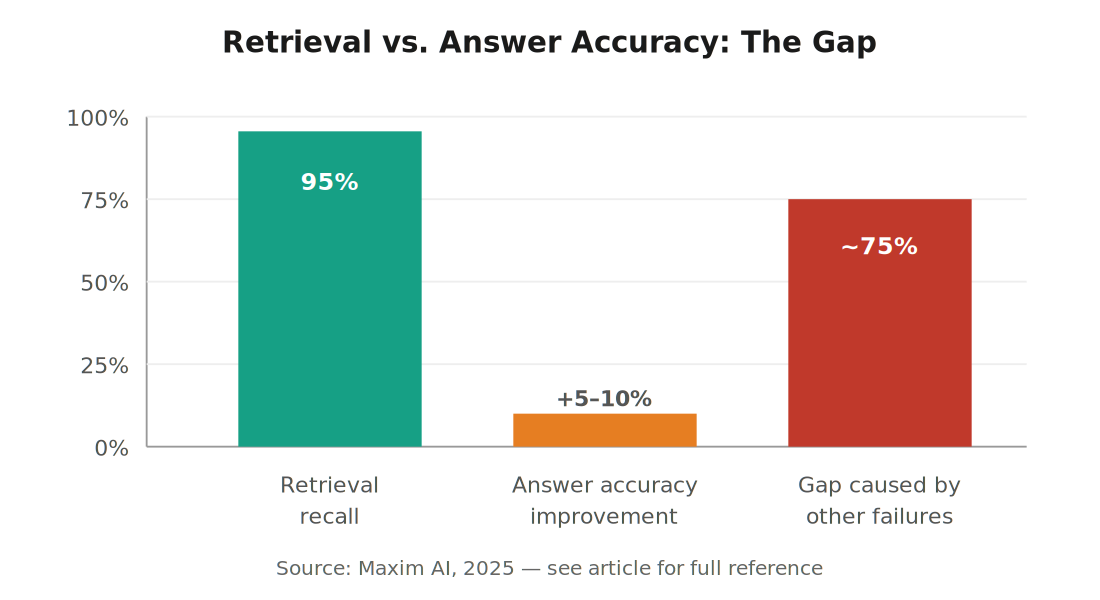
Here’s the data point that surprises most ecommerce owners. Research on RAG evaluation shows that improving retrieval recall from 80% to 95% may only improve answer quality by 5–10% — because the bottleneck isn’t usually finding the right information. It’s everything that happens after retrieval.
In plain English: most teams keep tuning their search. The search was already fine. The chatbot is still wrong because the answer-building step is broken.
How OpenSource Technologies (OST) Builds RAG That Actually Works for Catalogs
After auditing dozens of chatbots, we built OST’s AI-Powered Ecommerce Chatbot around four principles:
- Product-aware chunking. Each product is kept whole — title, specs, price, variants in one piece — so the chatbot never sees half the story.
- Hybrid retrieval. Semantic search plus keyword and SKU matching, so vague queries and exact part numbers both work.
- Live tool-calls for truth data. Inventory, prices, and shipping are fetched live from your store at conversation time — never from the vector database. The database is for meaning. The store is for truth.
- An eval harness before every catalog update. Before any change goes live, we run a set of real shopper questions to confirm answers are still right.
This is how a chatbot moves from “retrieves products” to actually closing sales.
Questions Ecommerce Owners Ask Us
“Isn’t this what any AI chatbot does by default?”
No. Most off-the-shelf chatbots use generic RAG with default settings. They work on FAQ pages and break on real catalogs. The four principles above need deliberate engineering.
“How often does the vector database need to refresh?”
Depends on your catalog. Weekly is fine for most stores — but prices and inventory should never come from the vector database. Those need a live API call every time.
“Can this work with my existing Shopify or WooCommerce store?”
Yes. We build catalog-aware RAG on Shopify, WooCommerce, OpenCart, Magento, and custom stacks. The principles are the same; the integration changes per platform.
The Bottom Line
A chatbot that retrieves the right product is a starting line, not a finish line. The shoppers who buy care whether the answer is accurate. If your chatbot is quietly quoting last week’s prices or yesterday’s stock, you’re losing trust on every conversation.
The fix isn’t to throw out RAG. The fix is to build it the way ecommerce actually works.
with OST’s AI engineering team. We’ll review your current setup, spot which of the five failure modes are happening, and show you exactly what to fix. Get started