If you’re running your business on a traditional content management system, you’ve probably noticed something. Your site is slower than your competitors’. Your developers say small changes take longer than they should. And every new project — a mobile app, an AI chatbot, a customer portal — ends up needing a different tool and a different content team.
That’s not a coincidence. Traditional CMS platforms were designed for a world where a website was just a website. In 2026, that world barely exists.
This is the quiet shift pushing more businesses toward headless CMS — and it’s worth understanding, because the choice you make here shapes your speed, your costs, and your ability to plug into AI for the next five years.
What Is a Headless CMS?
A traditional CMS bundles two things together: where your content lives (the database) and how it gets displayed (the theme, the front-end, the page templates). They’re locked together. Change one, and you usually have to wrestle with the other.
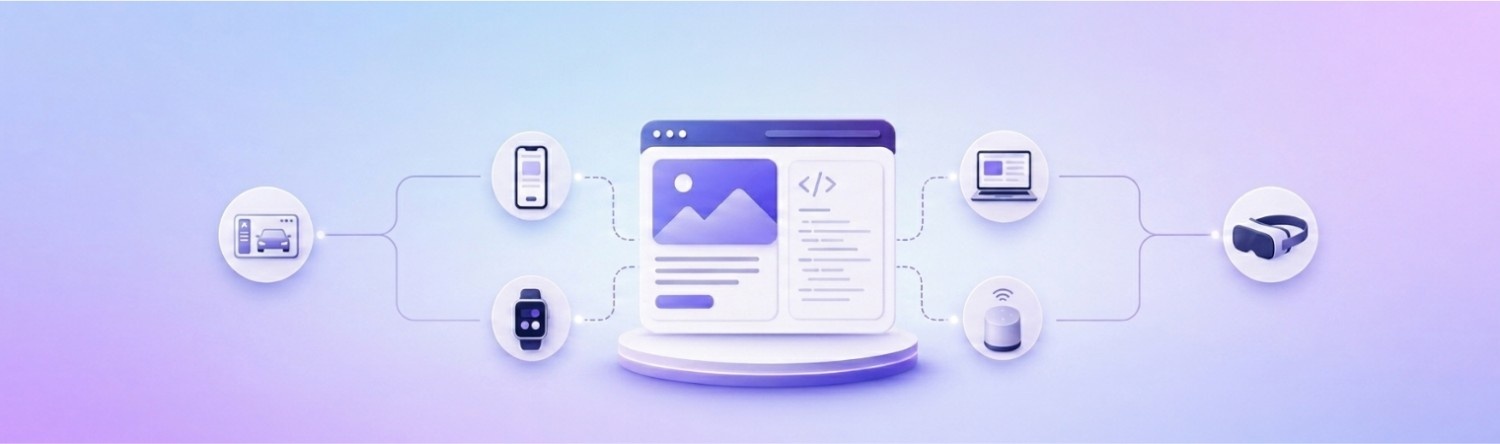
A headless CMS separates them. Content lives in a clean, structured backend. The front-end — your website, your mobile app, your in-store kiosk, your AI chatbot — pulls that content through an API and decides for itself how to display it.
The practical result is simple: one source of content can power many destinations. The same product description that shows on your website can feed your iOS app, your voice assistant, your customer support bot, and the structured feed you send to AI shopping platforms — all without a marketer copy-pasting anything.
Why the Shift Is Accelerating in 2026
Three things changed in the last 18 months that pushed headless from a developer preference to a business decision.
Generative AI changed how content needs to be structured. AI engines don’t crawl websites the way traditional search engines do — they pull from clean, structured data feeds. Sites built on traditional CMS platforms often have content trapped inside HTML templates that AI struggles to parse. Headless platforms expose content through APIs by default, which is exactly what AI engines want.
Performance became a ranking factor that buyers can feel. Headless sites built on modern frameworks routinely load in under a second. Traditional CMS sites, even well-optimized ones, rarely get below 2.5 seconds. That difference shows up in conversion rates, bounce rates, and increasingly in Core Web Vitals scores.
Multi-channel is no longer optional. If your business needs a website, a mobile app, a partner portal, and an AI assistant — and most do — headless lets one content team feed all of them. Traditional CMS forces you to maintain content in multiple places.
Headless vs. Traditional CMS — At a Glance
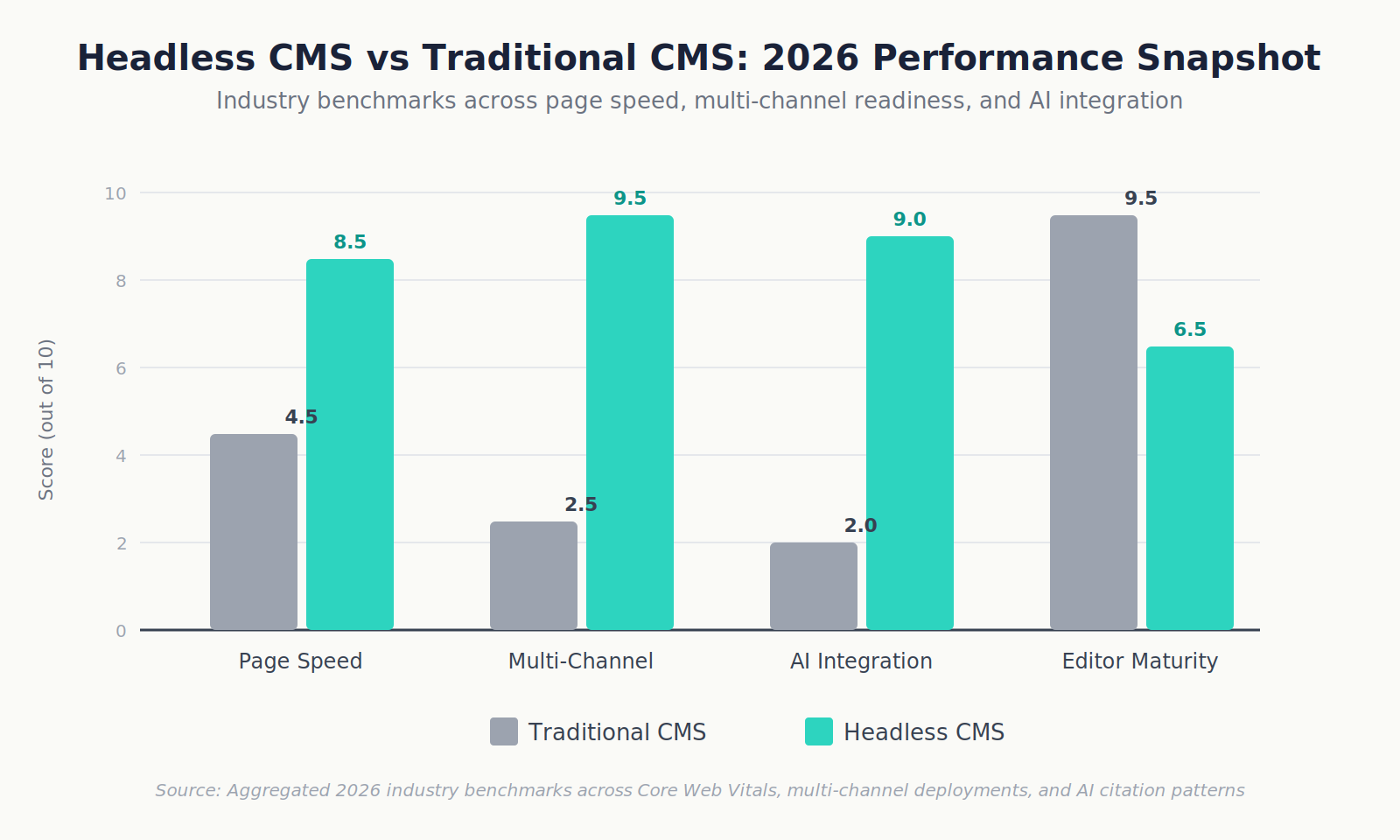
Headless CMS vs Traditional CMS: 2026 Performance Snapshot
| Capability | Traditional CMS | Headless CMS |
|---|---|---|
| Front-end flexibility | Locked to themes | Any modern framework |
| Performance | Generally slower | Significantly faster |
| Multi-channel publishing | Requires plugins/workarounds | Native via API |
| AI / structured data | Often trapped in HTML | API-first, AI-friendly |
| Editor experience | Mature, familiar | Improving rapidly |
| Time to launch | Faster for simple sites | Longer setup, faster scaling |
| Total cost (3-year) | Lower upfront, higher long-term | Higher upfront, lower long-term |
When Headless Is the Right Move — and When It Isn’t
Headless isn’t automatically better. It’s better for specific situations.
Headless is the right call when your business needs to publish to more than just a website, when site speed materially affects revenue, when you’re planning AI integrations or a mobile app in the next 12–18 months, or when your developers regularly hit walls with what your current CMS can do.
A traditional CMS is still the right call when your site is primarily a marketing brochure, your content team has deep expertise in your current tool that you don’t want to retrain, your budget is tight, or your timelines are short. Honesty matters here — a lot of businesses don’t actually need headless, and switching for the wrong reasons creates more problems than it solves.
Common Questions About Headless CMS
Where to Start
If you’re considering headless, the first step isn’t picking a platform. It’s an honest audit:
- How many channels does your content need to reach in the next 18 months?
- How is your current site speed affecting revenue?
- How much time do your developers spend fighting your CMS?
- Are you planning AI features, a mobile app, or major ecommerce expansion?
If the answers point toward multi-channel, performance pressure, or AI integration, headless is worth a serious look. If they don’t, a well-optimized traditional CMS is probably still your most cost-effective option.
Need Help Deciding? Let’s Talk.
At OpenSource Technologies (OST), we’ve spent 14+ years helping businesses pick the right CMS for where they are and where they’re going. We work across traditional, headless, and modern frameworks — which means we don’t push the same hammer at every problem.
If you’d like a no-pressure conversation about whether headless makes sense for your business — and what the realistic migration path would look like — reach out at contact@ost.agency or visit www.ost.agency.
In our next post, we’ll go deep on PayloadCMS — the modern, AI-ready headless CMS we recommend most often for Next.js builds in 2026.