In our last post (Headless CMS in 2026: Why More Businesses Are Quietly Moving Away From Traditional Platforms), we walked through why more businesses are moving from traditional CMS platforms to headless architecture. If you’ve decided headless makes sense for you, the next question is the harder one: which one?
There’s no shortage of headless CMS platforms on the market in 2026. They all promise faster sites, cleaner APIs, and better developer experience. But after working across the full landscape, one name keeps rising to the top of our recommendations for modern Next.js builds: PayloadCMS. Here’s why.
What Is PayloadCMS?
PayloadCMS is an open-source headless CMS and application framework built with TypeScript, React, and Next.js. With ~42,000 GitHub stars and production deployments at companies like Microsoft, ASICS, and Blue Origin, it’s no longer a fringe choice — it’s quickly becoming the default for modern web teams.
The thing that makes it different: as of Payload 3.0, it installs directly into your Next.js app folder. There’s no separate backend service to deploy, no SaaS subscription, no third-party hosting layer. Your CMS and your front-end live in the same codebase.
For teams already building on Next.js, that’s a meaningful simplification. One repo, one deploy, one stack — instead of two services to coordinate.
Why PayloadCMS Is Gaining Ground in 2026
Three things changed in the last 12 months that pushed Payload from “interesting” to “default.”
Native Next.js integration matured. Payload 3.0 made it the only major CMS that runs natively inside a Next.js app. For teams already on Next, this removes an entire category of integration headaches.
The AI-native turn. In April 2026, Payload shipped something no other major CMS has: a built-in evaluation suite that measures how well AI tools like Cursor, Claude Code, and Copilot understand and generate Payload code. It also ships AI Auto-Embedding for RAG-ready vector embeddings out of the box. Translation: if your team uses AI to write or modify CMS configs, Payload is now the platform most likely to produce working code on the first try.
Open source means freedom. Payload is fully open source under the MIT license. You self-host, own your data, and avoid the usage-based pricing surprises that have hit several SaaS-only CMS platforms in the last two years.
Where PayloadCMS Stands Across the Capabilities That Matter
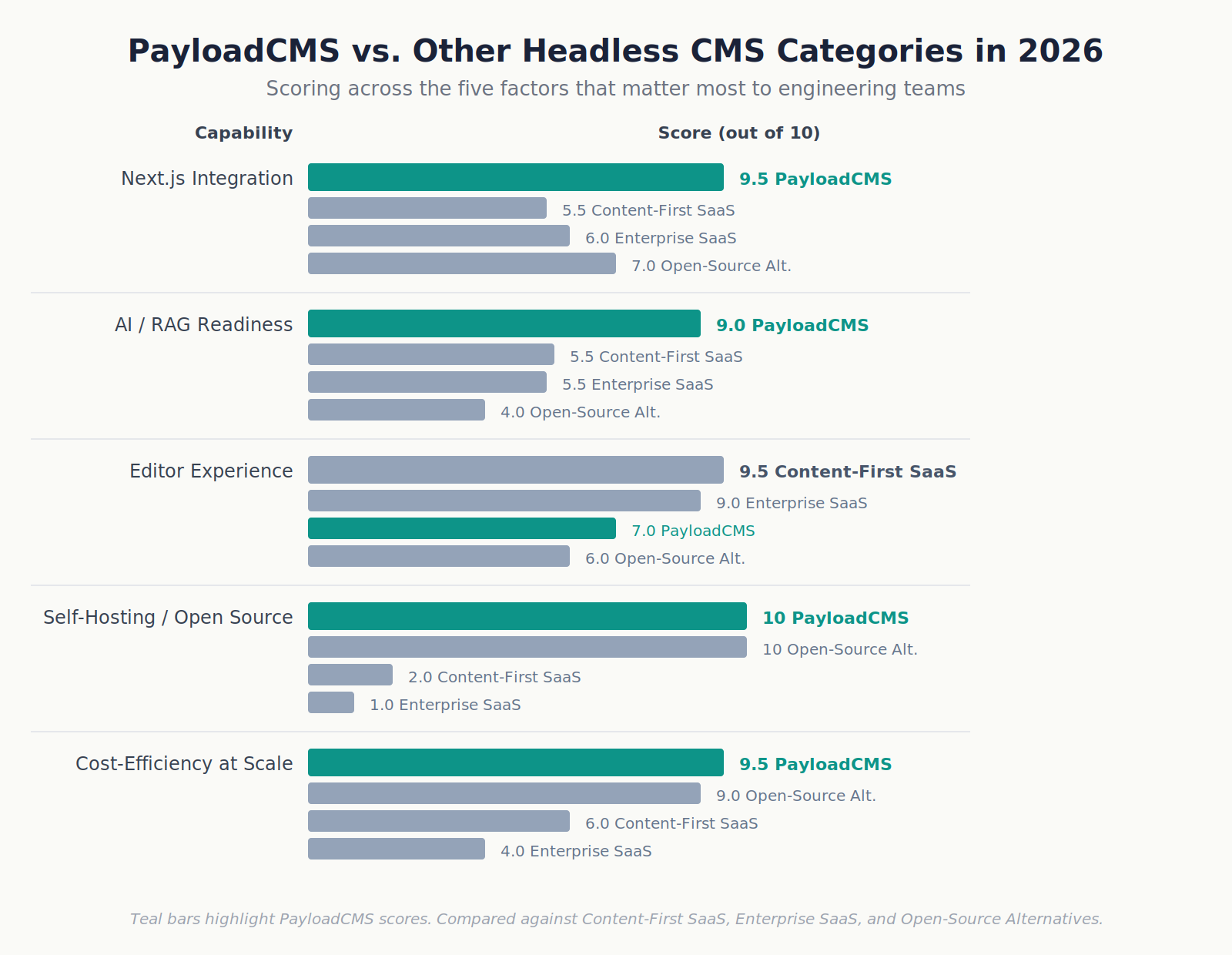
PayloadCMS vs. Other Headless CMS Categories: Scoring across the five factors that matter most to engineering teams
The chart above shows how PayloadCMS scores across the five capabilities most engineering teams evaluate when picking a headless CMS in 2026. Payload leads on Next.js integration, AI readiness, self-hosting, and cost-efficiency at scale. The one area where it scores below other category leaders is editor experience — the admin panel is good and improving fast, but content-first platforms with a longer history still have the edge for non-technical marketing teams.
That tradeoff matters: if your team is heavily content-led and your priority is the editor experience, Payload may not be the right fit. If your team is engineering-led and your priority is a clean, AI-ready, full-stack TypeScript foundation, Payload is hard to beat.
Best Use Cases for PayloadCMS
PayloadCMS shines in five specific scenarios:
Custom websites and SaaS platforms that need both a marketing site and an application backend in one stack. Payload doubles as an app framework, not just a CMS.
Internal portals and dashboards where role-based access, custom workflows, and structured data matter more than a polished front-end editor.
AI-ready content platforms that need clean, structured data and vector embeddings for RAG-powered search or chatbots.
Headless ecommerce backends where the storefront is built in Next.js and the product catalog needs full custom logic.
Digital asset management for teams that need a content backend with serious access control, localization, and media handling.
When PayloadCMS Is Not the Right Choice
This is where most blog posts get vague. We won’t.
PayloadCMS is the wrong call when your team has no TypeScript or React experience, when you need a polished out-of-the-box editor that non-technical marketers can pick up in an hour, or when your site is primarily content-driven with no app logic. In those cases, a more traditional or content-first CMS will likely serve you better.
PayloadCMS is also overkill for simple brochure sites. The setup investment doesn’t pay back if you don’t need the flexibility.
Common Questions About PayloadCMS
Is PayloadCMS free?
Yes. It’s open source under the MIT license. Enterprise features like SSO, AI auto-embedding, publishing workflows, and the visual editor are paid add-ons.
How does Payload compare to a traditional CMS?
Different tools for different jobs. Traditional CMS platforms have a long head start on editor experience, plugin ecosystem, and non-technical user familiarity. Payload wins on performance, developer experience, structured content, API-first architecture, and AI-readiness. For a content-heavy publisher, traditional may still be the better answer. For a Next.js app or custom platform, Payload wins.
Common Questions About PayloadCMS
Should You Use PayloadCMS?
If you’re building on Next.js, planning AI features, and have TypeScript experience on your team, Payload is probably the strongest choice available in 2026. If your priorities are different, the answer is less clear.
The honest reality: the right CMS depends on your team, your stack, and where your business is going in the next 18 months. There is no universal winner.
Thinking About PayloadCMS for Your Next Build?
At OpenSource Technologies (OST), we build on PayloadCMS, traditional CMS platforms, and the full headless landscape — which means we can give you an honest answer about what’s right for your situation, not just what we want to sell you.
If you’re evaluating PayloadCMS for a new build or considering a migration, we’d love to help you think through it. Reach out at contact@ost.agency or visit www.ost.agency.
We’ve spent 14+ years getting this kind of decision right for businesses across 35+ countries. Let’s make sure your next CMS choice is one you don’t regret in three years.
Let’s Talk About Your Project