Somewhere right now, an AI agent is drafting a report, pulling your morning metrics, reviewing a codebase, and scheduling follow-ups — all without anyone asking it to start.
It used to be simple. Work happened when people showed up. Tasks waited. Inboxes grew overnight. The morning commute was time lost — unless you were the kind of person who answered emails on your phone, which somehow made everything worse.
That dynamic is ending. Not loudly, not with a press conference, but quietly — in background processes, scheduled tasks, and AI agents that don’t need you present to get things done.
This is the quiet takeover. And understanding it is no longer optional for businesses that want to stay competitive.
What We Mean by AI Automation in 2026
AI automation is not a new concept. Businesses have used rule-based automation — Zapier flows, scheduled scripts, robotic process automation — for years. But what is happening in 2026 is categorically different.
Traditional automation follows rules. It does exactly what you tell it, in exactly the order you specify, and breaks the moment something unexpected happens.
Modern AI automation reasons. It understands context, adapts to changing inputs, handles ambiguity, and completes multi-step tasks that would have required human judgment just two years ago.
The key distinction
Old automation: If X then Y. New AI automation: Here is the goal — figure out X, Y, and Z yourself, and tell me when it’s done.
This shift is powered by a new generation of AI agents — systems that can perceive their environment (your files, your apps, your browser), reason about what needs to happen, take action, and report back. The human becomes the director, not the executor.
The Numbers Tell the Story
If you want to understand how fast this is moving, look at what is already happening in the market:
4%
of all public GitHub commits now written by AI
70%
of new enterprise AI deals going to Claude in 2026
6,000+
apps connected via AI automation protocols
These are not projections. They are current production metrics from tools that have already escaped the experimental phase. And they are growing — the GitHub commit figure doubled in a single month.
Claude Code, Anthropic’s agentic coding tool, now generates over $2.5 billion in annualised revenue. Enterprise software stocks dropped the day Claude Cowork was announced. IBM suffered its worst single-day loss since 2000 after Anthropic published a blog post about using AI to modernise legacy code.
The market is not speculating about AI automation. It is already repricing around it.
How AI Is Doing Your Job While You Sleep
Let’s make this concrete. Here are six categories of work that AI agents are now completing autonomously — while the humans responsible for those tasks are commuting, sleeping, or in meetings:
Morning briefings and daily summaries
AI reads your email, calendar, Slack, and news feeds overnight. You wake up to a structured summary of what matters, what’s urgent, and what can wait — which is exactly how AI can become a helpful part of your daily routine. No inbox archaeology required.
Code review and pull requests
Developers text a task from their phone on the commute. AI reads the codebase, makes changes, runs tests, and opens a pull request. The developer reviews and approves on arrival.
SEO and content workflows
Competitor analysis, keyword research, content gap identification, schema audits — entire 40-hour workflow stacks running in the background without supervision.
Data extraction and reporting
Weekly metrics, pipeline reports, performance summaries — AI pulls data from connected systems, formats it, and delivers it to the right people on schedule.
Customer support triage
AI reads incoming support tickets overnight, categorises them by urgency and type, drafts responses for routine queries, and flags complex cases for human review in the morning.
Document processing and compliance
Contracts reviewed, invoices extracted, regulatory filings checked for completeness — intelligent document recognition handles the paper trail while your team focuses on decisions.
The Architecture Behind the Automation
Understanding why this works now — when it didn’t work five years ago — requires a brief look at what has changed technically.
Agentic AI vs. rule-based automation
The old model required you to specify every step. The new model requires you to specify the goal. This sounds like a small difference. It is actually everything. Goals survive change. Rules break on the first exception.
Context windows that hold entire projects
Modern AI models can hold up to one million tokens of context — roughly 750,000 words — in a single session. This means an AI agent can read your entire codebase, your complete email archive, or a year’s worth of documents, and reason across all of it simultaneously.
MCP: the universal connector
The Model Context Protocol, released by Anthropic and now downloaded 100 million times per month, is the plumbing that connects AI to your tools. Google Drive, Slack, GitHub, Jira, Stripe, Notion, Zapier — over 6,000 apps now speak the same protocol. AI automation no longer requires custom integrations for each tool. It connects to everything at once.
Persistent memory and project context
AI can now remember. Across sessions, across devices, across time. It knows your naming conventions, your style guide, and your team’s past decisions. You don’t re-explain your architecture every morning. It already knows.
The compound effect
Each of these capabilities is useful on its own. Combined, they create something qualitatively different: an AI that can take a complex, multi-step goal stated once and pursue it across tools, files, and time, without needing you to supervise each step.
What This Means for Your Business
The businesses that understand AI automation early are not just saving time. They are fundamentally restructuring what their team is for.
When the 40 hours of busywork that consumed your team last week can be delegated to AI agents, the question becomes: what should your team be doing with that time instead? The answer — strategy, relationships, creativity, judgment, decisions that require human wisdom — is also what makes the difference between a good business and a great one.
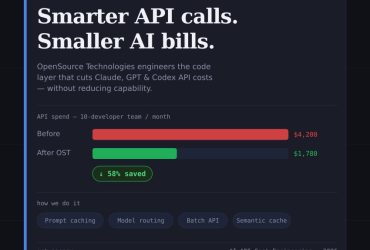
Consider the competitive dynamics. If your competitor automates 30% of their operational workload this year, they can either cut costs or redeploy that capacity into growth. Part of that cost advantage comes from infrastructure discipline — knowing how to stop overpaying for AI APIs while still running powerful workflows is becoming a core operational skill.
For leaders to consider
The question is not whether AI automation will affect your industry. It already is. The question is whether you will be the one driving that change in your market, or the one responding to it.
Industries Already Being Transformed
No sector is immune, but some are moving faster than others:
- Software development: 4% of all GitHub commits are now AI-authored. Entire features built, tested, and submitted without a developer touching a keyboard.
- Finance and legal: Contract review, compliance monitoring, regulatory filing checks — work that took teams of specialists now runs in the background.
- Healthcare: Patient record summarisation, appointment management, clinical documentation — AI handles the administrative load so clinicians can focus on care.
- Marketing and SEO: Competitor analysis, content gap research, campaign performance reporting — all running autonomously while the team focuses on strategy.
- Customer operations: Tier-1 support handled by AI, with seamless escalation to humans for complex cases. Response times drop from hours to seconds.
The Honest Risks
No credible treatment of AI automation can ignore the risks. They are real and worth naming clearly.
- Security and prompt injection: AI agents that can read and write files can be manipulated by the malicious content they encounter. This is an active area of research and requires careful implementation.
- Silent failures: Automated workflows that fail without alerting anyone can cause more damage than manual processes. Monitoring and human checkpoints remain essential.
- Over-delegation: Automating tasks that require human judgment, relationship nuance, or ethical consideration creates a different category of risk than automating data processing.
- Skill atrophy: Teams that delegate everything to AI risk losing the ability to do those things themselves — which matters when the AI gets it wrong.
None of these risks argue against AI automation. They argue for thoughtful implementation — starting with well-defined, lower-stakes workflows, building confidence, and expanding deliberately.
Where to Start: A Practical Framework
The businesses that win with AI automation are not the ones that automate everything at once. They are the ones who identify the right starting points and build from there.
Step 1 — Identify your busywork
List the tasks your team does repeatedly that require moderate but not exceptional judgment: data gathering, formatting, summarising, categorising, and scheduling. These are your first automation candidates.
Step 2 — Pick one workflow and do it properly
Resist the urge to automate ten things at once. Pick one workflow, implement it well, measure the time saved, and document what you learned. This builds the internal confidence and expertise to scale.
Step 3 — Connect your tools
Ensure your AI has access to the systems it needs. Modern protocols like MCP make this straightforward — connect once, and the AI can move fluidly between your email, calendar, project management, and data systems.
Step 4 — Set checkpoints, not supervision
Automation should not require constant watching. But it should have defined moments where a human reviews output before it moves forward. Build these into your workflows from the start.
Step 5 — Expand deliberately
Once your first workflow is running reliably, apply the same process to the next candidate. Each automation you build teaches you something that makes the next one easier.
The Quiet Takeover Is Not Coming — It Has Arrived
The title of this piece uses the word ‘quiet’ deliberately. AI automation is not arriving with fanfare and press releases. It is arriving in the background — in the workflows of the businesses that have started implementing it, in the commits being merged, in the reports being generated, in the support tickets being resolved.
By the time most organisations realise how much has changed, the gap will already be significant.
The good news is that the tools, the protocols, and the expertise to implement AI automation effectively exist today. The question is not whether you can do this. It is whether you will.
Bottom line
AI automation is not a future capability. It is a present reality. The organisations that treat it as infrastructure — not a feature — will compound their advantage every month from here.
Book a free consultation to automate your business